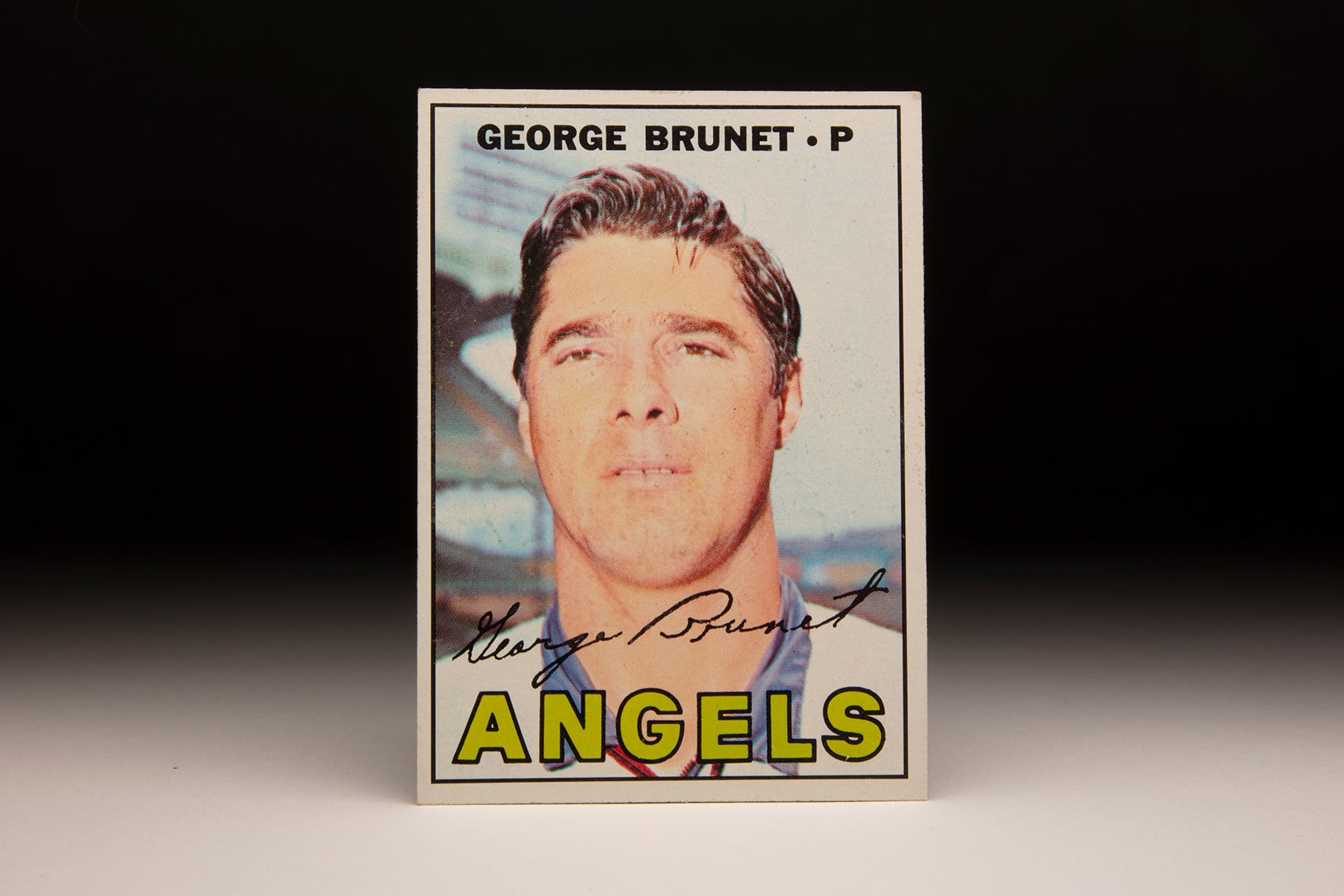
#CardCorner: 1967 Topps George Brunet
His baseball-reference page credits him with more than 4,600 professional innings pitched, which would rank in the Top 25 all-time if they all came in the big leagues.
George Brunet, however, likely worked more than 6,000 innings when winter ball play is considered and was active in the Mexican League well past age 50.
“When my arm gives out, I’ll quit,” Brunet told the Los Angeles Times in 1979.
It was a left arm that was one of the most durable in the game’s history.
Born June 8, 1935, in Houghton, Mich. – located on the “tail” of the Upper Peninsula near Lake Superior – George Stuart Brunet was the son of a Frenchy Brunet, a wheelman on a Great Lakes steamer. George starred in American Legion ball and for Calumet High School. He signed as an amateur free agent with the Detroit Tigers in 1953.
“They gave me $500,” Brunet told Sports Illustrated in 1980. “I bought a dining room set for my parents, a coat for my mother and a night on the town.”
Assigned to Class D Shelby of the Tar Heel League in 1953, Brunet moved on to Class D Seminole of the Sooner State League a year later, going 6-12 with a 6.37 ERA while walking 132 batters compared to 123 strikeouts.
The Athletics acquired Brunet for the 1955 season, and he split time between Seminole and Hot Springs of the Class C Cotton States League that year, going 11-11 while fanning 141 batters in 157 innings.
“I remember a bus ride we took from Hot Springs to Greenville, Miss.,” Brunet told the Newspaper Enterprise Association in 1966. “Ten hours in the middle of the summer in that heat. There were other trips in other leagues where we’d leave one city after a night game and get to the next city about an hour before we were supposed to be at the ballpark. We traveled in those old yellow school buses. You just hoped the guy next to you would get up so you could stretch out.”
In 1956, Brunet moved from Class C Crowley to Class B Abilene to Class A Columbia and all the way to Kansas City, where he made his big league debut for the A’s against the Senators on Sept. 14. He would make six total appearances for Kansas City that month, striking out five while walking 11 over nine innings.
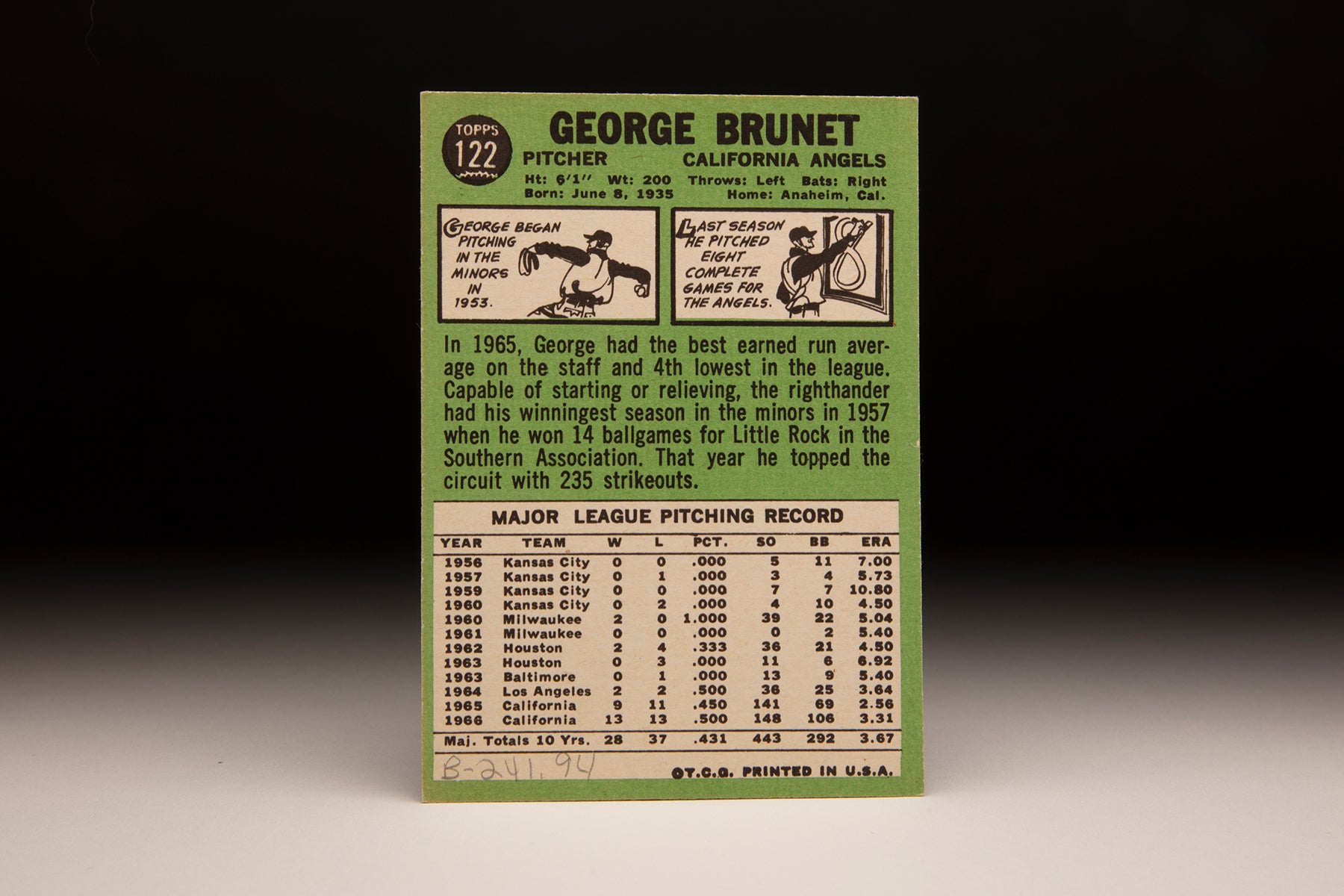
Brunet pitched winter ball in Panama after the season, the first of many years he would head to the Caribbean during the cold days in the Northern Hemisphere. In 1957, he spent the entire minor league campaign with Double-A Little Rock, leading the Southern Association with 235 strikeouts while going 14-15 with a 3.42 ERA. The Athletics once again brought him to the big leagues in September, where he got his first decision in a tough-luck 3-0 loss to the Yankees in a Sept. 15 start where he worked seven innings. He would pitch in four games with Kansas City that year, striking out three while walking four over 11.1 frames.
The Athletics brought Brunet to Spring Training in 1958 but optioned him to Triple-A Buffalo before later sending him back to Little Rock. He went a combined 9-13 with 156 strikeouts in 191 innings and returned to Spring Training with the A’s in 1959, where he made the Opening Day roster.
But after just two appearances – where he allowed six earned runs over 4.2 innings – Brunet was sent to Triple-A Portland. He blamed the demotion on an incident that happened during Spring Training. He and some teammates were “directing traffic” in front of the team hotel in the early morning hours when they stopped a car containing Athletics general manager Parke Carroll and manager Harry Craft.
“(Athletics farm director) George (Selkirk) told me (the next day) that I really screwed up,” Brunet told Sports Illustrated. “He said they were going to have to make an example out of me and send me down.”
Brunet spent the rest of the season with Triple-A Portland, going 5-13 with a 3.78 ERA. Then in 1960, the A’s put Brunet on the Opening Day roster and pitched him in three games before trading him to Milwaukee on May 11 in exchange for pitcher Bob Giggie.
It was the beginning of an odyssey that would see Brunet travel throughout the baseball world.
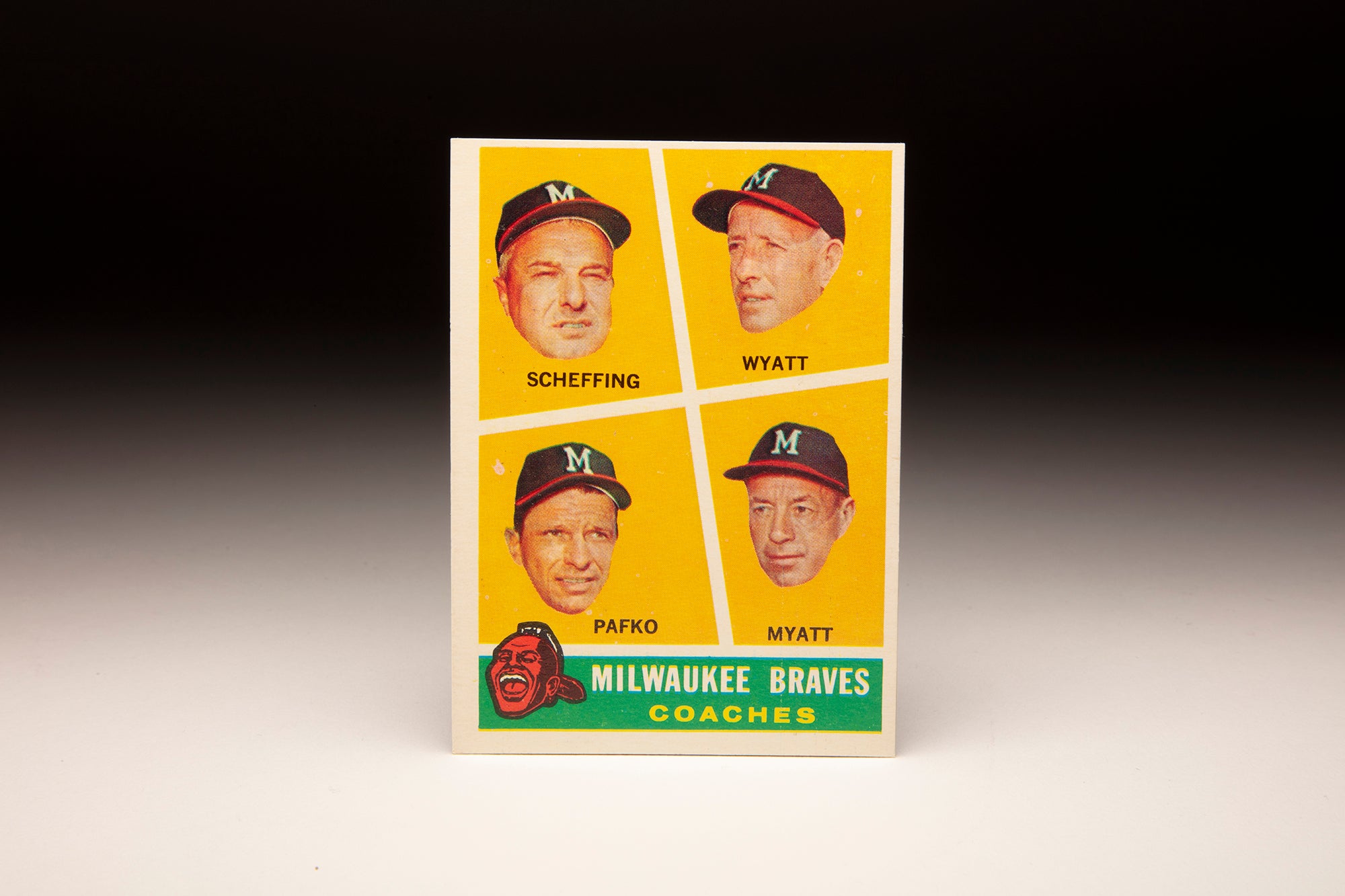
The Braves sent Brunet to Triple-A Louisville, where he went 4-1 with a 0.78 ERA in 46 innings before being recalled to Milwaukee. Working with Braves pitching coach Whitlow Wyatt – who advised Brunet to adopt an over-the-top delivery rather than his side-arming approach – Brunet went 2-0 with a 5.07 ERA in 17 games the rest of the season.
Brunet won a spot in the Braves’ bullpen at the start of the 1961 season but was sidelined after just one game when he underwent an appendectomy. He returned in June and made four more appearances out of the bullpen before being sent to Triple-A Vancouver, where he remained the rest of the year. In 20 games with the Mounties, he was 5-4 with a 3.81 ERA.
The Braves sent Brunet to Triple-A Hawaii to start the 1962 season before trading him to the new Houston Colt .45s on May 16. After 20 appearances with Triple-A Oklahoma City, Brunet was summoned to Houston – where he went 2-4 with a 4.50 ERA over the last two months of the season.
Houston put Brunet on the Opening Day roster in 1963 but sent him back to Triple-A in May with an 0-3 record and 7.11 ERA. His contract was sold to Baltimore on July 14, and he made 16 appearances out of the Orioles bullpen, going 0-1 with a 5.40 ERA.
The next season, the Orioles sent him to Triple-A Rochester before shipping him back to Houston, where he pitched well for Oklahoma City before the Astros sold his contract to the Angels on Aug. 18. He would appear in 10 games for Los Angeles late in the season, going 2-2 with a 3.61 ERA.
At the end of the 1964 season, Brunet had appeared in at least one game in eight MLB seasons. But he was a combined 6-13 with a 5.01 ERA to go with 154 strikeouts and 117 walks in 219 innings.
Ironically, he would pitch in only seven more big league seasons. But his career was really just getting started.
“I’ve been sent down for some pretty silly things,” Brunet told the Newspaper Enterprise Association in 1966. “I’ve always bounced back. But until I came to the Angels, I never really had a chance.
“I kept saying all along that I could win. I knew I had a strong arm.”
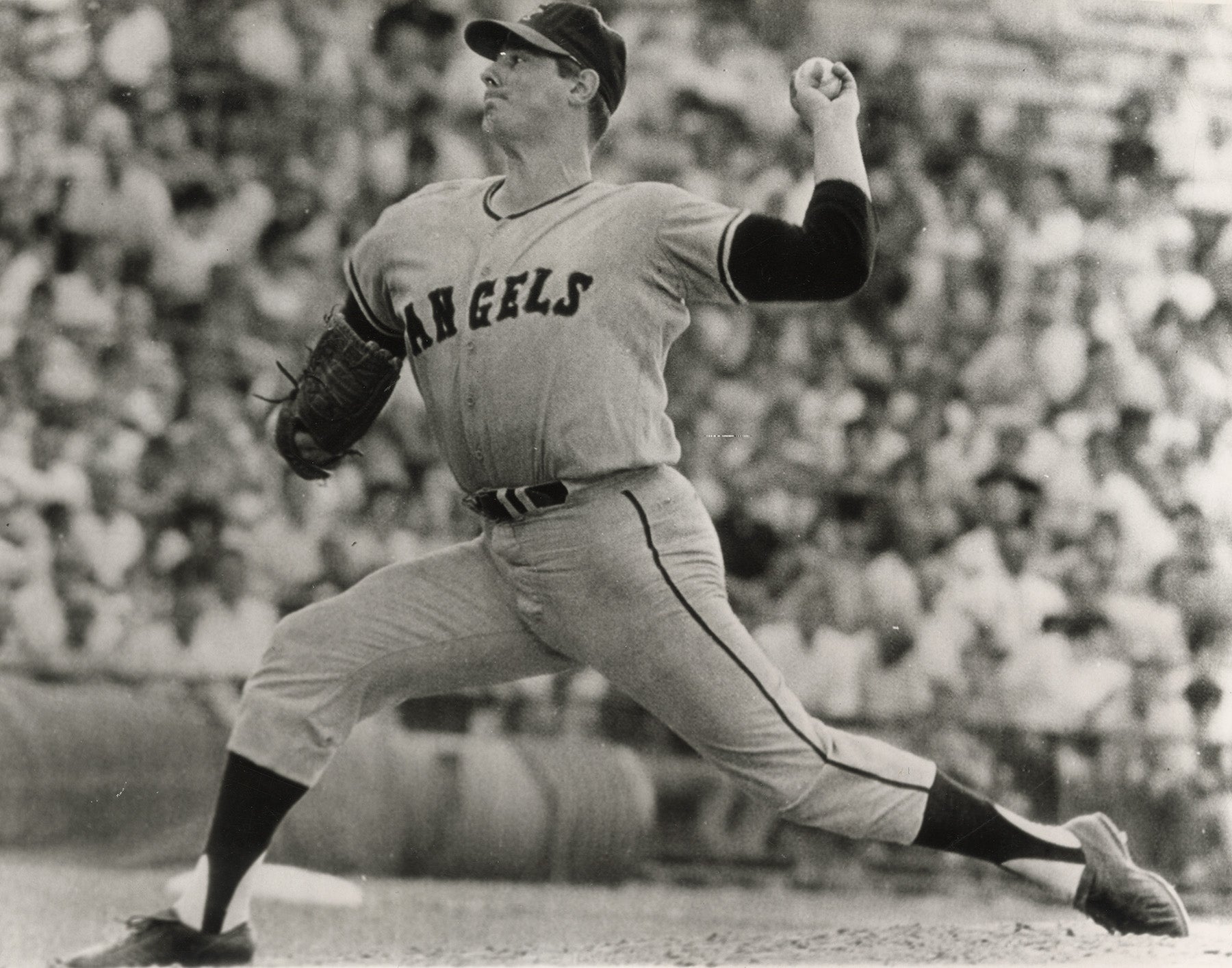
Brunet reported to Spring Training in 1965 at 207 pounds, about 25 less than he weighed the previous year. It quickly became apparent that he would be a key pitcher for the Angels that season.
“His stuff has been as good and probably better than any southpaw we’ve ever had,” Angels manager Bill Rigney told the AP.
Brunet, meanwhile, just hoped for a little stability.
“I’m tired of switching uniforms and jumping around,” Brunet told the AP. “I’ve been wearing out two cars a year just moving back and forth.”
For the next six years, Brunet spent all his time in the big leagues.
In 1965, Brunet started the season in the bullpen before moving into the rotation for good in late May. He pitched a two-hitter against Baltimore on May 28 and shut out the Tigers on three hits on June 22 before pitching a 10-inning shutout against the Senators a month later.
He finished the year with a 9-11 record and 2.56 ERA, which ranked fourth in the American League. His Wins Above Replacement mark of 4.1 that season would be the best of his big league career.
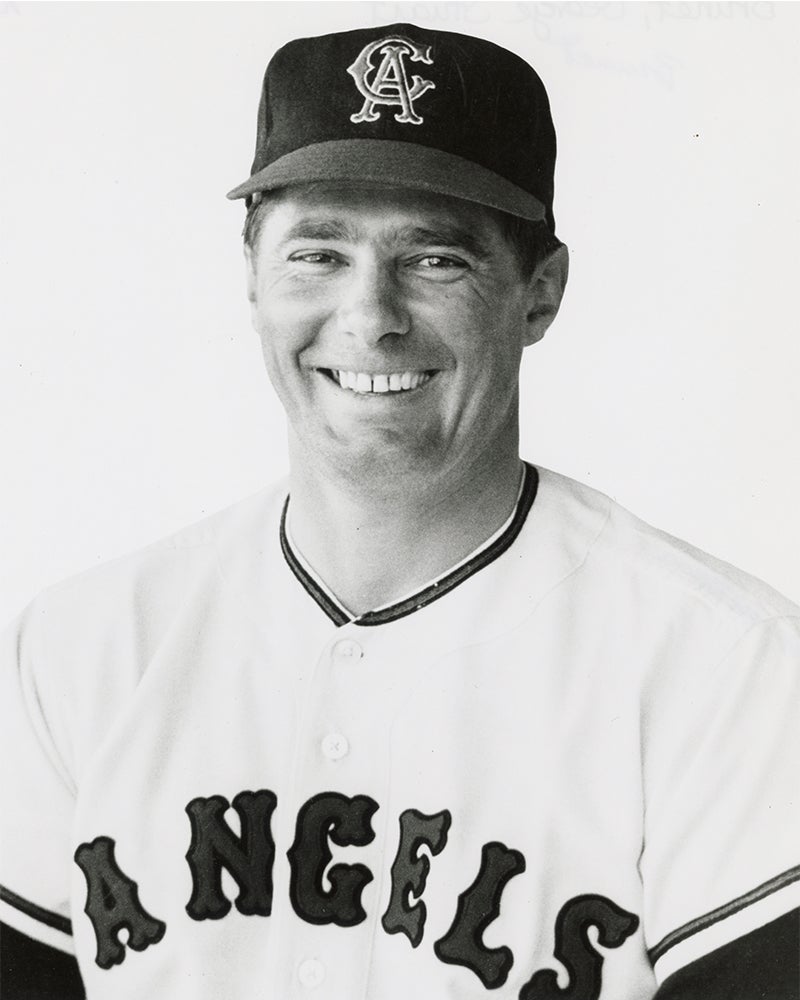
By 1966, Brunet was firmly entrenched in the Angels’ rotation. He defeated his home-state Tigers five straight times that year – spinning three complete games and another where he pitched 9.1 shutout innings despite walking 10 batters.
“There is no way to explain what he does to us,” future Hall of Famer and Tigers legend Al Kaline said to the Associated Press in 1966. “He gets the ball over the plate, and that’s half the battle.”
Brunet finished 13-13 with a 3.31 ERA in 1966, striking out 148 batters over 212 innings.
Rigney credited Brunet’s newfound change-up with the pitcher’s success.
“He gets it over the plate and mixes up the hitters,” Rigney told the Independent Star-News of Pasadena, Calif. “With his strong arm, he has the perfect combination now.”
In 1967, Brunet was named the Angels’ Opening Day starter, beating Detroit for the seventh straight time dating back to 1965. But he then lost nine straight decisions before shutting out the Tigers on June 9. He would work in an MLB career-best 250 innings that season and pitched to a 3.31 ERA for the second straight year. But he went 11-19, leading the majors in losses.
“All I need is a couple of breaks,” Brunet told the Register of Orange County, Calif., in the spring of 1968. “They make the difference between winning 18 or 20 games and being a .500 pitcher. I just want to forget all about last year.
“One thing I’ve never done in my life is give up.”
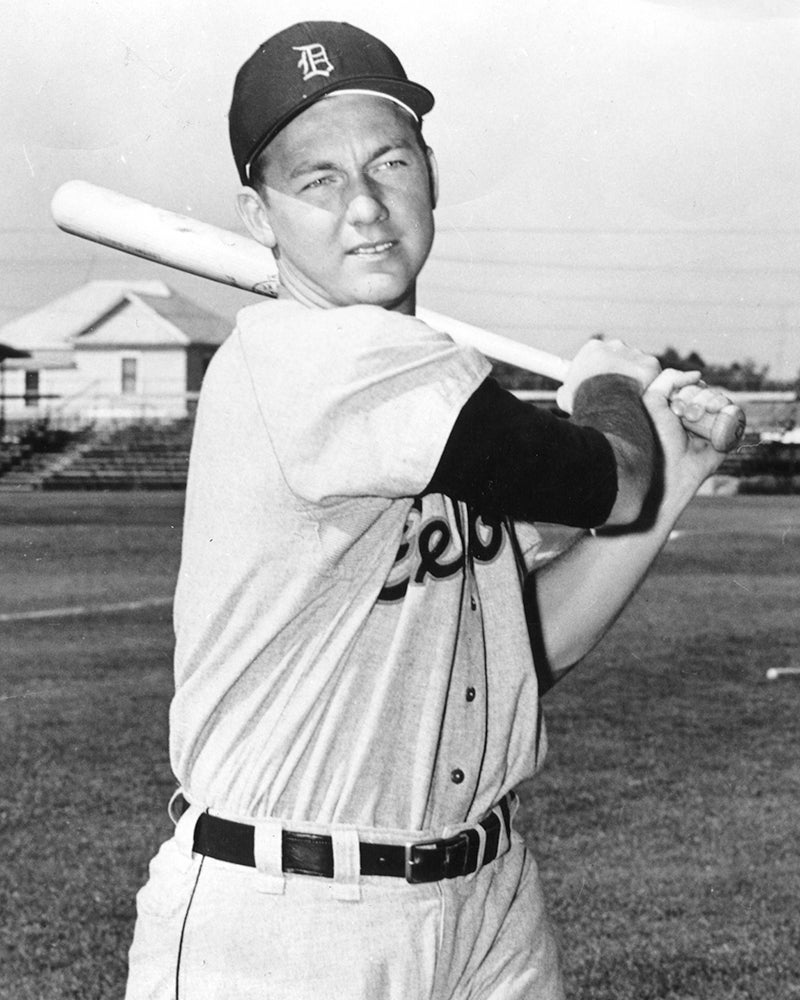
Brunet demonstrated that tenacity in the final game of the 1967 season. With the Angels playing the Tigers in a doubleheader, Detroit needed to sweep to finish the season in a tie with the Red Sox and force a one-game playoff. The Tigers won the first game but trailed the nightcap 8-5 entering the bottom of the ninth when Bill Freehan doubled and Don Wert walked to start the frame off the Angels’ Minnie Rojas.
Rigney then called on Brunet, who had given up four runs in a two-inning start the day before. Brunet proceeded to induce Jim Price to fly out to left field before getting Dick McAuliffe to ground into a double play for just the second time all year, preserving the Angels’ lead and ending the Tigers season.
Brunet started on Opening Day again in 1968 but continued to suffer tough luck, going 13-17 (leading the AL in losses again) with a 2.86 ERA over 245.1 innings.
“I’ve never had an unluckier pitcher,” Rigney told the AP in 1968. “We seldom ever score any runs when Brunet is pitching.”
In 1969, Brunet – reportedly playing at a significantly higher weight than he did the year before – was battered by several teams in Spring Training games, causing Rigney to express concern.
“Bru hasn’t looked good at all this spring,” Rigney told the Long Beach Press-Telegram. “Even the left-handers have been busting him.”
Brunet brushed aside the exhibition performances and – even though he didn’t get another Opening Day start – won his first game before losing five in a row. With trade rumors in the air for much of the early season, Brunet was sold to the expansion Seattle Pilots on July 31.
He went 2-5 with a 5.37 ERA in 11 starts for Seattle, finishing the season with a combined 8-12 record and 4.44 ERA in 164.1 innings. When Jim Bouton’s seminal book “Ball Four” was published in 1970, some of Brunet’s quirks were prominently mentioned.
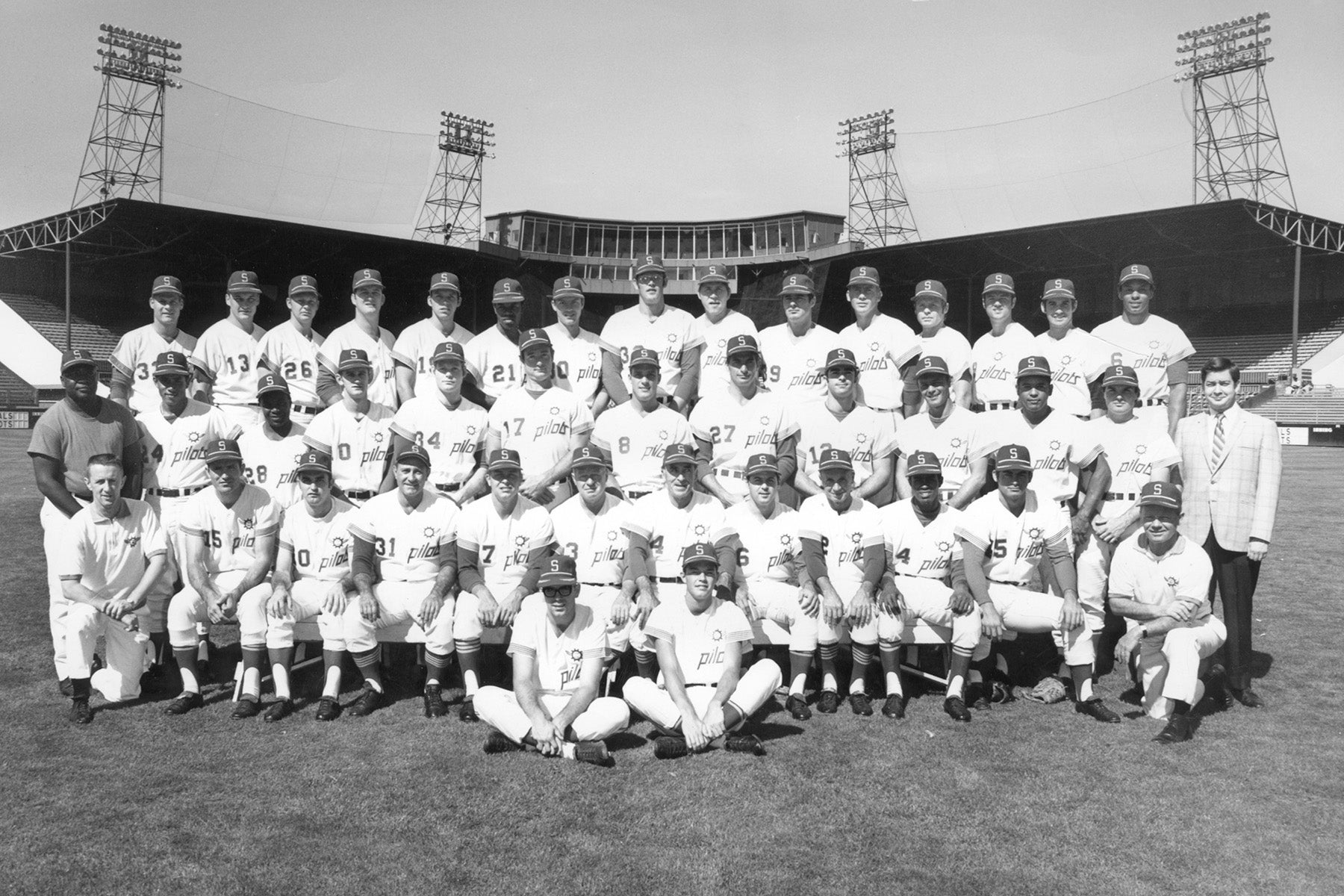
By then, Brunet had changed teams twice. On Dec. 4, 1969, the Pilots traded him to the Senators for pitcher Dave Baldwin. He started the season in Washington’s rotation but was sent to the bullpen in August before being traded to the Pirates on Aug. 31 in exchange for pitcher Denny Riddleberger. At the time of the trade, Brunet was 8-6 with a 4.42 ERA over 118 innings.
He pitched in 12 games for the Pirates in September, making a spot start while mostly working as a lefty specialist. He went 1-1 with a 2.70 ERA to help Pittsburgh win the National League East title but was not included on the postseason roster. It would be as close as Brunet would come to pitching in the postseason.
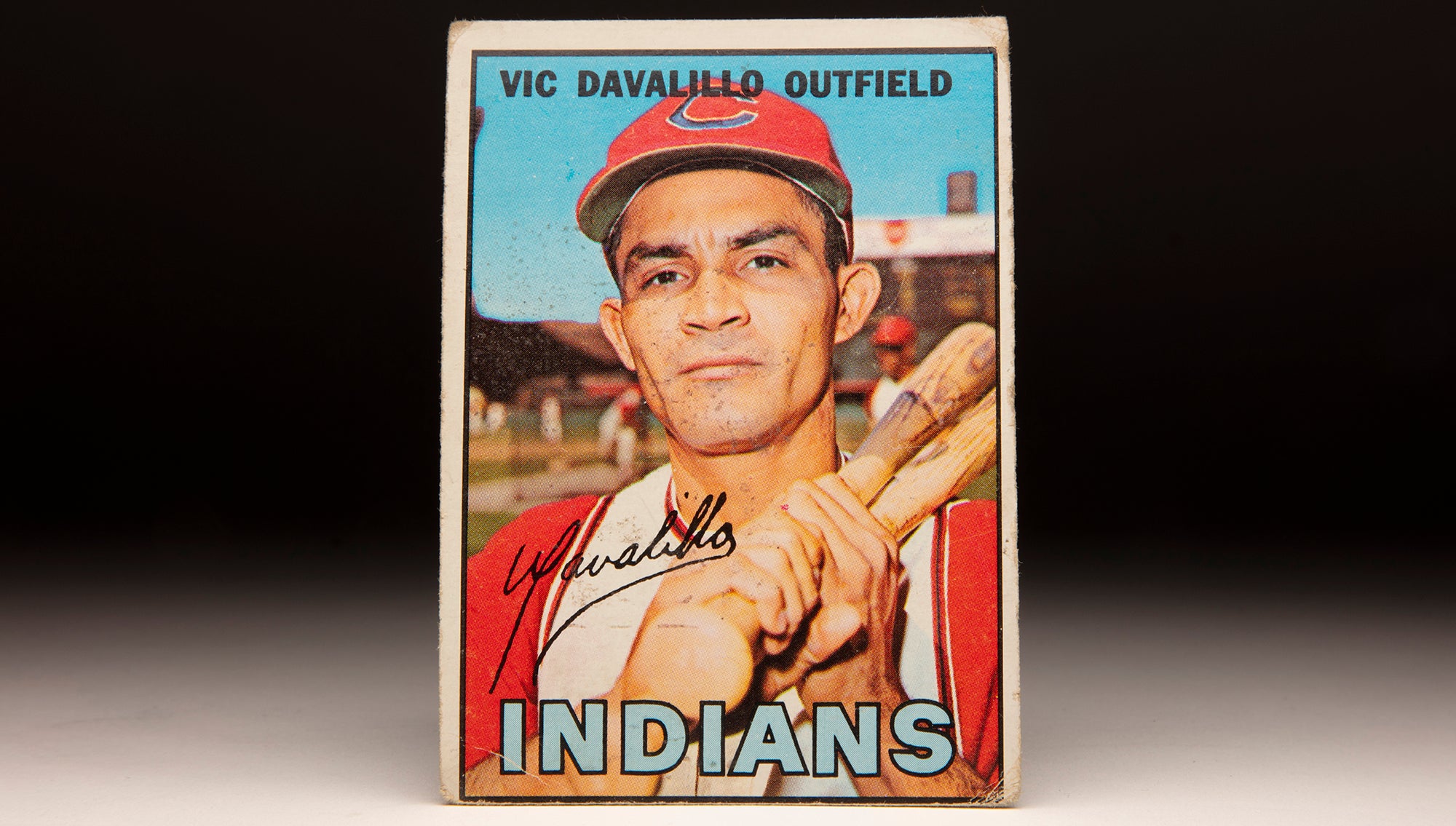
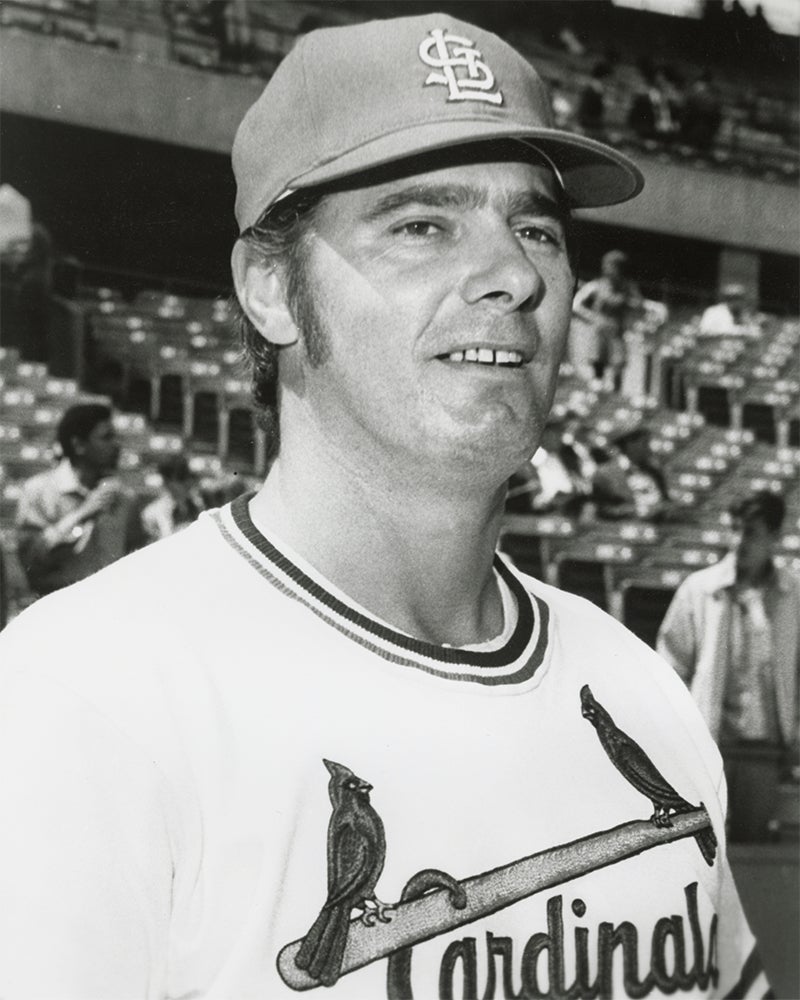
On Jan. 29, 1971, the Pirates traded Brunet and Matty Alou to the Cardinals in a deal that brought Nelson Briles and Vic Davalillo to Pittsburgh. Briles and Davalillo would play major roles in the Pirates winning the 1971 World Series title.
Brunet, meanwhile, was released by the Cardinals on May 10 after going 0-1 in seven appearances out of the bullpen. It was his last stint in the big leagues.
“I felt like I’d been hit over the head with a sledgehammer,” Brunet told the Los Angeles Times about his release. “I couldn’t believe it. I’m in better shape now than I’ve been in three or four years. That’s one of the reasons I was so surprised when they released me. I could see it if my arm was bothering me or something. But I feel great.”
Brunet immediately found work pitching batting practice for the Angels but found no teams who wanted him on a big league roster. He soon signed with Triple-A Hawaii and went 4-4 with a 4.09 ERA the rest of the 1971 season before returning to the Islanders in 1972, where he went 14-9 in 28 starts. He hooked on with the Phillies’ Triple-A team in Eugene in 1973 but was released after going 2-1 with a 5.00 ERA in five starts.
“I spent part of (1973) coaching some kids in a Senior Division league in Anaheim,” Brunet told Sports Illustrated, referring to the town where his family still called home. “We weren’t far from (Anaheim Stadium), so I could see the lights every night. One night I just looked at those lights and said: ‘What the hell am I doing here?’”
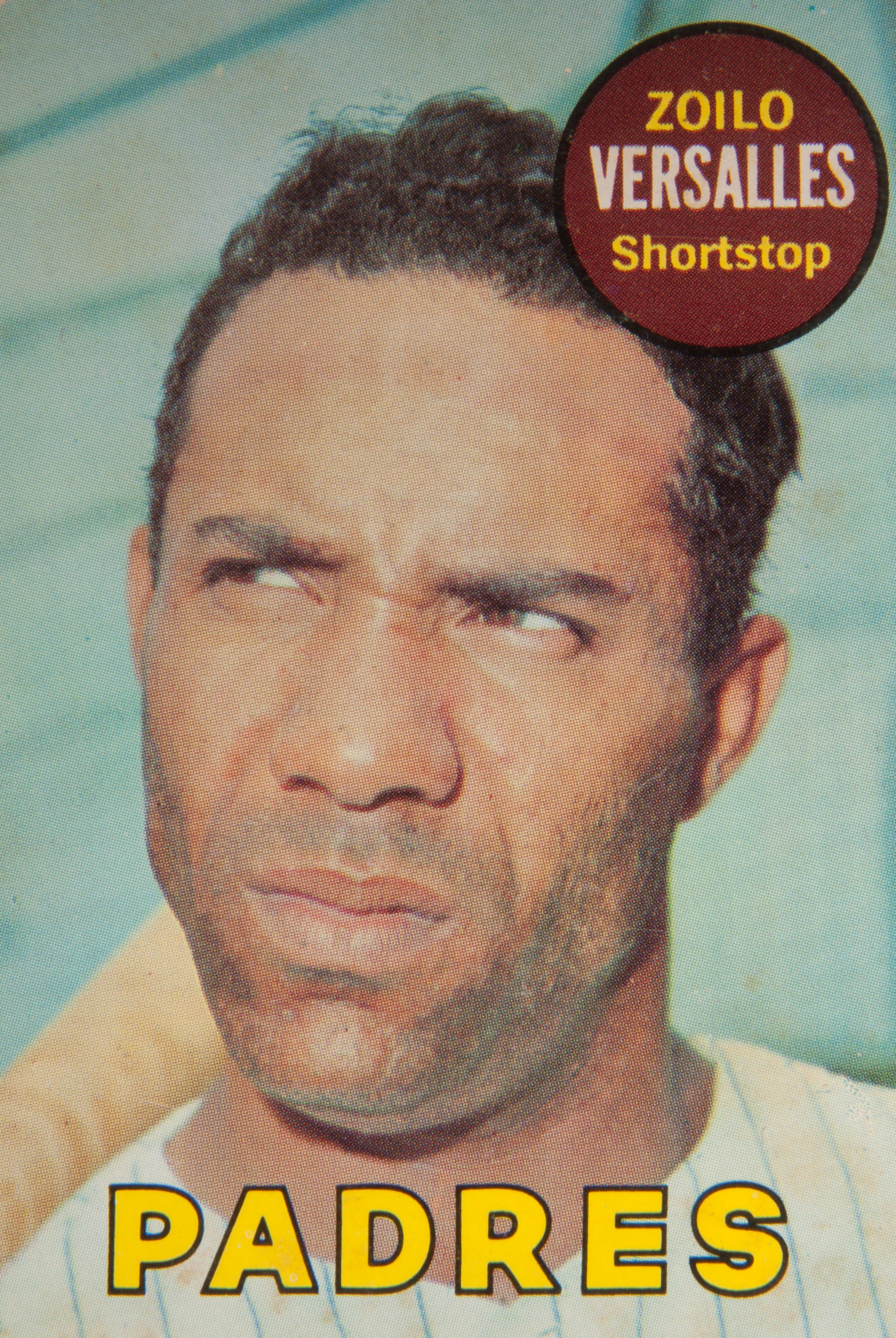
Brunet headed for Mexico, signing with the Petroleros de Poza Rica in Veracruz. After going 1-2 with a 1.38 ERA in four starts, Brunet returned to Poza Rica in 1974 and spent the next five seasons there, winning a combined 61 games as he pitched into his 40s. He threw a no-hitter at age 42 in 1977 (also managing the team for part of that season) and struck out 208 batters over 246 innings the following year, sharing the field with former big leaguers like Jesús Alou, Willie Crawford, Willie Davis, Diego Seguí and Zoilo Versalles.
“He surprised me,” longtime Dodgers scout Mike Brito told the Los Angeles Times about Brunet in 1979. “I tell you what, this guy can pitch. He gets the best hitters out. The last six years, he’s been one of the most consistent pitchers in the league.”
After winning 14 games with teams in Coatzacoalcos and Mexico City in 1979, he returned to Veracruz in 1980 and won a total of 14 games for two teams in a season interrupted by a strike. At age 47, he won 14 games for Veracruz in 1982 and continued to make appearances throughout the 1980s while running a charter boat service in Mexico.
On Oct. 25, 1991, Brunet suffered a heart attack in Poza Rica and passed away at the age of 56.
Over 15 seasons in the big leagues, Brunet was 69-93 with a 3.62 ERA, striking out 921 batters in 1,431.2 innings. He maintained that except for a blood clot that sidelined him for two weeks while he was in the minors, he never had an arm injury.
It was an arm that kept him in demand, having been traded five times in the big leagues while having his contract purchased on four separate occasions.
During a relatively short life, George Brunet traveled about as far as any pitcher ever has.
“It’s the only thing I know,” Brunet told Sports Illustrated in 1980 when he was 45 years old. “Besides, I can’t think of anything that has made me happier than pitching.”
Craig Muder is the director of communications for the National Baseball Hall of Fame and Museum