Cooperstown Symposium hosts researchers in annual event
The National Pastime reexamined, reinterpreted and reimagined was at the heart of the recently completed 37th Cooperstown Symposium on Baseball and American Culture.
The nearly 200 registrants for the annual baseball gathering – founded in 1989 – came from different regions of the country, different academic backgrounds and ages, and with different stories to tell. But their shared love of the game helped form a unique congeniality.
The three-day Symposium, held at the National Baseball Hall of Fame and Museum, concluded on May 29. It remains a distinctive event in the world of academia and fandom. But this year’s event had an added twist.
“We are delighted that so many women came and participated in the Symposium this year,” said Cassidy Lent, the Hall of Fame’s library director and co-director of the Symposium. “From the Larry Lucchino Keynote Speaker, Melissa Ludtke, to our Skirting the Game: Jean Hastings Ardell’s Women and Baseball panel with Kat Williams, Greta Langhenry and Katie Woods, to our closer for the event, Women’s Pro Baseball League Commissioner Justine Siegal, and everyone in between, it has been a phenomenal event.
“Of our roughly 180 registrants, about 60 of them were women. This growth has been a goal of ours and we hope to see everyone return and welcome new friends in the years to come.”
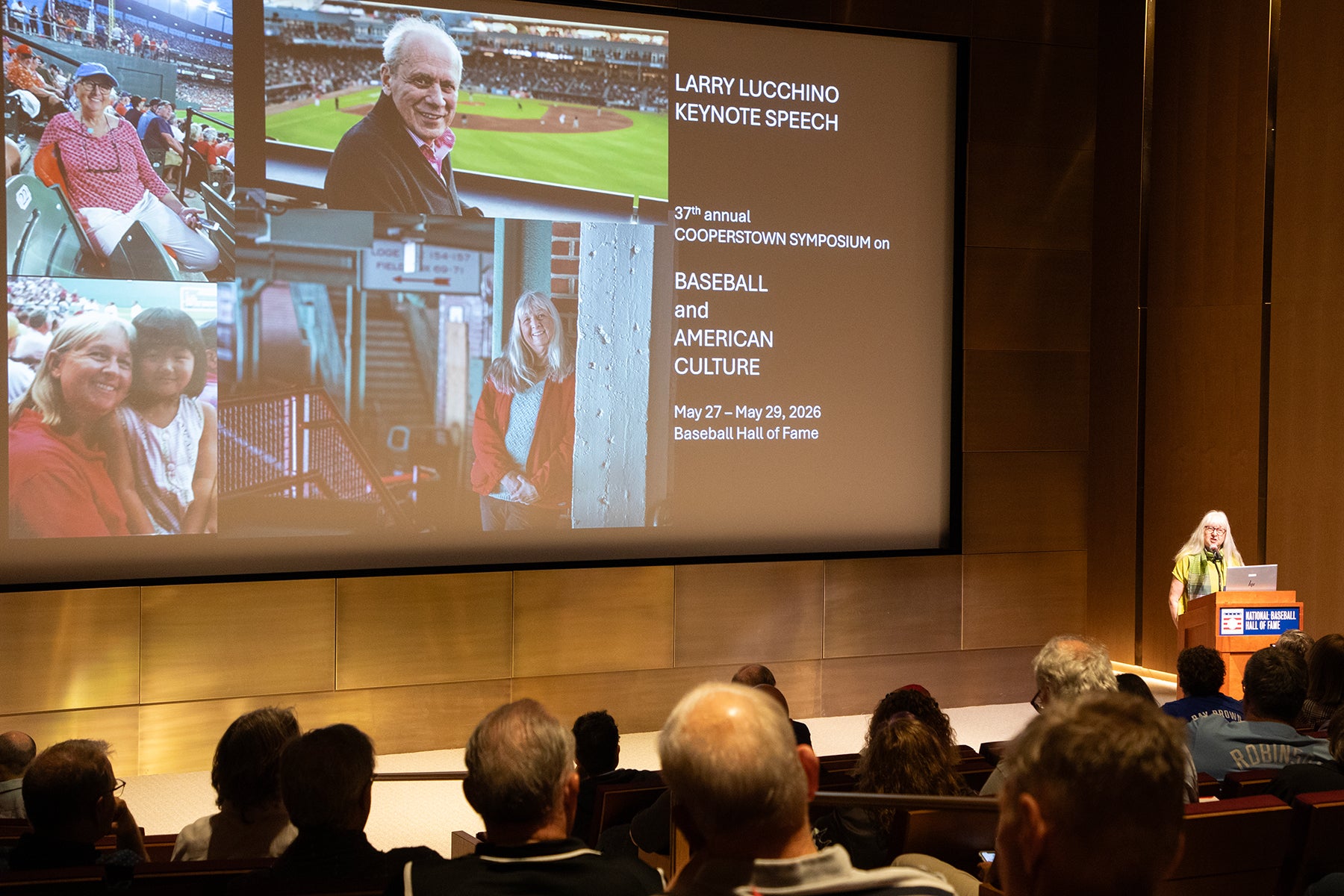
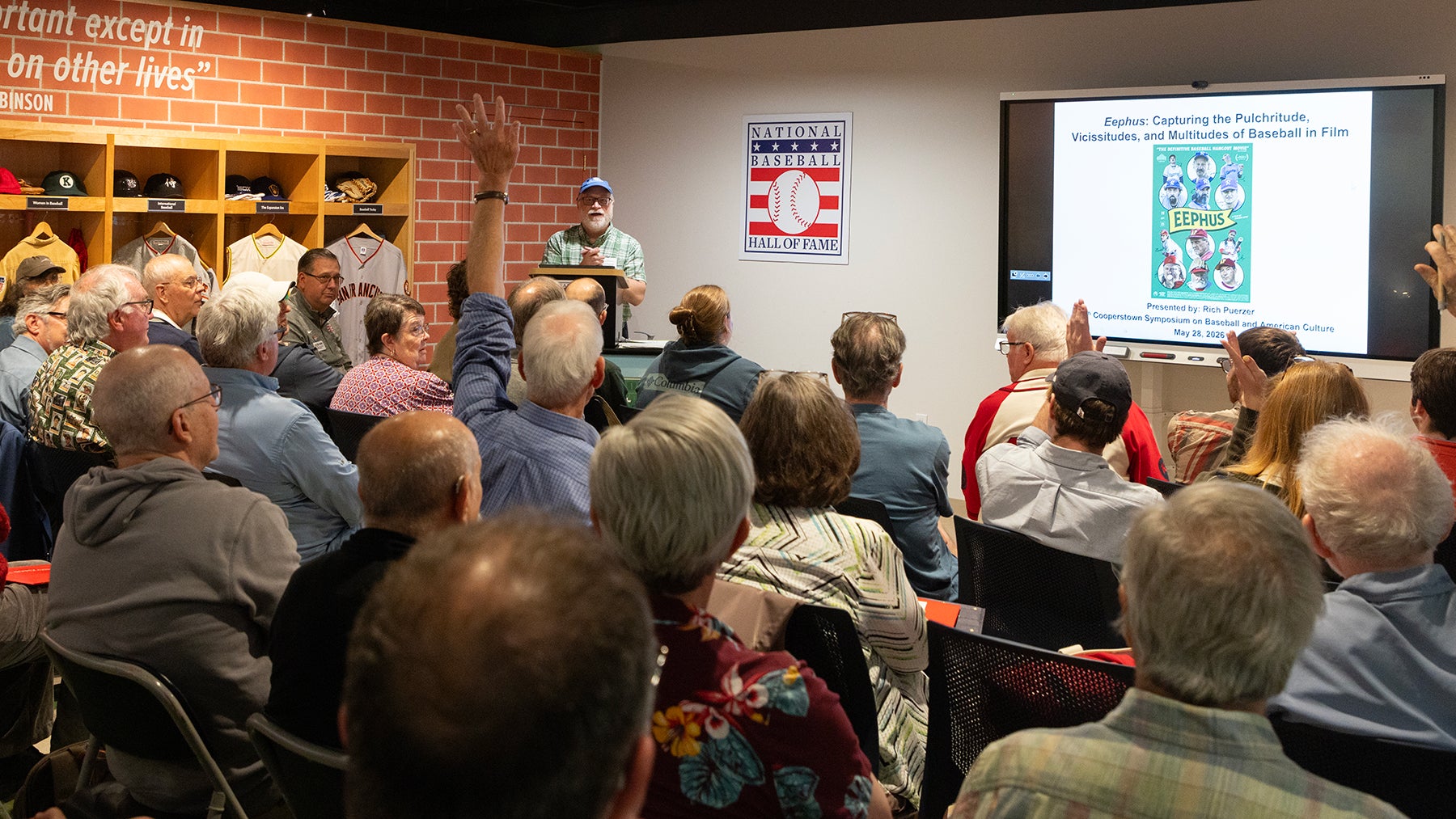
Providing a unique platform for attendees to visit Cooperstown and to discuss baseball and its relation to our culture and society, the game on the field isn’t the point; the talk is about everything else – art, music, poetry, literature, economics and architecture, to name just a few subjects.
Bill Simons, history professor at the State University of New York at Oneonta and co-director of the Symposium, said: “In addition to baseball scholarship, the conference features fraternization between the generations, playing of town ball, and the banquet in the plaque room. The Symposium … constitutes baseball’s preeminent academic conference. Accomplished baseball scholars provide interesting and incisive presentations on virtually every aspect of the game, employing baseball to examine topics whose input extends far beyond the ballpark.”
Co-sponsored by the State University of New York at Oneonta and the National Baseball Hall of Fame and Museum, the Symposium examines the impact of baseball on American culture from inter- and multi-disciplinary perspectives.
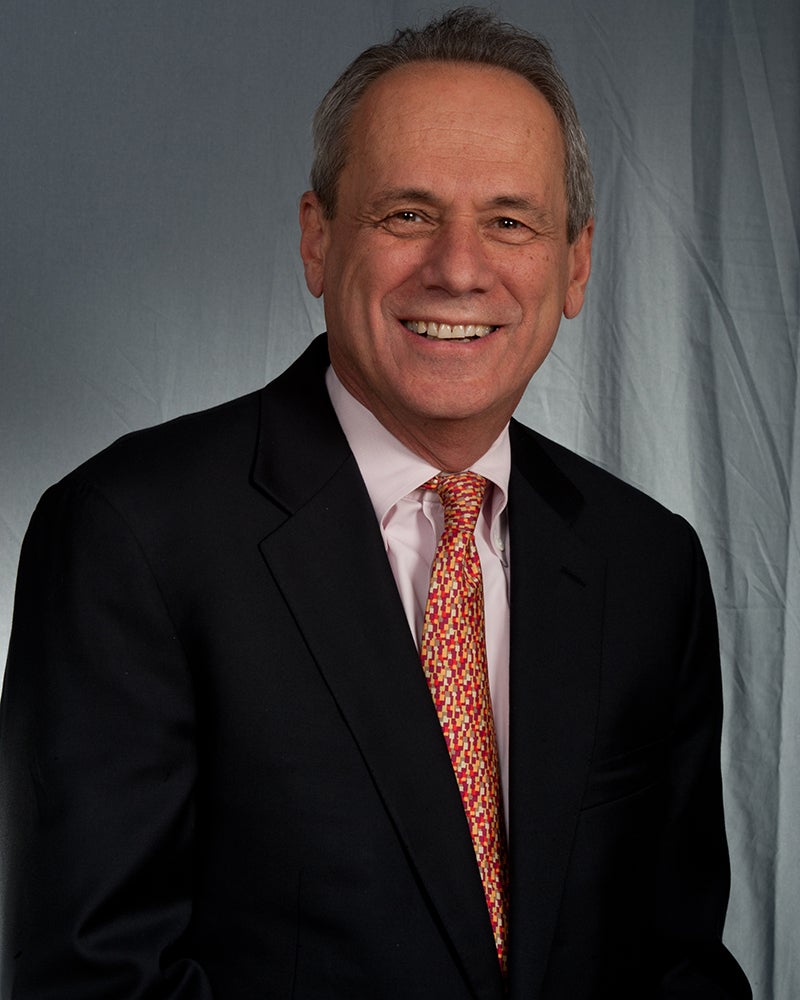
“You’re in for an incredible treat,” said Hall of Fame President Josh Rawitch addressing an audience of attendees prior to the Larry Lucchino Keynote Speaker address by journalist and author Melissa Ludtke at the Hall of Fame’s Grandstand Theater. “So, this year, another very exciting addition to this is that the Larry Lucchino Family Foundation has helped fund our keynote speaker. (For) those that don’t know, Larry had an incredible history in the game of baseball with the Orioles, the Padres, with the Red Sox – a lover of ballparks, one of the modern architects of making ballparks what we see today.”
This year’s Symposium kicked off with Ludtke, who Simons introduced as a major American journalist and author.
“Melissa’s 2024 autobiographical book Locker Room Talk: A Woman’s Struggle to Get Inside, details her determined battle, ultimately successful, to gain access to MLB locker rooms, allowing her and other women journalists to be able to do their jobs,” Simons said. “Along the way, Melissa faced cruel mockery and objectification from media and moguls. Her triumph and victory in Ludtke v. Kuhn, one of women’s sports defining federal court cases, pushed open a previously intractable gender barrier.”
Ludtke was a reporter at Sports Illustrated, was a correspondent at Time, and the editor of Nieman Reports at Harvard University’s Nieman Foundation for Journalism. Her federal lawsuit, Ludtke v. Kuhn, which in 1978 secured equal access for women sports reporters, meant women could interview players, coaches and the manager in the locker room, as male reporters had done for decades.
“When I heard the date on which I’d be speaking, I realized right away that I’d be in Cooperstown to celebrate my 75th birthday, which I am doing today – with you,” Ludtke said. “As a texter reminded me, I am celebrating my Diamond Jubilee. And what better place to do than in the place that created baseball’s diamond. There is no place I’d rather be. Only wish my mom who passed her love of the game to me could be here with me, too.”
Ludtke would continue by stating her sex discrimination case against Major League Baseball was never about ballplayers’ nudity. Nor was it about her morality even though most male sportswriters in 1970s America wanted people to think it was.
“I saw writers and commentators pit what Commissioner Bowie Kuhn liked to call the ballplayers’ ‘sexual privacy’ – though I never quite knew what he meant when he said that – against what these men claimed was my immorality for wanting equal access to baseball’s locker rooms,” she said. “Which is where the interviews took place. So, to do my job I had to work there. When the public assessed the evidence that they’d been handed, my feminine virtues were found sorely lacking. So, time after time, I lost my case in the court of public opinion.
“Fortunately for me, my fight for equal access was judged in a court of law, where I had the U.S. Constitution on my side. Specifically, its Fourteenth Amendment with its mighty Equal Protection Clause. This amendment – added soon after the Civil War – was designed to ensure equal treatment under the law for former slaves and free (Black Americans) who experienced racial discrimination.”
According to Ludtke, nearly all of her case’s media coverage was saturated with mocking words, suffused with a demeaning tone and meant to provoke giggles – at her expense. Two phrases rarely, if ever, appeared in stories about her and her case: “equal access” and “equal rights.”
“Soon after being informed that I’d been given the locker room green light by the 1977 World Series teams – the Yankees and Dodgers – he (Commissioner Bowie Kuhn) rescinded their permissions before I could walk to either door,” she said. “Kuhn had his media director ban me in the middle of Game 1 by informing me that despite my press credential granting me clubhouse access.
“Nearly 50 years have passed since then, and finally I’ve written my story. Not surprisingly, mine is a very different story than the one the men told in the 1970s.”
The next Cooperstown Symposium on Baseball and American Culture is scheduled for June 2-4, 2027.
Bill Francis is the senior research and writing specialist at the National Baseball Hall of Fame and Museum