Randy Marsh brings history to Cooperstown
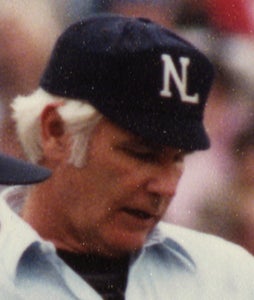
Former big league umpire Randy Marsh spent 29 seasons as one of the game’s top “men in blue.” One of the more dramatic games in history, which took place more than three decades ago, recently brought him to Cooperstown.
In a major league career that began in 1981, Marsh has totaled more than 3,800 games – regular season, postseason and All-Star Games – as an umpire. But one in particular still stands out.
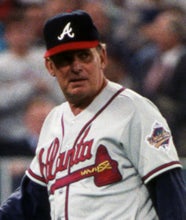
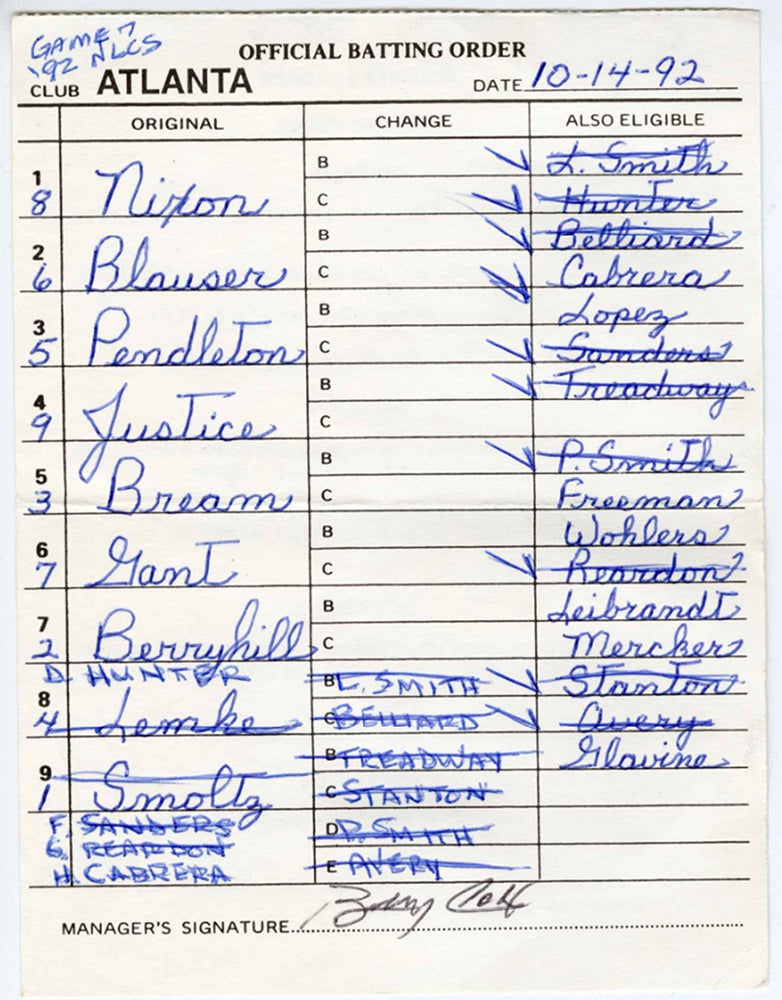
On Oct. 14, 1992, Game 7 of the National League Championship Series took place at Atlanta-Fulton County Stadium, pitting the defending NL champion Braves against the visiting Pittsburgh Pirates. This was a rematch of the 1991 NLCS, which saw Atlanta win in seven games before losing to the Minnesota Twins in another epic seven-game series.
Marsh, who started the game as the first base umpire, by the second inning found himself working behind the plate due to a sudden illness from John McSherry. Little did Marsh know what was in store for him.
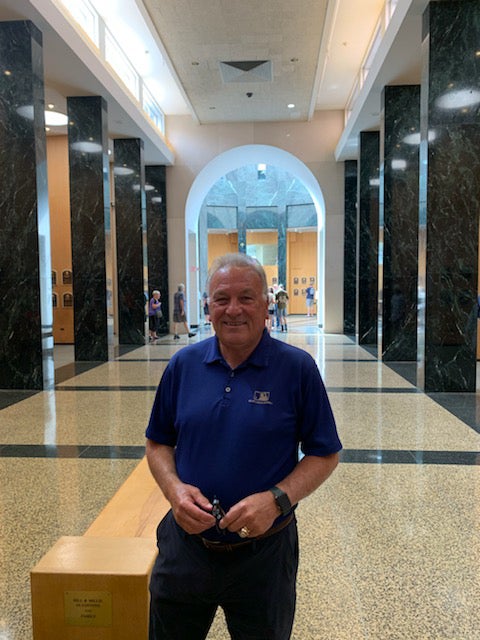
“We thought John McSherry was having a heart attack. At the end of the first inning, we all came into the umpire room and said, ‘John, you’ve got to get out of here.’ And Bill White was the National League president at the time and he was great. He said, ‘John, don’t worry about this game. We’ve got to get you taken care of,’” recalled Marsh, telling the story while in the National Baseball Hall of Fame and Museum’s Plaque Gallery on May 27. “We asked John, which one of us do you want to work home. He said, ‘Randy.’ I had worked home plate during Game 2. I think I took 11 minutes to get all my stuff on. We had already packed it up to go home because it was Game 7.
“It ended up being probably the most exciting game I worked in my life.”
The bottom of the ninth began with Pittsburgh holding a 2-0 lead behind eight shutout innings by ace Doug Drabek. A double, an error and a walk loaded the bases with no outs and Drabek was replaced by closer Stan Belinda. A sacrifice fly brought in a single run, a walk followed and loaded the bases, and an infield popup brought the Bucs within one out of a pennant.
What happens next is memorable to both baseball fans and Marsh. Atlanta’s third-string catcher Francisco Cabrera, who finished with only 10 at-bats during the regular season and was the last Braves’ position player available on the bench, came to the plate pinch-hitting for pitcher Jeff Reardon. On a 2-1 count, Cabrera singled to left field, with David Justice scoring from third and Sid Bream chugging from second toward the plate. Barry Bonds, Pittsburgh’s Gold Glove Award-winning leftfielder and who would become that season’s National League Most Valuable Player, made the throw attempting to nip Bream at the plate, but the toss was offline and Pirates catcher Mike LaValliere made a desperate attempt to tag out the runner. Marsh called him safe, sending Atlanta to their second consecutive Fall Classic. For many, the play is known as “The Slide.”
“It was a very close call. It’s just the circumstances, too, that made it exciting for me. I wasn’t planning on working behind the plate. I ended up being put in there,” Marsh said. “There ended up being a play at the plate and Bream was safe. I walked off the field and one of my umpire partners said, ‘You earned some big spurs there tonight, buddy, coming in and working the game like that.’ It ended up being really magnified. They used that picture of me calling Sid Bream safe for everything – billboards, credit cards, even bobbleheads.
“My really good friend who lives in Atlanta, he came up to see us during the winter, and he said to my wife, ‘I don’t want you to take this the wrong way, but your husband’s rear end is spread all over Atlanta.’ It was a picture taken from behind me.”
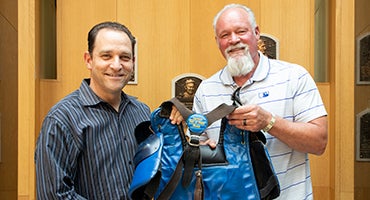
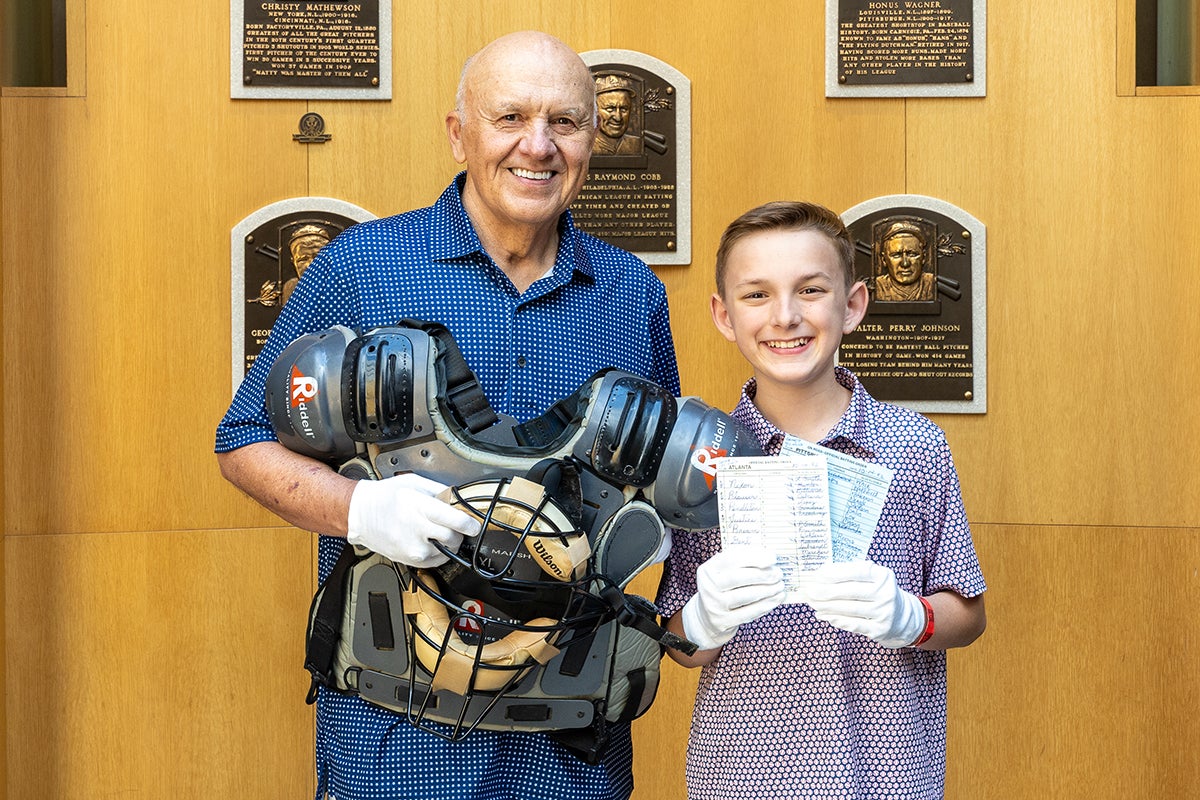
While in Cooperstown, the 77-year-old Marsh signed documents officially donating his chest protector and mask worn on that memorable evening to the Hall of Fame, as well as a lineup card from the game.
“There’s not that many umpires in the Hall of Fame, and I’m not in the Hall of Fame, but to have my stuff here from that game is special to me,” Marsh said. “My 11-year-old grandson Marshall is here with me today. He said, ‘You know, in years to come when we get older, I’ll be able to bring my friends up here and we can see your equipment here in the Hall of Fame.’ That’s pretty cool.”
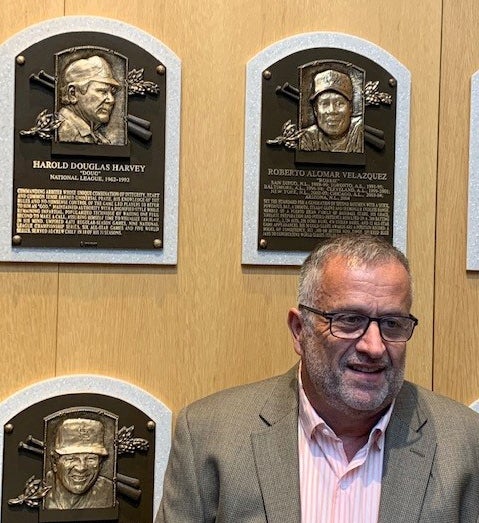
Marsh’s last time visiting Cooperstown came in 2010 for the Hall of Fame induction of fellow umpire Doug Harvey, a visit that included fellow umps Bruce Froemming, Joe West, Ed Montague and Jerry Crawford.
“All the guys that came here worked with Doug and were all particularly close with him. They became family friends,” Marsh said. “When I first started, before I was on a regular crew for the whole year, I was in and out working with Doug. You’d just sit there and learn and listen to what he had to say. It was a great weekend.”
Born and raised in Kentucky, Marsh began umpiring amateur games at 16 and eventually began working professionally in the minors for 13 seasons, making stops in the Appalachian League (1968-69), Florida State League (1970-71), Eastern League (1972-73) and Pacific Coast League (1974-81). His major league debut came on May 22, 1981, a series opener with the Reds hosting the Dodgers at Riverfront Stadium. Cincinnati just happened to be where Marsh was then living in the offseason.
“I just loved baseball. I found out early that I should be an umpire, not a player,” he said with a laugh. “I got a job in the Appalachian League, $450 a month, and eight cents a mile on my car, and I was in professional baseball.”
During his career, Marsh worked four All-Star Games, five Division Series, nine League Championship Series and five World Series, including three Fall Classics as the Crew Chief. Retiring after the 2009 season, Marsh spent one year as an Umpire Supervisor in 2010, then served as Major League Baseball’s Director of Major League Umpires from 2011-2019. He is currently an MLB Umpire Observer based in Cincinnati.
Marsh had 52 ejections during his time in the majors, a list that included tossing Hall of Fame manager Bobby Cox twice. Cox holds the all-time record with 162 career ejections.
“I still say Braves pitching coach Leo Mazzone got him ejected most of the time, because Leo would start screaming on pitches, and then Bobby, he just threw his hat up in the air, but when he threw his hat up in the air, guys would unload on him,” Marsh said. “And when you ejected him, he’d come out there and he’d be a little mad. But after the game, you’re walking down the back hallway, going to your car, he’d say, ‘Hey, Randy, how are you doing?’ It was like it was completely over.
“Matter of fact, when he retired, they had a dinner for him. And they had several players send in videos. And they asked me to send one in. I did. And I had a video of the times he was tossed.”
Marsh now has a memory that will live forever in Cooperstown.
“(Baseball has) been everything to me,” Marsh said, “being involved in a game that I think is the greatest game going. I wasn’t the greatest ball player, but I could be on that field every day, just like a major league player, be good at my job, and be able to make a career out of it. And it was never a job. I always said. ‘It’s not a job if you like it.’ And I loved it.”
Bill Francis is the senior research and writing specialist at the National Baseball Hall of Fame and Museum