#CardCorner: 1982 Topps Rodney Scott
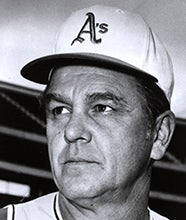
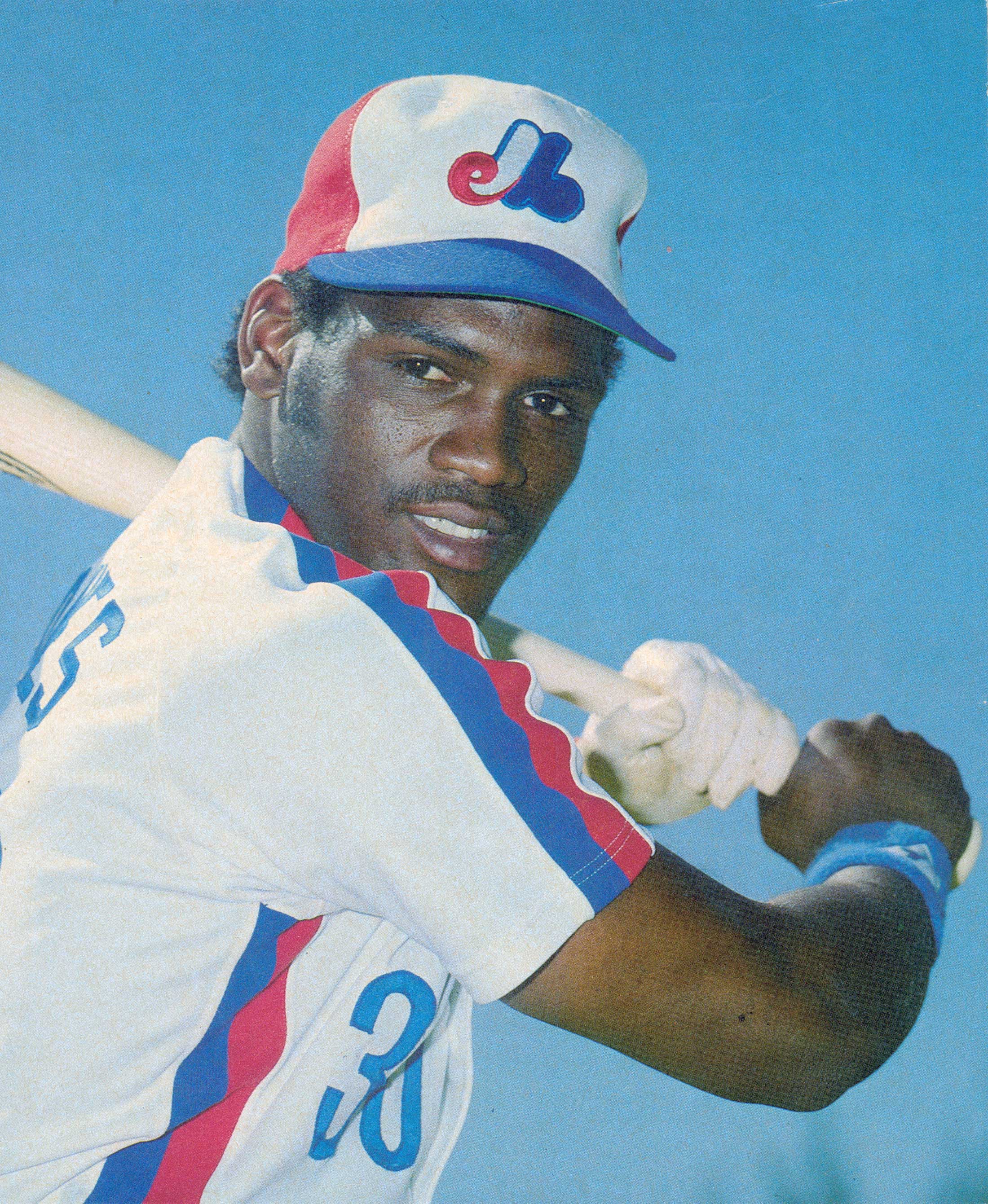
A favorite of Hall of Fame manager Dick Williams, Rodney Scott was among the speedy table-setters who energized the late 1970s/early 1980s Expos during the team’s most successful era.
And though those Expos never made it to the World Series, Scott has a place in history for fans who remember that Astroturf-fueled era of basepath magic.
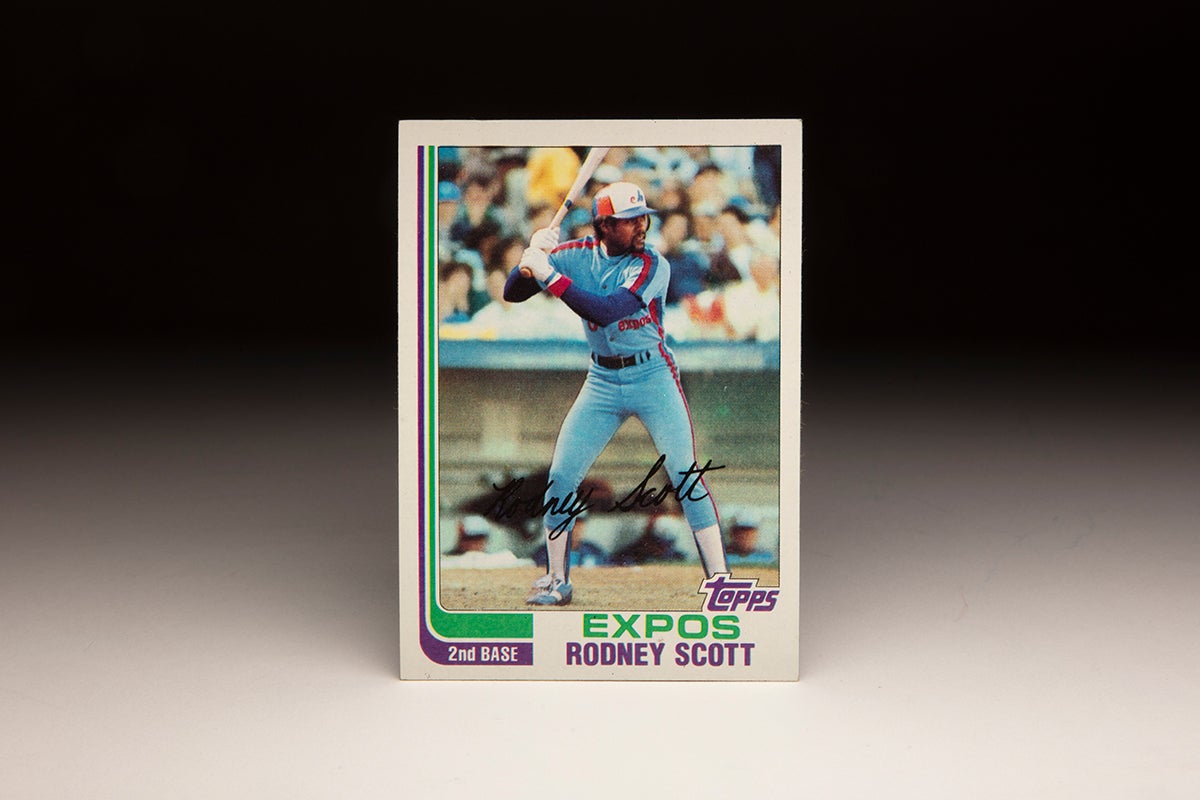
Rodney Darrell Scott was born Oct. 16, 1953, in Indianapolis, Ind. He excelled in baseball, football and basketball at Arlington High School, earning All-Indiana honors on the diamond and attracting scholarship offers on the hardwood.
“I had the instinct you need to play sports,” Scott told the Montreal Gazette in 2007. “I think instinct is as important in baseball as hitting or throwing or running. I had that at 18 and was ready for pro baseball.”
When the Royals selected Scott in the 11th round of the 1972 MLB Draft, he quickly signed – his father, Charlie, told the Indianapolis News that Scott’s bonus was “close to $10,000” – and reported to the team’s Gulf Coast League outpost in Sarasota, Fla., where he hit .376 with 16 steals in 35 games. Scott had also committed to play basketball for Vincennes University but decided against it when the Royals agreed to let him suit up for Manatee Junior College in nearby Bradenton, Fla.
In 1973, Scott began the season with the San Jose Bees of the Class A California League. But he hit just .220 in 48 games before the Royals reassigned him to Billings of the Pioneer League, where Scott batted .297 with 26 steals in 64 contests.
In 1974, Scott – who was primarily a shortstop at this point – began the season at Class A Waterloo of the Midwest League. He batted .258 with 39 steals in 58 games before earning a promotion back to San Jose, where he hit .300 with 46 steals in 63 games. All told, Scott stole 85 bases in 91 attempts that season and looked for any way he could find to take advantage of his speed.
“Pretty soon,” Scott told The Courier of Waterloo, Iowa, “I will start working on my bunting.”
Scott’s speed got him noticed at the Royals’ Spring Training camp in 1975, and manager Jack McKeon found a spot for him on the Opening Day roster.
“I had no idea I’d be up here (in the big leagues),” Scott told the Kansas City Times when the Royals stopped in San Jose, Calif., at the end of Spring Training to play the San Francisco Giants in an exhibition game. “I didn’t anticipate it. I just did the best I could and hoped.”
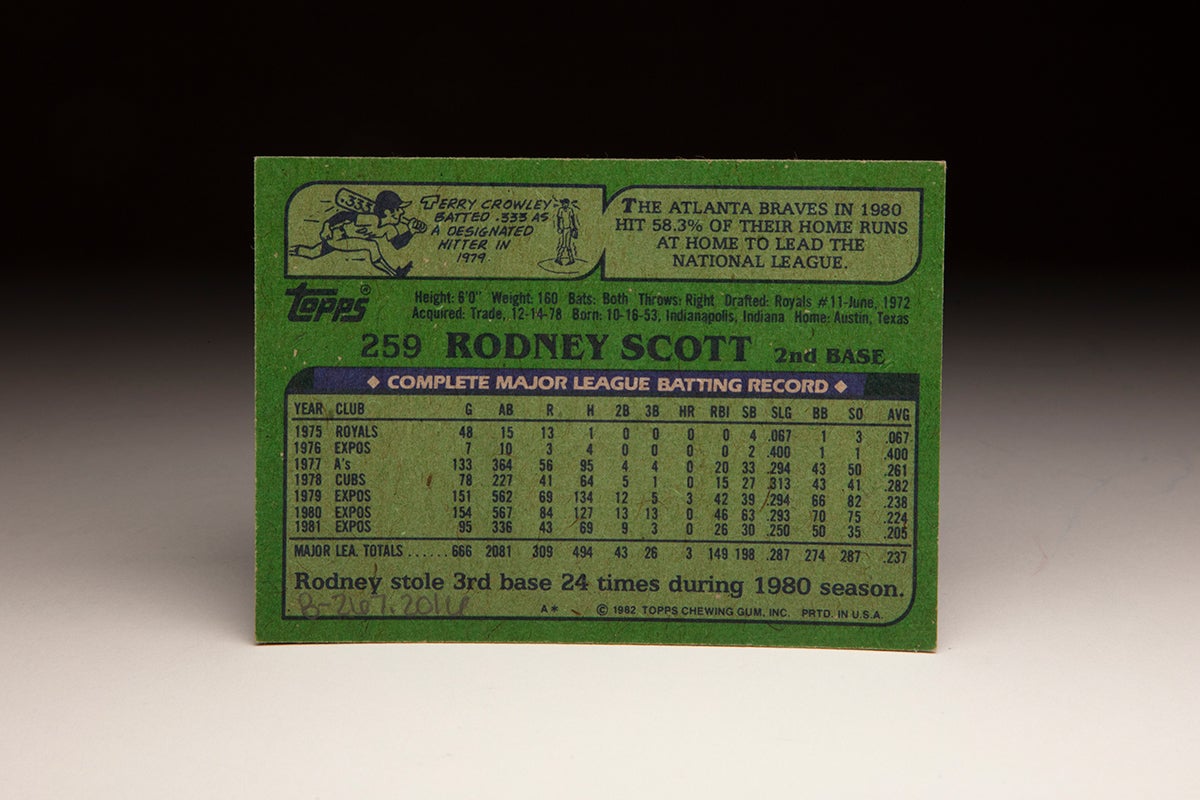
Scott made his MLB debut on April 11 as a pinch-runner against the Twins. He recorded his first stolen base the next day while pinch-running for designated hitter Tony Solaita. Scott’s first seven games came as a pinch-runner, and he was hitless in five plate appearances (covering 18 games) when the Royals sent him to Double-A Jacksonville in late May.
With the Suns, Scott batted .338 with 14 walks and 12 steals in 20 games before returning to Kansas City in July. He would play in 16 games over the next five weeks, starting just once before being optioned to Triple-A Omaha, where he played 12 games before returning to Kansas City in September. For the season, Scott played in 48 games with the Royals, recording one hit in 15 at-bats while stealing four bases and scoring 13 runs.
It was with the Royals that Scott earned his lasting nickname: Cool Breeze.
“(Teammate) John Mayberry called me ‘Cool Breeze’ because I didn’t let things get me down,” Scott told the Montreal Gazette.
But Scott would not be Mayberry’s teammate for long. On Dec. 22, the Royals sent Scott to the Montreal Expos as the player to be named later from a March deal that brought catcher Bob Stinson to Kansas City.
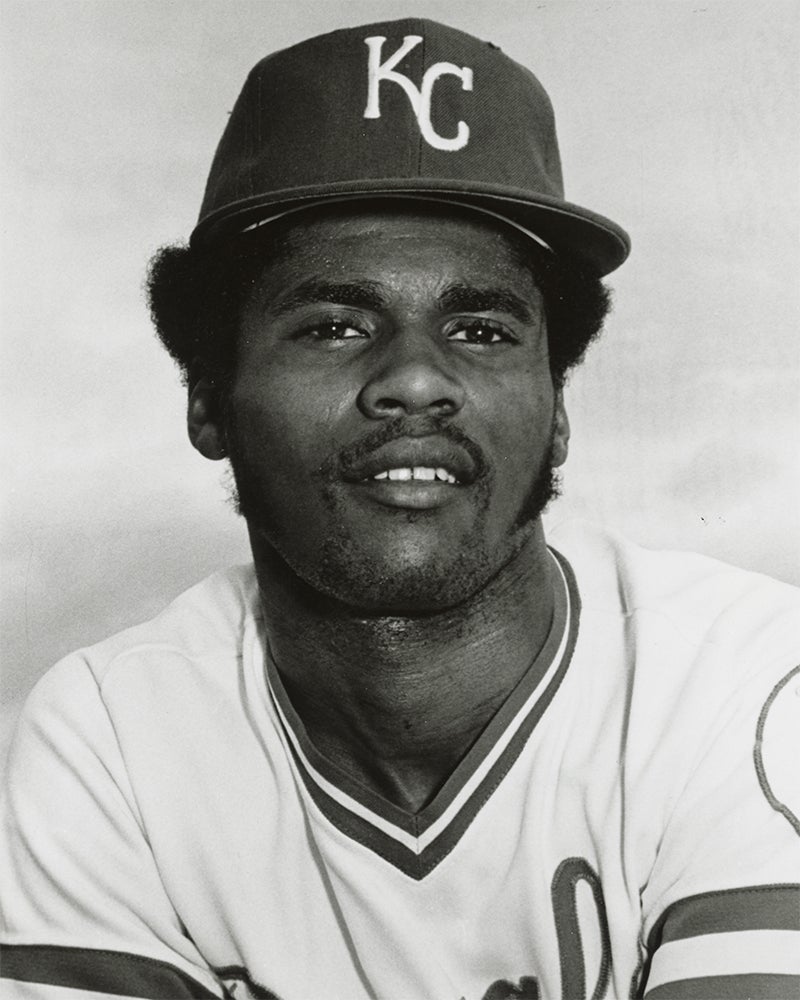
With no designated hitter in the National League to preserve starting pitchers from pinch-hitters, Scott found his path to a roster spot difficult. The Expos sent him to Triple-A Denver, where he learned to switch-hit and batted .307 with a .395 on-base percentage, 75 runs scored and 35 steals in 114 games on a team that featured future Hall of Famer Andre Dawson as well as big leaguers Warren Cromartie and Roger Freed (who hit 42 home runs).
The Expos brought Scott back to the majors in September, where he appeared in seven games while totaling four hits and two steals.
Then in the span of 11 days in the spring of 1977, Scott was traded twice. On March 15, the Expos sent Scott to the Texas Rangers in exchange for pitcher Jeff Terpko. Ten days earlier, Scott had claimed a mistake was made in the language of his 1977 contract and that he considered himself to be a free agent. Expos general manager Charlie Fox then rid himself of the problem by trading Scott.
“I guess…Charlie Fox wanted me to sign for his price and I wouldn’t,” Scott told the Gazette in 1979.
But on March 26, Scott was on the move again when the Rangers sent him, pitcher Jim Umbarger and a reported $250,000 to the Athletics for Claudell Washington, one of only three players (along with Vida Blue and Bill North) remaining on the A’s from their World Series-winning teams.
Scott got his first Opening Day start in 1977 at second base for Oakland, recording a hit and a stolen base. The A’s soon moved him to shortstop after acquiring Marty Perez from the Yankees in a deal that saw Mike Torrez go to New York. Scott returned to second base late in the season and finished the year hitting .261 with 33 steals (sixth in the AL) in 133 games.
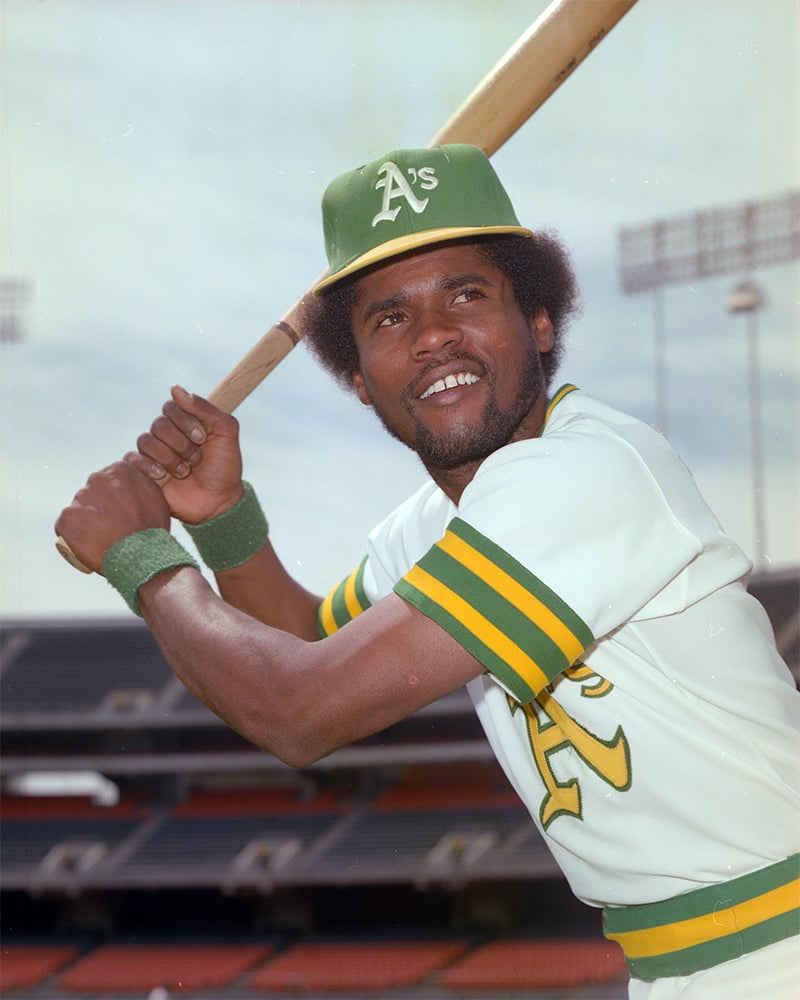
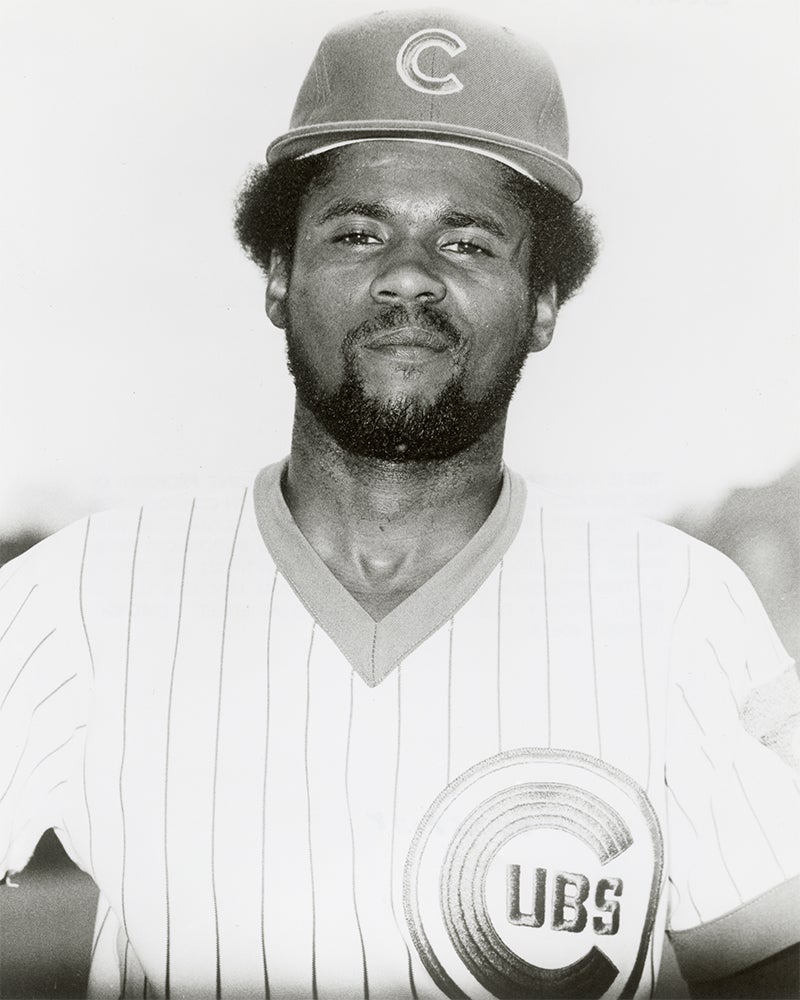
But on March 29, 1978, Scott was on the move again – this time to the Cubs in exchange for pitcher Pete Broberg. With Manny Trillo and Iván de Jesús set at second base and shortstop, respectively, in Chicago, Scott was assigned to Triple-A Wichita.
“I was a little surprised the A’s were sending me out because I was the American League’s sixth base-stealer last season, and because I didn’t bat that much,” Scott told the Wichita Beacon.
In Wichita, Scott took advantage of the new turf field at Lawrence Stadium and hit .262 with 36 steals in 63 games before the Cubs recalled him on June 23. He spent most of the rest of the season as Chicago’s third baseman, batting .282 with a .403 OBP, 27 steals and 43 walks in 78 games.
But his fine numbers did not earn him any security. On Dec. 14, Scott was traded for the fifth time in less than three years, going back to Montreal with outfielder Jerry White in exchange for Sam Mejías.
The Expos were entering their third year under manager Dick Williams and had assembled a roster that featured young stars Larry Parrish and Ellis Valentine along with future Hall of Famers Gary Carter and Dawson. The middle infield positions appeared to be set with veterans Chris Speier at shortstop and Dave Cash at second base, relegating Scott to a bench role.
But Williams loved speed, and Scott was ready to deliver.
“You can’t count (Scott) out as a regular,” Williams told the Gazette in the spring of 1979. “He has good speed and range and a pretty good arm. He’s able to hit, too.”
By Opening Day, Scott was starting at second base and hitting second in the lineup.
“I’m at the point where, if given the right opportunity, I can deliver in all departments,” Scott told the Gazette. “I can field and I can get on base and when I get on base I can run on them. I can score runs.”
Scott and the Expos were 50-35 at the All-Star break and maintained a comfortable lead in the NL East before Pittsburgh got hot in the second half.
“Rodney is one of the reasons we are where we are,” Williams told the Gazette in 1979. “In Rodney’s case, his numbers are superficial. It’s his (defensive and baserunning) contribution which counts, and that’s been magnificent.”
The Expos entered a four-game series against the Pirates on Sept. 24 a half game ahead of Pittsburgh. The teams split a doubleheader on Sept. 24 – with Cash and Speier starting the opener and Scott starting at shortstop in the nightcap, going 1-for-3 before leaving the game in favor of pinch-hitter John Tamargo, whose two-run double in the top of the eighth tied the score in a game Montreal went onto win 7-6.
But Pittsburgh won the next two games – Scott went a combined 4-for-8 – to take a game-and-a-half lead in the division and did not relinquish the lead the rest of the year. Scott finished the season – which saw Montreal win what was an Expos all-time-best 95 games – hitting .238 with 69 runs scored, 39 steals and 66 walks in 151 games.
Following the 1979 season, the Expos added more speed to their roster by acquiring Ron LeFlore from the Tigers. With Cash having been traded to the Padres, Scott settled in at second base and in the second spot in the batting order behind LeFlore. The result was Scott’s best season of his career.
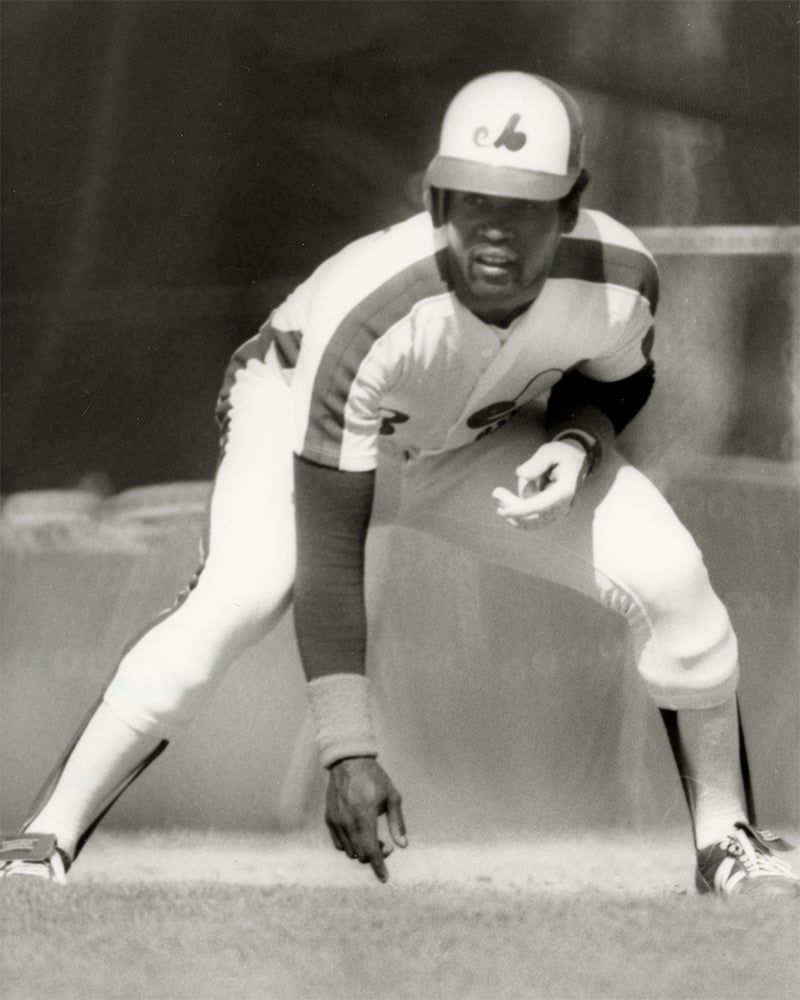
Though he hit just .224, Scott drew 70 walks, scored 84 runs and tied Pittsburgh’s Omar Moreno for the NL lead in triples with 13. Scott also drew praise for his defense as he made just 12 errors at second base in 679 chances – good for a .982 fielding percentage. Williams called him the team’s Most Valuable Player midway through the season.
“(Scott is) the most instinctive ballplayer I’ve ever seen, a tremendous competitor,” Expos general manager John McHale told the Gazette. “You can see that by the way the other teams react to him. They’d like to cut his heart out.”
But it was Scott’s legs that were making headlines around baseball. He stole a career-high 63 bases in 1980 – including 24 steals of third – teaming with LeFlore (97 steals) to set a Modern Era MLB record with 160 combined stolen bases, breaking the previous mark of 148 set by Lou Brock (118) and Bake McBride (30) in 1974. Vince Coleman (110 steals) and Willie McGee (56 steals) of the 1985 Cardinals would eventually break the LeFlore-Scott standard and still hold the record. But LeFlore and Scott comfortably sit in second place and could be there for the foreseeable future.
The Expos once again went into the final weekend of the season with a chance to win the NL East. On Saturday, Oct. 4, the Expos needed to defeat the Phillies to pull into a tie and make the regular season finale a winner-take-all affair. Scott seemingly put Montreal in the driver’s seat when his seventh-inning double off Sparky Lyle scored Tim Raines to give the Expos a 4-3 lead.
But Bob Boone’s two-out single off Woodie Fryman in the ninth inning scored Bake McBride to tie the game. Then in the 11th, Mike Schmidt’s two-run homer off Stan Bahnsen – with Don McCormack, who had zero major league at-bats to that point, on deck – gave the Phillies a 6-4 lead. The Expos were unable to score in the bottom of the 11th, giving Philadelphia the division crown.
Scott finished that game 3-for-4 at the plate.
In the spring of 1981, Scott worked with Expos hitting coach Pat Mullin to improve his batting skills from the left side. In 1980, Scott hit just .205 against right-handed pitching but .289 against lefties.
But Scott also felt unappreciated and told the media he would not be saying much in 1981.
“Talking is a distraction, so I won’t talk,” Scott told the Gazette. “I’m not saying anything to anybody.”
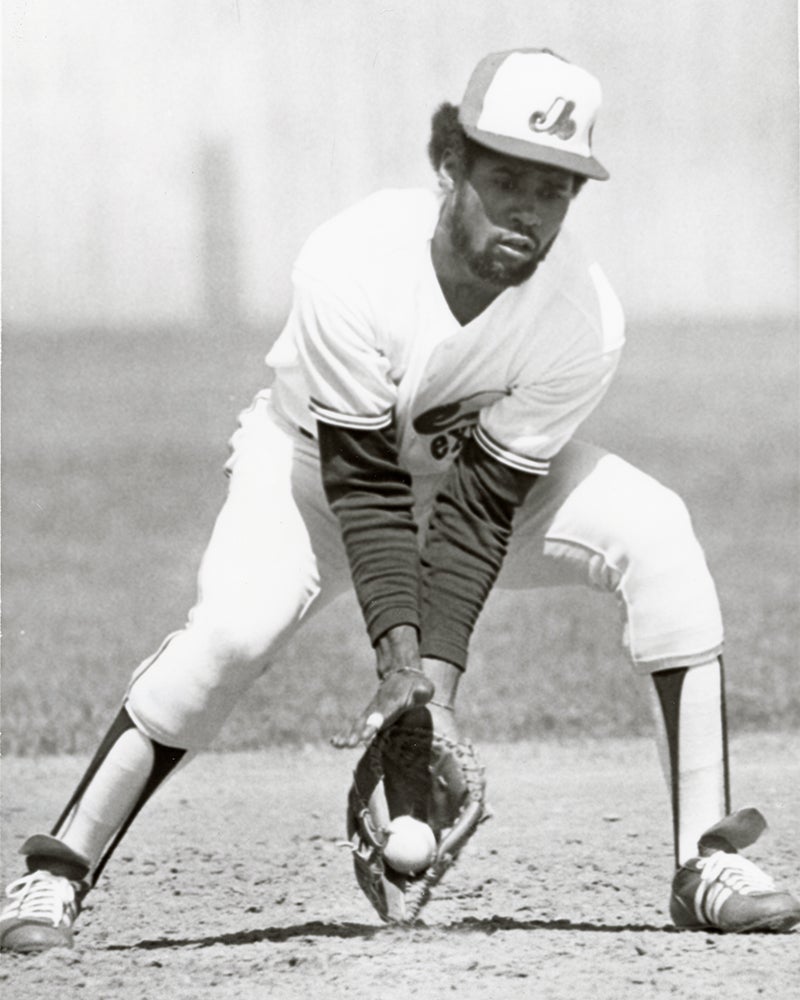
Scott and the Expos agreed to a one-year deal worth $225,000 for 1981, and Scott kept his job at second base despite the presence of Raines, who was a minor league second baseman and appeared ready for the big leagues in 1981. The Expos moved Raines to left field but told Scott during the offseason to prepare to play shortstop in case Raines could not make the transition.
It turned out to be a non-issue as Raines stormed through the league in 1981, batting .304 with a big league-best 71 steals in just 88 games. Scott posted a slightly better on-base percentage (.308 to .307) over his 1980 total but saw his average drop to .205 with 30 steals in that strike-shortened season.
The Expos dismissed Williams in September and replaced him with Jim Fanning, who led Montreal to the second-half NL East title. But Scott hurt his shoulder against the Pirates on Oct. 1 and played in just one of Montreal’s final three games of the regular season, appearing as a pinch-runner on Oct. 3.
He did not play at all in the Expos’ five-game win over the Phillies in the Division Series.
Healthy again for the NLCS vs. the Dodgers, Scott went 2-for-3 with a walk and a stolen base in Montreal’s 5-1 loss in Game 1. He had just one more hit in the rest of the series, going 1-for-15 over four games as the Dodgers defeated Montreal.
It would be Scott’s only career postseason games as his time with the Expos wound down.
“I’d have to say Rodney Scott is the best No. 2 hitter I’ve ever worked with,” Raines told the Gazette about his Expos teammate in 1982.
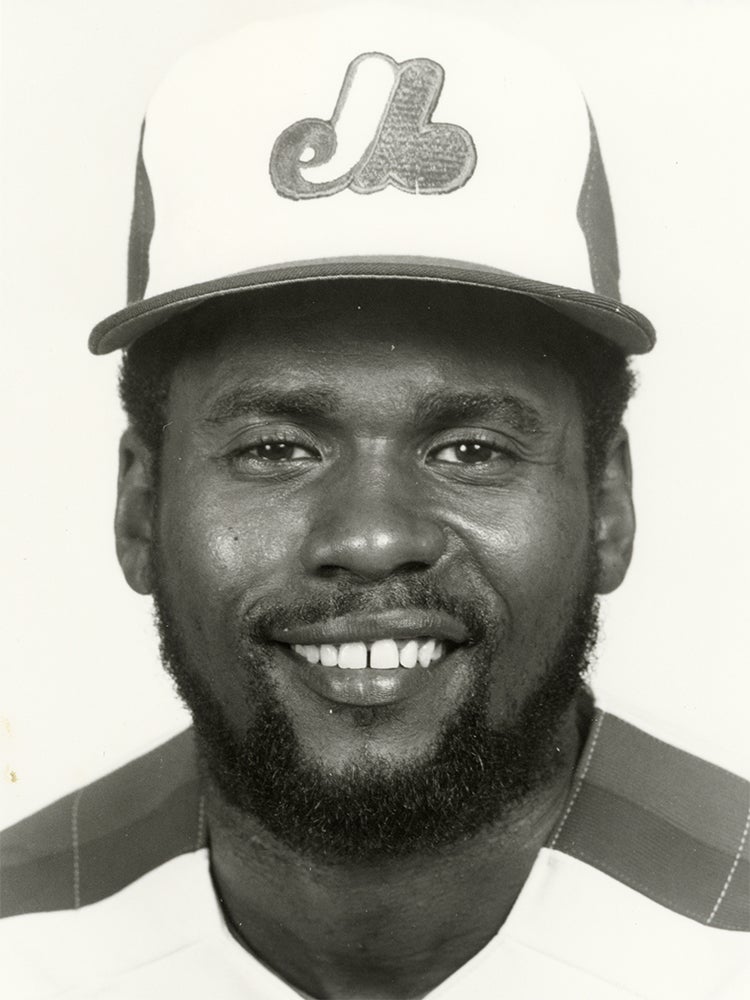
But with his biggest supporter – Williams – no longer in the dugout, the Expos started prospect Wallace Johnson at second base on Opening Day in 1982. Relegated to utility duty, Scott appeared in just 14 of Montreal’s first 22 games, including only five starts. Then on May 8, the Expos released Scott, suggesting that he was not a good influence on younger players. Scott’s preference for night life was well known throughout the league, and the Expos front office accused Scott of marijuana use.
“He wasn’t participating,” Expos general manager John McHale told the Gazette. “He wouldn’t practice or attend team meetings. He wouldn’t accept the role of a utility man.”
Teammate Bill Lee was incensed by Scott’s release and missed that night’s game before destroying his uniform in manager Jim Fanning’s office. Lee was subsequently released on May 9.
Scott, meanwhile, found work with the Yankees when they offered him a contract on June 15. He hit .366 in 30 games for Triple-A Columbus before coming to New York. But in 10 games with the Yankees in August, Scott hit just .192 with two steals. The Yankees released him on Aug. 25, and Scott returned home to Austin, Texas.
Scott had one more chance at the big leagues, agreeing to a contract with the Expos’ Triple-A team in Wichita on June 26, 1983.
“He convinced me he’s serious, that he wants another chance,” McHale told the Gazette. “Well, nothing is forever. We’ve given a lot of people second, third, 15th chances around here, so we’re giving this guy a second chance.”
Scott hit .307 in 48 games with the Aeros, drawing 25 walks but stealing just five bases in 11 attempts. The Expos did not bring him to Montreal, and after spending the next three seasons in the Mexican League, Scott’s playing career came to an end save for some games with the Senior Professional Baseball Association’s West Palm Beach Tropics – managed by Dick Williams – in 1989.
Scott took his MLB pension early and lived for many years with his mother. In eight big league seasons, he batted .236 with a .326 OBP, 316 runs scored and 281 walks. He is the only Modern Era (post 1900) player with at least 200 stolen bases (205) and fewer than 510 hits (504).
But for Expos fans of the team’s glory days, Rodney Scott holds a special place in history.
“I remember Montreal as being a wonderful place,” Scott told the Gazette in 2007. “I always had a good time.
“You never know what life holds for you. You do the best you can while you can and hope for the best.”
Craig Muder is the director of communications for the National Baseball Hall of Fame and Museum