#Shortstops: Folded in Honor
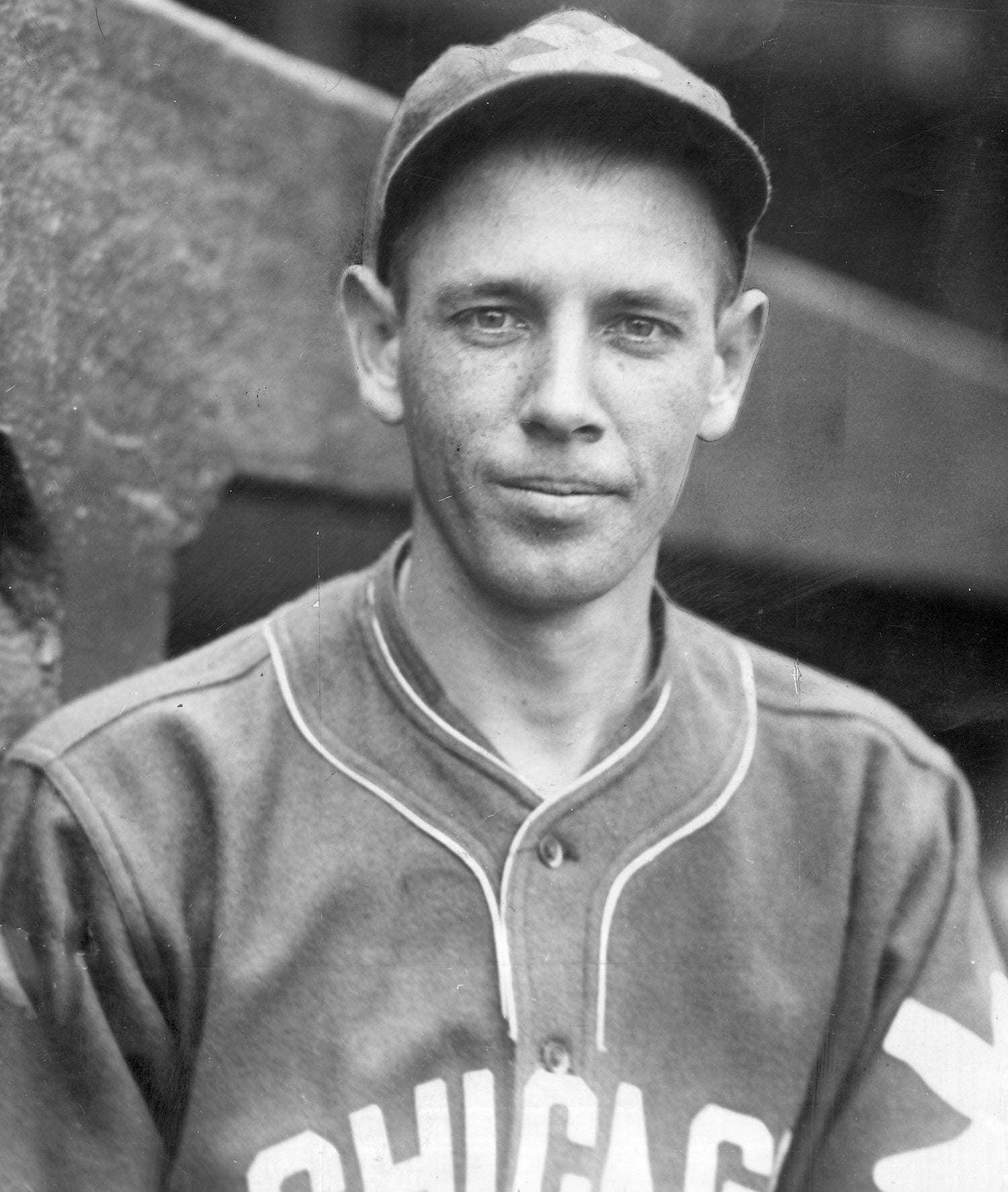
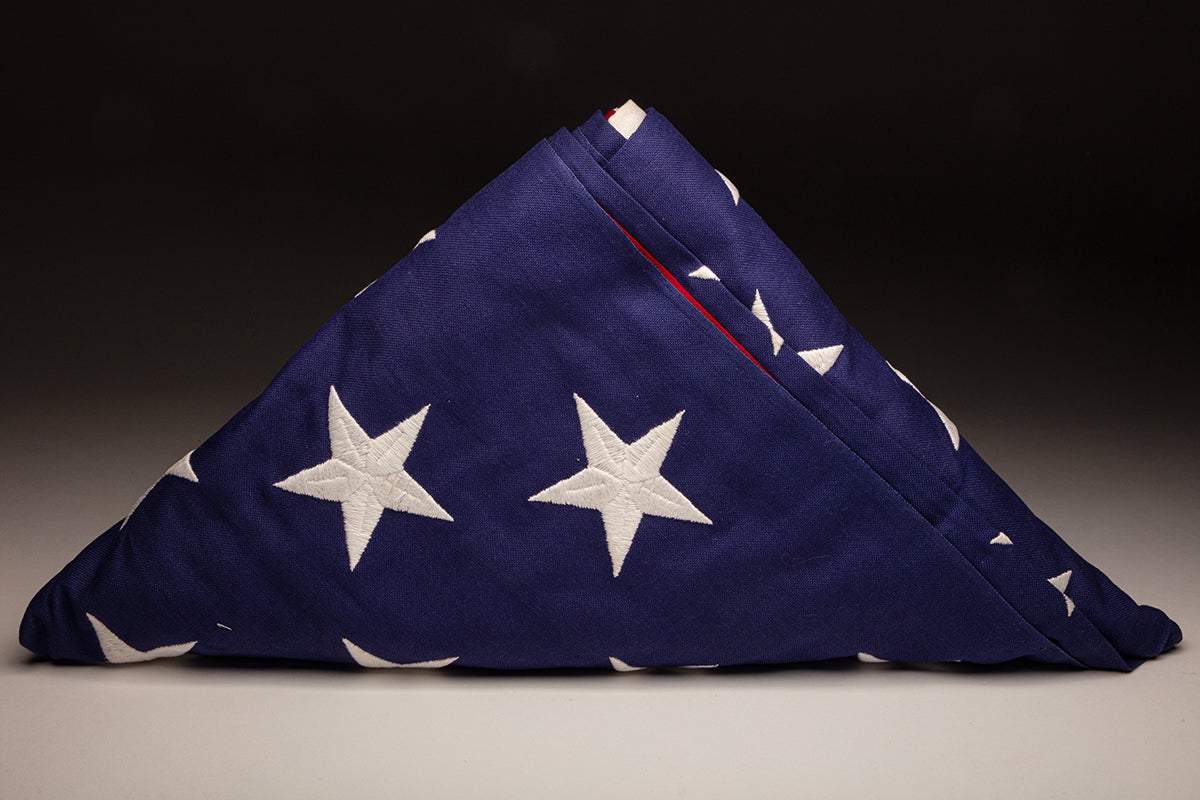
Among the artifacts preserved in the collections of the National Baseball Hall of Fame and Museum is the American flag that rested upon the casket of – and which was presented to his next of kin following his military honors funeral – Theodore Amar “Ted” Lyons (1900-1986), the Hall of Fame pitcher from the Chicago White Sox and United States Marine Corps veteran.
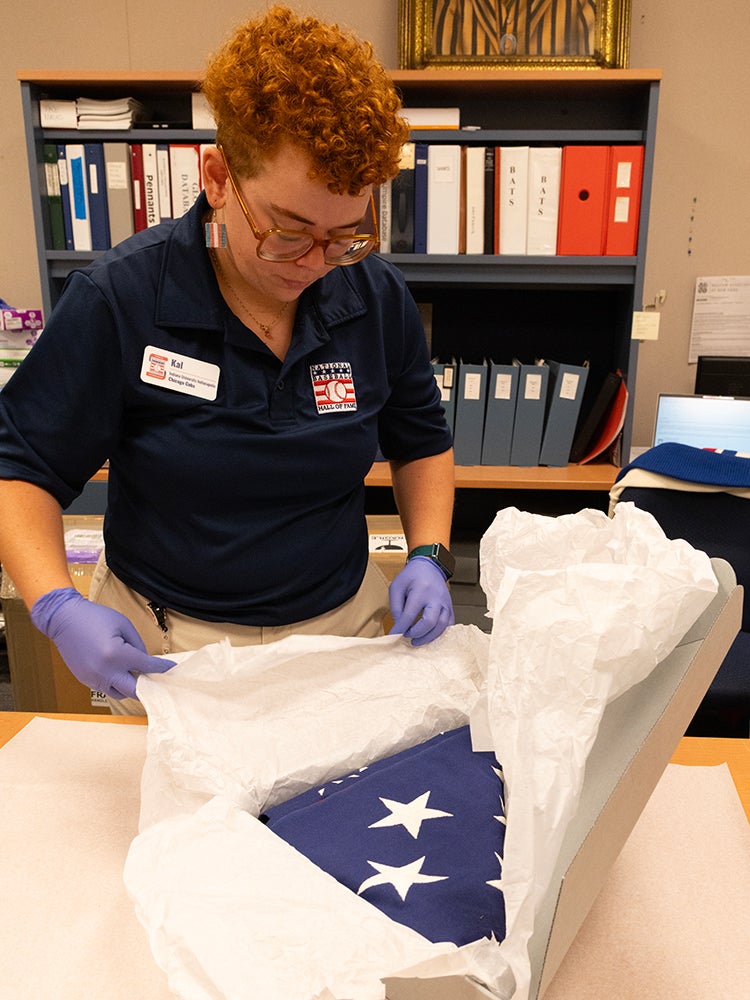
The flag remains in its triangle fold in which it was presented to Lyons’ family, who then later donated it to the Museum. Today, it is housed within archival-quality materials, including acid-free unbuffered tissue and an acid-free storage box. This is to protect the flag from agents of deterioration, such as light and dust.
The decision to keep the flag folded reflects more than a preservation choice. It is also a question of memory, meaning and respect.
Conservation specialists often recommend that, for long term preservation, large textiles be unfolded and rolled onto acid-free tubes covered in acid-free unbuffered tissue. Then the rolled textile should be wrapped in clean, unbleached cotton fabric, and secured with cotton twill tape strands. Doing so can reduce stress on the fabric and help prevent permanent creases, which can quicken breakdown of the textile fibers.
Burial flags, however, occupy a unique place among historical objects. They are not only textiles; they are deeply personal memorials presented in recognition of a veteran’s service to their country.
There is no federal law or official regulation requiring a burial flag to remain folded after it was presented to the next of kin of the deceased. Likewise, there is no prohibition against carefully unfolding the burial flag for examination or preservation. Yet, many people view the folded flag as an important part of the funeral ceremony itself. The triangular shape is the form in which the flag was last used to honor the veteran and the form in which it was entrusted to those who would remember them.
For this reason, the Museum made the decision to preserve the flag as it was received – folded. While unfolding and rolling a burial flag for conservation purposes can be a thoughtful and respectful choice, retaining the folded configuration was decided to be the most appropriate approach for this particular item. In doing so, the goal is not only to preserve the flag itself, but also to honor the veteran for whom it was presented and to preserve the ceremonial form that remains an enduring symbol of service and memory.
The veteran honored by this flag was Ted Lyons, one of the most accomplished pitchers in Chicago White Sox history. Born in Lake Charles, La., on Dec. 28, 1900, Lyons attended Baylor University before signing with the White Sox in 1923. Remarkably, he never played in the minor leagues and spent his entire major league career with the White Sox, pitching from 1923 to 1942, and again in 1946.
Early in his career, Lyons established himself as one of the American League’s premier pitchers, leading the league in wins in both 1925 and 1927. After injuries diminished the effectiveness of his fastball, he reinvented himself by developing a slower curveball and knuckleball, extending his career for more than a decade. His adaptability and durability earned him great respect. He earned the nickname “Sunday Teddy” as he was often used primarily as a Sunday starter during the latter years of his career. Between 1935 and 1942, he won 98 games while appearing in no more than 26 games in any season.
Lyons’ baseball career was interrupted by World War II, and in 1943, he enlisted in the United States Marine Corps and eventually attained the rank of captain. Serving primarily in the South Pacific, he organized and managed military baseball teams and helped promote morale through the game he loved. After his honorable discharge in December 1945, he returned to the White Sox for a final season before becoming the club’s manager.
In 1955, Lyons was elected to the National Baseball Hall of Fame in recognition of a career that included 260 victories and nearly a quarter-century of service to the White Sox organization. Yet his legacy extends beyond baseball statistics and Hall of Fame honors. The funeral flag preserved by the Museum serves as a tangible and powerful reminder of both his military service and the respect accorded to him at the end of a remarkable life.
Through the preservation of this artifact, visitors are invited to remember not only Ted Lyons, the Hall of Fame pitcher, but also Ted Lyons, the United States Marine, whose service to his country remains an important part of his enduring legacy.
Burial American flags are provided at no cost for eligible veterans by U.S. Department of Veterans Affairs; an application form can be found online or at your local Post Office. Information on how to care for and retire an American flag can be found at your local veterans service organization.
Kal Demaree (they/them) is the 2026 Collections Intern in the Hall of Fame’s Frank and Peggy Steele Internship Program for Leadership Development