#CardCorner: 2000 Topps Brian Giles
Part of a Cleveland farm system so flush with talent that he was deemed expendable, Brian Giles became a new-age statisticians’ dream before advanced metrics changed the game.
The numbers he left behind still rank among the best of his era – or in some cases, any era.
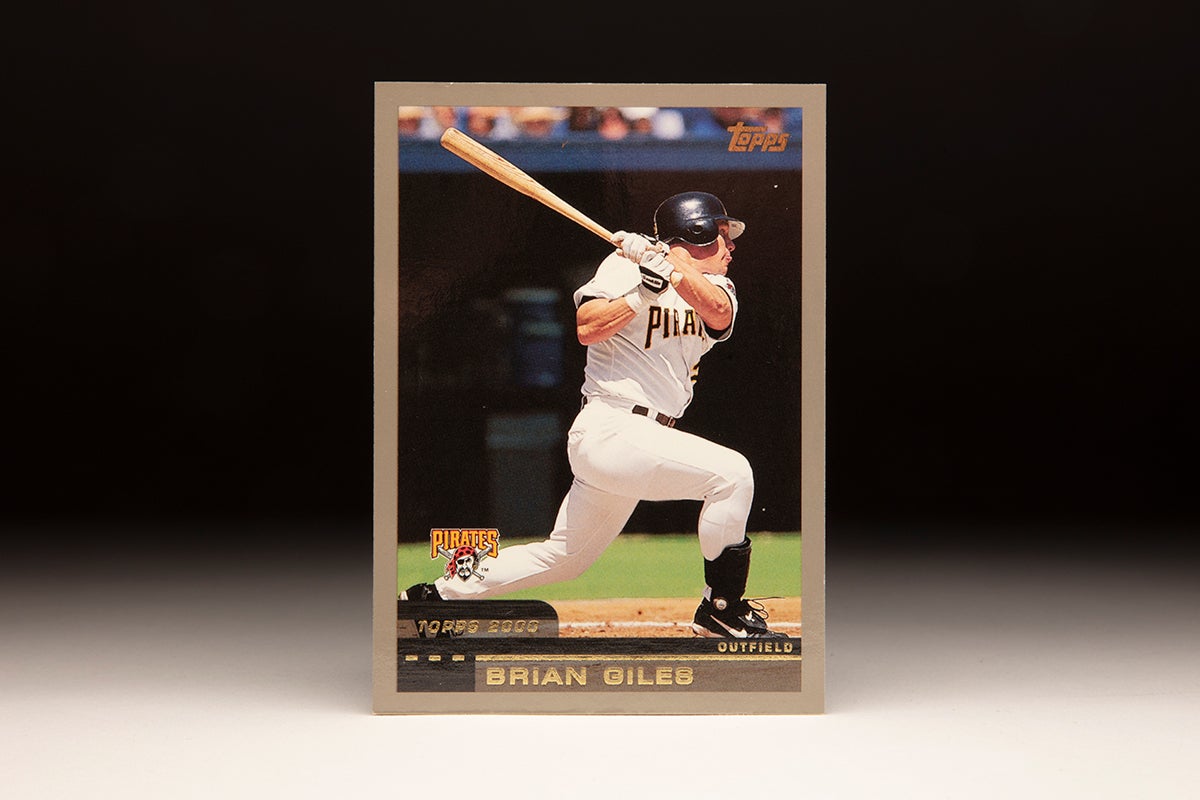
Born Jan. 20, 1971, in El Cajon, Calif., Brian Stephen Giles was one of four children born to Bill and Monica Giles. He grew up immersed in sports, serving as a ballboy for the NBA’s San Diego Clippers when he was in middle school.
At Granite Hills High School, Giles starred in football and baseball. As a sophomore, he was a reserve behind future NFL fullback Tommy Vardell in the Granite Hills backfield and was also Vardell’s teammate in Little League.
As a senior, Giles rushed for 1,694 yards, finishing his career with 35 touchdowns.
“He was smaller but was out there in center field (in Little League) making diving catches,” Vardell told the Pittsburgh Post-Gazette in 1999. “Later, he broke a lot of my records in football. They fed him the rock all the time.”
Giles also established two career-long habits in high school: Weightlifting and fun-loving behavior. He became known for both throughout the game.
“He’s just an idiot. An idiot,” Giles’ younger brother Marcus – who would play seven seasons in the big leagues with Atlanta and San Diego and who idolized his brother – told the Post-Gazette. “His favorite actor is Chevy Chase, and Chevy does some stupid things.”
Giles also became known for his attention to personal grooming, which included shaving his legs. But what really stood out was Giles’ talent, which he was able to demonstrate on a professional level when Cleveland selected him in the 17th round of the 1989 MLB Draft following his high school graduation.
“For as long as I’ve known him, Brian has had a baseball in his hands,” Giles’ uncle, Dan Giles, told the Ramona (Calif.) Sentinel in 1997.
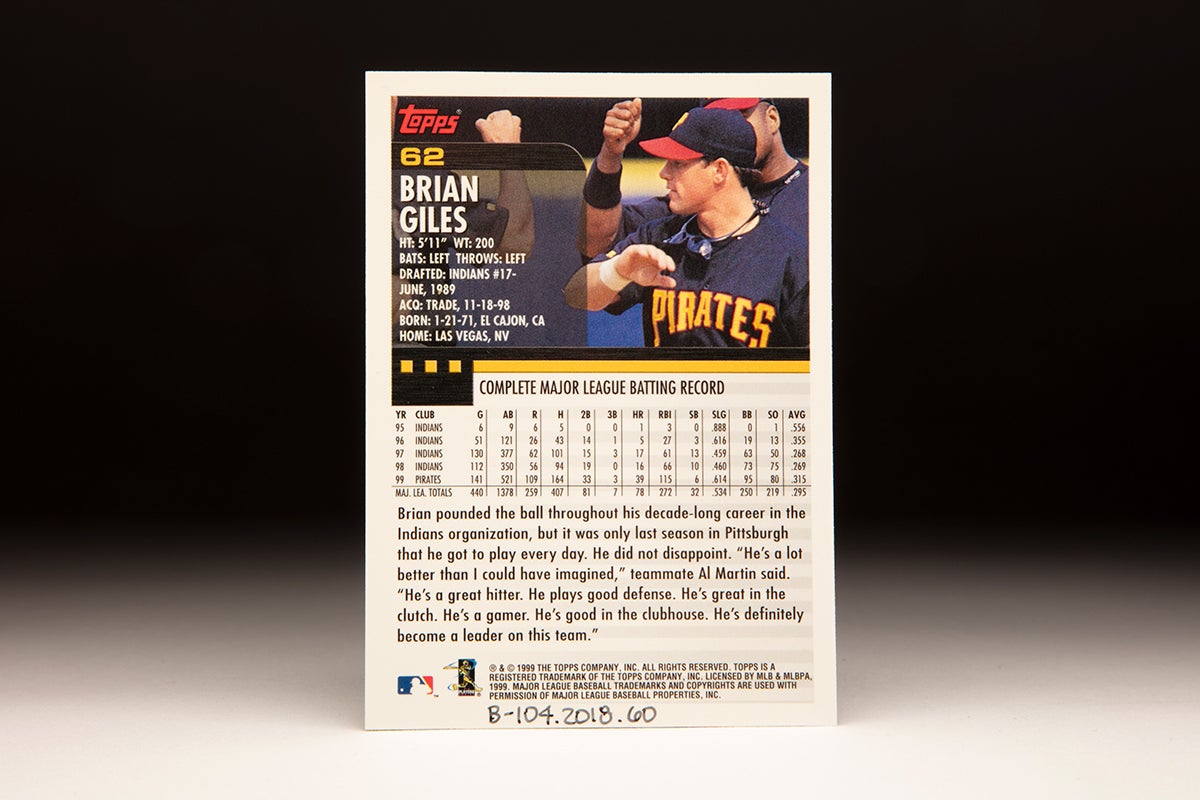
Reporting to Burlington of the Appalachian League, Giles hit .310 in 36 games but had no home runs. He moved up to Class A Watertown of the New York-Penn League in 1990, batting .289 with 15 doubles, two triples and a homer in 70 games while also drawing 48 walks. His plate discipline would produce a .403 on-base percentage – the first of three minor league seasons where Giles would post a .400-or-better OBP.
Giles steadily climbed the ladder in a Cleveland system that was filled with talent as executives Hank Peters and John Hart rebuilt the franchise. Giles hit .310 with four homers, 47 RBI and 68 walks in 125 games for Class A Kinston in 1991, then split the 1992 season between Kinston and Double-A Canton-Akron. A broken hand limited him to 65 games that year, but Giles returned to Canton-Akron in 1993 and resumed his upward trend, batting .327 with eight home runs, 64 RBI, 18 stolen bases and 57 walks to go with a .409 OBP.
“This has been a great year all around for me,” Giles told the Akron (Ohio) Beacon Journal toward the end of the 1993 season. “The thing that’s obviously important is that I’ve put together some very good statistics. That gets me the attention of the organization, something I don’t think I had coming into the year.
“I’m optimistic the Indians have noticed what I’m doing. And I’m confident that good things are going to happen to me next year.”
In 1994, the Indians’ rebuild began to pay off as the team posted its first winning season since 1986 and only its second in 13 years. Giles spent the whole season at Triple-A Charlotte, where he hit .313 with 16 homers, 58 RBI and a .390 OBP. He returned to Triple-A in 1995, this time in Buffalo, where he virtually duplicated his 1994 season with 15 homers, 67 RBI, a .310 batting average and a .395 OBP.
Cleveland called him up to the big leagues in September as the Indians were running away with the AL Central title. Giles got into six games, batting .556 with a homer and three RBI in nine plate appearances.
Though he was not included on the postseason roster, Giles appeared to be part of Cleveland’s future. But the next three seasons would prove challenging.
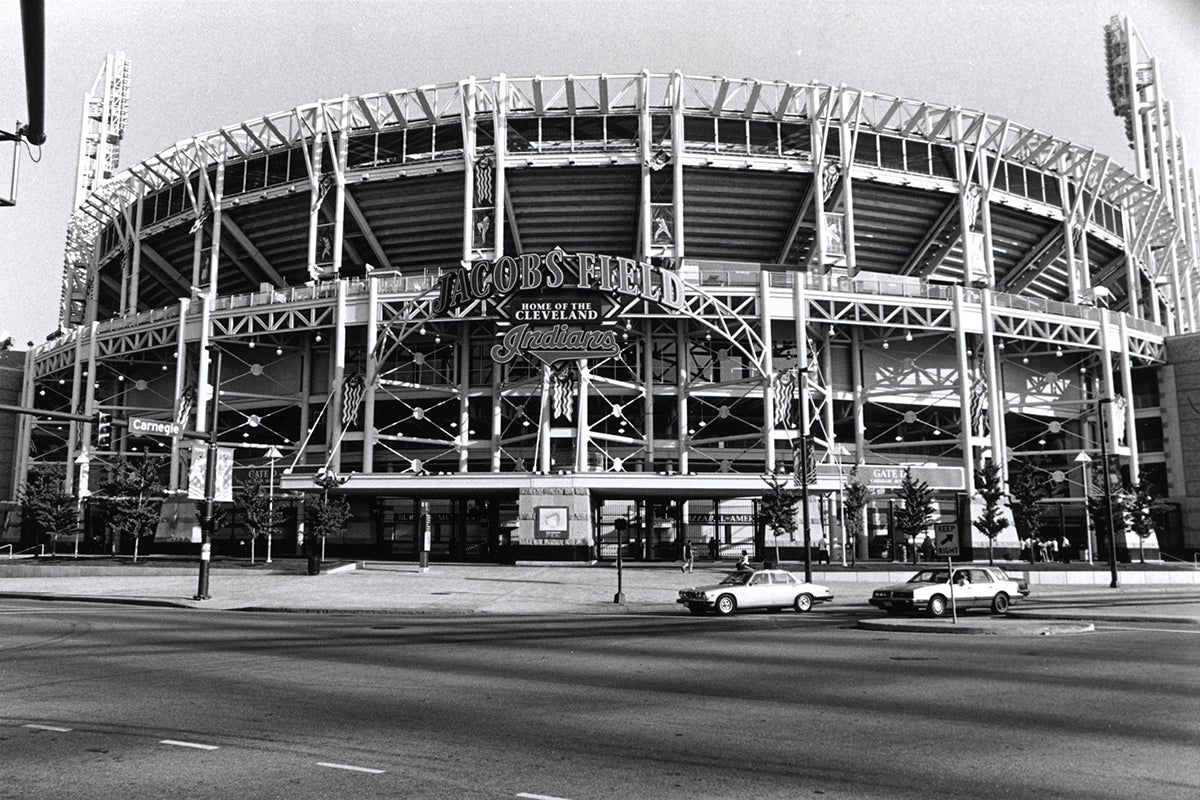
In 1996, Giles began the season with Buffalo and once again torched Triple-A pitching, batting .314 with 20 homers, 64 RBI, 42 walks and only 29 strikeouts in 83 games. He was recalled to Cleveland in July when pitcher Greg Swindell went on the disabled list and blasted a ninth-inning, pinch-hit, two-run home run in his first at-bat on July 12, tying a game vs. the Twins at 5 in a contest the Indians would win 7-5.
By the end of July, Giles was seeing regular at-bats as a DH and finished the year hitting .355 with a .434 OBP, five homers and 27 RBI in 51 games. Cleveland again won the AL Central, and this time Giles was placed on the postseason roster. But Baltimore eliminated the Indians in four games in the ALDS, with Giles coming to bat just once as a pinch-hitter.
Following the season, Indians left fielder Albert Belle signed a record-setting free agent deal with the White Sox, a move that apparently cleared the way for Giles to get more playing time. Giles was slated to platoon with newly signed Kevin Mitchell in left field for Cleveland in 1997, but on March 25, Cleveland sent Kenny Lofton and Alan Embree to the Braves in exchange for Marquis Grissom and David Justice.
Justice was immediately plugged into left field, and Giles went back to the bench.
“That just changed everything,” Giles told the Akron Beacon Journal about the trade. “I went from a guy who was going to play a lot in left field to a guy at the end of the bench.”
Knee and elbow injuries sidelined Justice in the second half of the 1997 season, however, and Giles stepped up in his place. In his final 69 games of the season, Giles totaled 37 RBI, 40 runs scored and 37 walks. Those numbers came despite the acquisition of Bip Roberts on Aug. 30 – a move that created a left field platoon of Roberts and Giles.
Giles finished the year with a .268 batting average, 17 homers, 61 RBI, 13 steals and 63 walks in 130 games. Cleveland advanced to the postseason for the third straight year.
“He’s just a good baseball player,” John Hart, by then the Indians general manager, told the Beacon Journal. “A very good baseball player.”
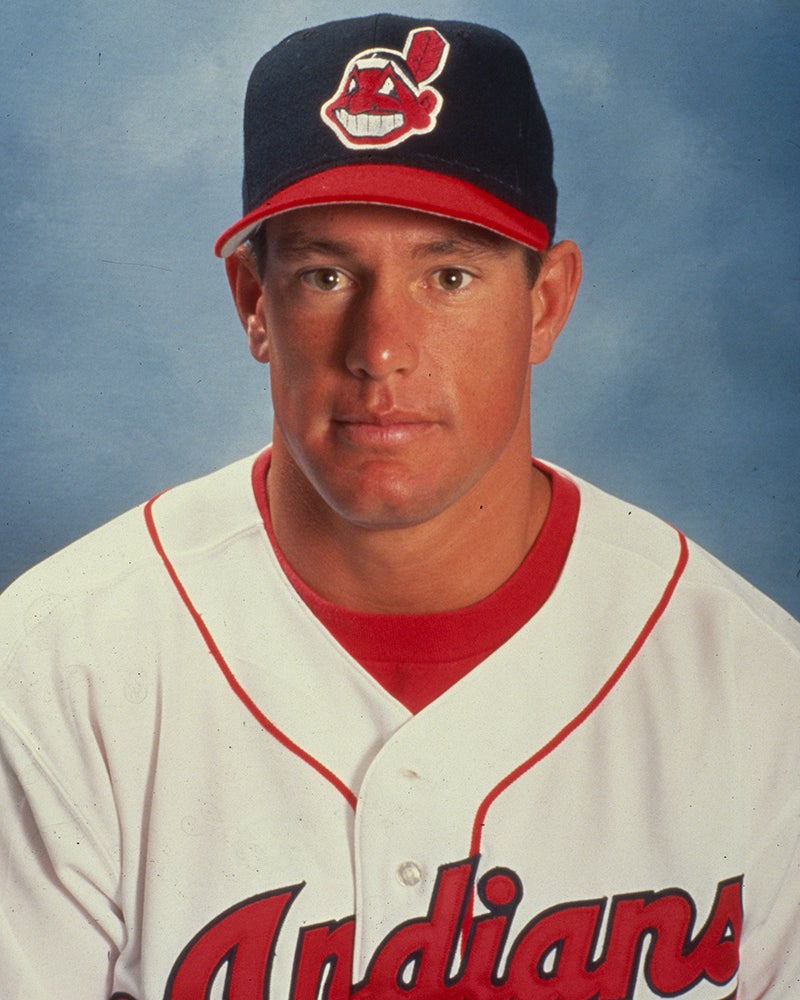
Giles made two starts in left field in the ALDS vs. the Yankees, going 1-for-7 at the plate as Cleveland won the series in five games. He made five more starts in the ALCS vs. Baltimore, batting .188 (3-for-16 with three doubles) with two walks as Cleveland advanced to the World Series.
But in the Fall Classic against the Marlins, Giles was moved to the bench in games in Miami due to the lack of a DH in National League parks. He appeared in five of the seven games but started only once, batting .500 (2-for-4) with four walks as Florida won the championship.
“It was disappointing we came so close and lost,” Giles told the Cleveland Plain Dealer. “But I try to look at the positive side of things. I look back on September and October and those were two months where we played some great baseball. October was awesome. How well we played didn’t dawn on me until I got home.”
Following the 1997 season, Giles looked like he would get regular playing time in ’98 with Justice recovering from injuries to start the year. But the Indians signed Gerónimo Berroa on Jan. 29.
“It’s frustrating, but this is a weird game,” Giles told the Plain Dealer in the spring of 1998. “You just have to be patient. It seems like I say the same quotes every year.
“They said they’re going to get me at-bats this year. I believe them.”
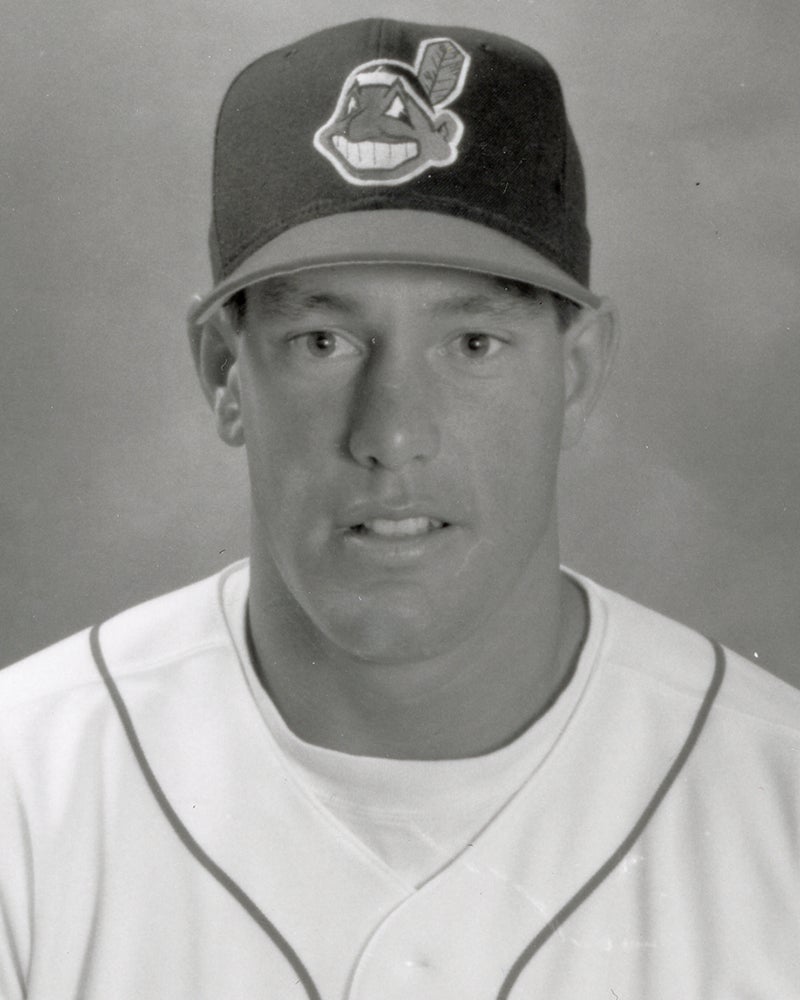
Cleveland even explored the possibility of a multiyear contract with Giles.
“We’ve talked to Brian about a multiyear offer,” Dan O’Dowd, the Indians director of baseball operations, told the Plain Dealer in the spring of 1998. “We’re still in the early stages of negotiations.”
On April 14, the Indians did sign Giles to an extension – locking him in for three years (with a club option for 2002) for about $5.5 million total. Giles’ 1998 season looked much like the 1997 campaign as he finished with a .269 batting average and .396 OBP over 112 games, with 16 homers and 66 RBI. Cleveland won the AL Central for the fourth straight year and defeated Boston in the ALDS before falling to New York in the ALCS. Appearing in seven of Cleveland’s 10 postseason games that year, Giles went 3-for-22 (.136) with two walks.
On Nov. 18, Cleveland traded Giles to the Pirates in a one-for-one deal for reliever Ricardo Rincón, who had pitched effectively for Pittsburgh for two seasons but was 28 years old and had spent the first few years of his career in the Mexican League.
By the end of May 1999, Rincón had pitched in eight games without a win or a save. Giles, meanwhile, had already won a National League Player of the Week Award and would soon become the Pirates’ best player.
“He’s far more than I expected – on and off the field,” Pirates outfielder Al Martin told the Post-Gazette early in the 1999 season. “I knew he was a good hitter, but I didn’t think he’d be the total package that he brought. This guy is a superstar waiting to happen.”
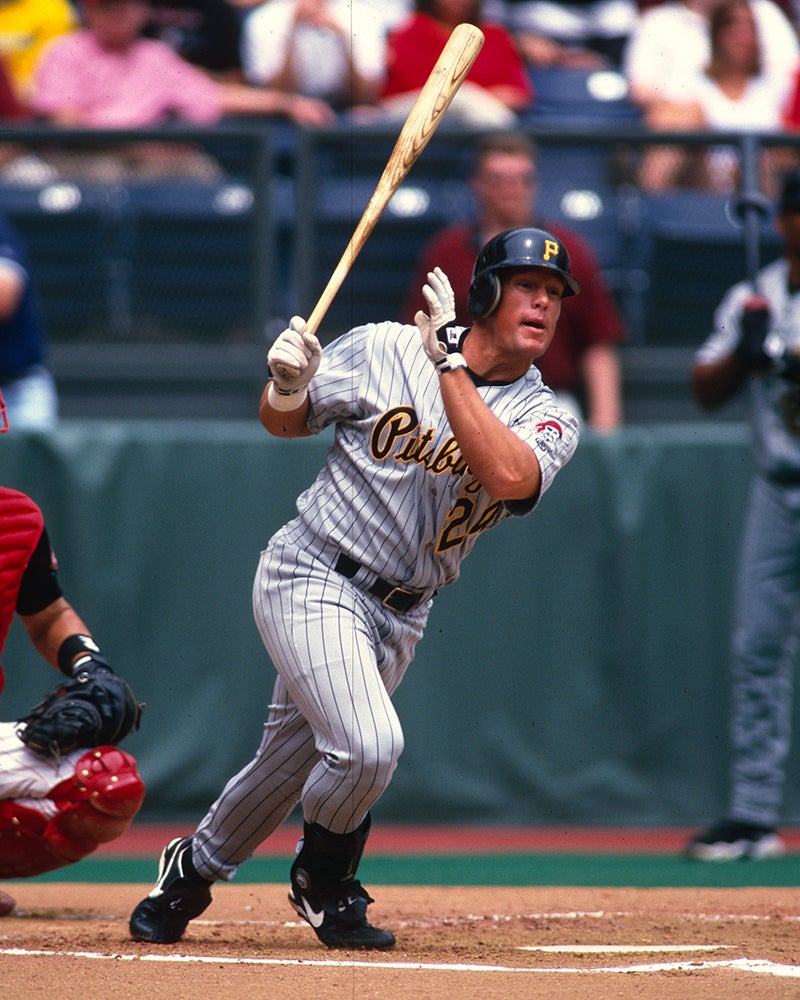
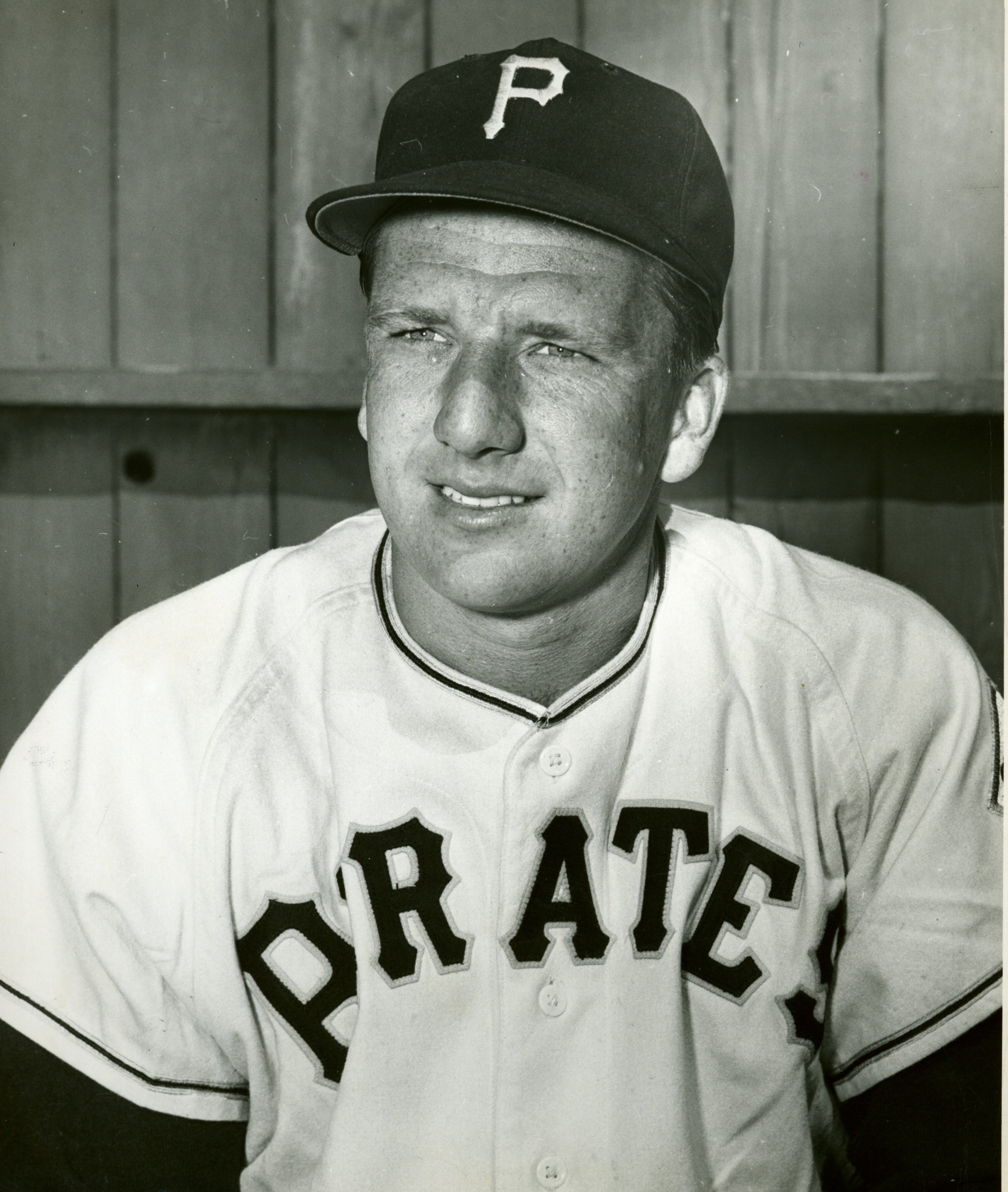
Giles hit .315 in 1999 with 39 home runs, 115 RBI and 95 walks despite missing the final 11 games of the year with a fractured finger. His 39 homers represented the third-best single season total in franchise history at that time, as only Willie Stargell and Ralph Kiner had reached the 40-homer threshold.
He also batted .299 against left-handers, thus forever dismissing the notion that he was a platoon player – and spent most of his time in center field.
On May 19, 2000, Giles signed the biggest contract in Pirates history, agreeing to a five-year extension starting in 2001 that was worth a guaranteed $45 million.
Fifteen years earlier, the Pirates franchise had been purchased for a total of $22 million.
“I always thought I could produce if I played every day, but there are always doubters until you do it,” Giles told the Associated Press after signing the new contract. “I always thought I had the talent to do it.”
The Pirates appeared to be building a core around Giles and young catcher Jason Kendall and won 78 games in 1999. But in 2000, the team went 69-93 despite Giles hitting .315 with 37 doubles, 35 homers, 123 RBI and 114 walks. He was named to his first All-Star Game and finished 19th in the NL Most Valuable Player voting – but Pittsburgh was soon in rebuilding mode again after firing manager Gene Lamont.
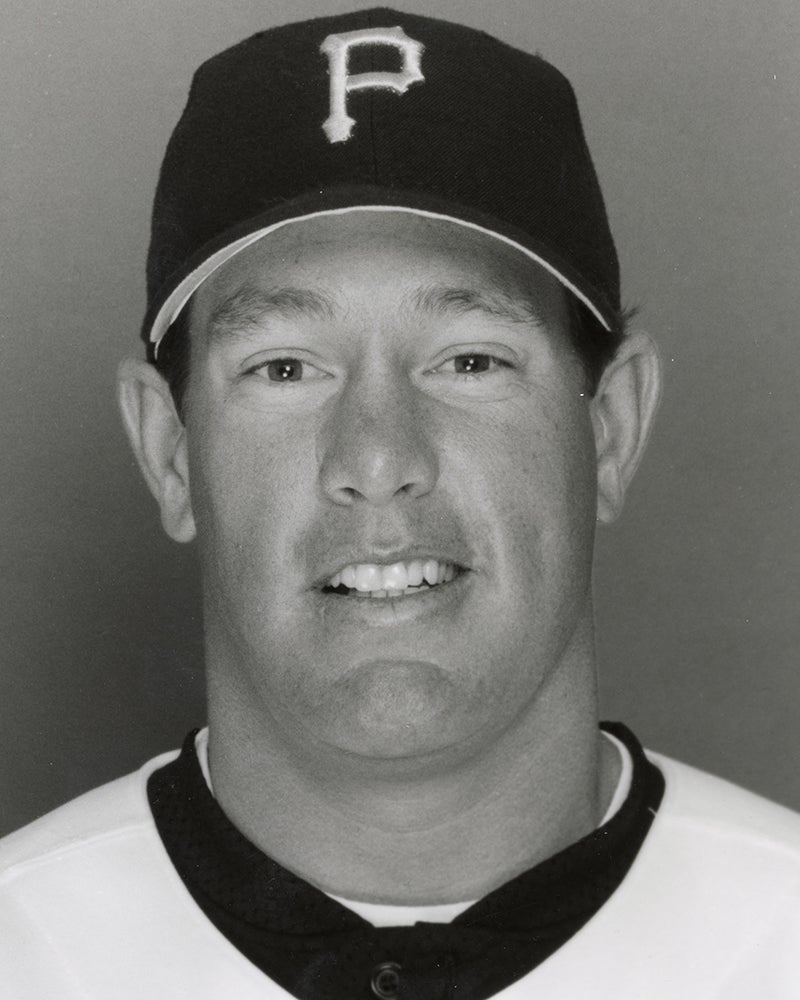
Lloyd McClendon took over in Pittsburgh in 2001 as the Pirates moved from Three Rivers Stadium to PNC Park. Giles moved to left field and continued his terrific numbers at the plate by hitting .309 with 37 doubles, 37 homers and 95 RBI while earning another All-Star Game selection, but the Pirates lost 100 games.
Giles provided one of the most memorable moments of the season, however, when his walk-off grand slam off future Hall of Famer Billy Wagner completed a seven-run rally with two outs and no one on in the bottom of the ninth as Pittsburgh turned an 8-2 deficit into a 9-8 win.
In what was a microcosm of the Pirates’ year, however, the win provided no momentum. It was the first game of a doubleheader, and Pittsburgh lost the nightcap 12-3.
In 2002, the Pirates improved to 72-89 as Giles produced his fourth straight stellar season – hitting .298 with 37 doubles, 38 homers, 103 RBI and 135 walks, two short of the franchise record set by Kiner in 1951 and good for a .450 OBP that ranked behind only Barry Bonds’ .582 mark (at the time the top figure ever and still second all-time behind only Bonds’ .609 mark set in 2004). He also finished what was then a career-best 13th in the league MVP voting. But it was becoming clear that Pittsburgh was not going to win with this core of players, and rumors abounded that Giles would soon be traded.
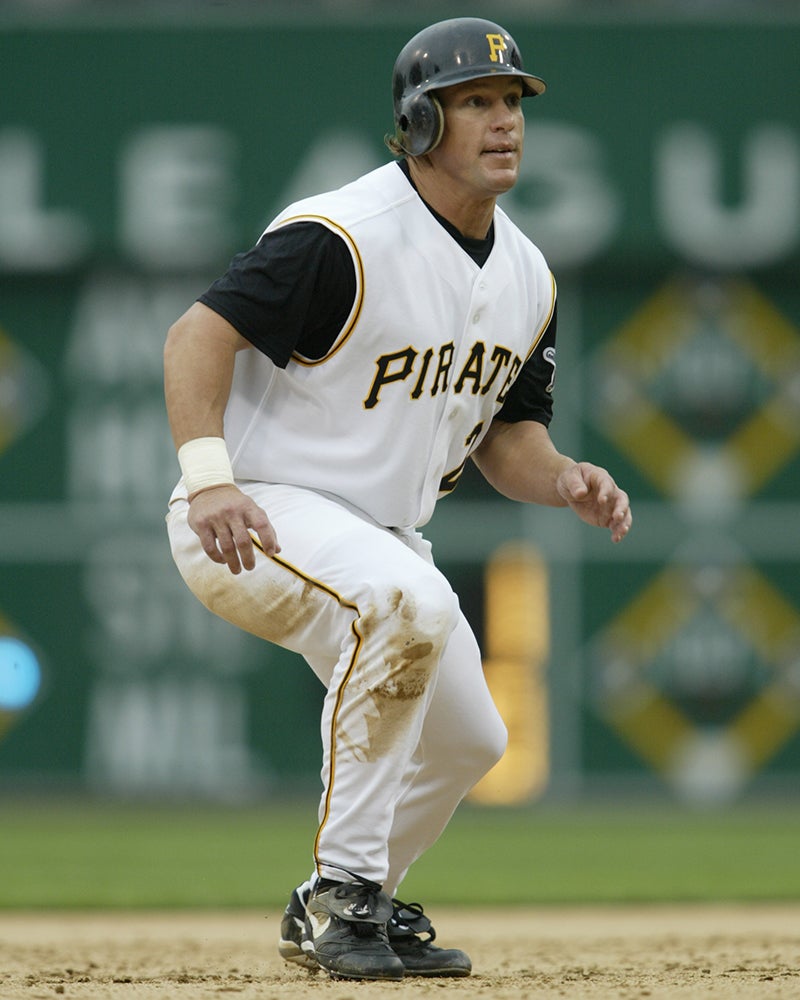
On Aug. 26, 2003 – with Giles hitting .299 with 16 homers, 70 RBI and 85 walks in 105 games – the Pirates sent their All-Star outfielder to the Padres in exchange for Jason Bay, Óliver Pérez and a minor leaguer.
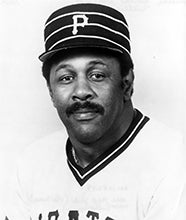
“He’s in a special category,” Pirates general manager Dave Littlefield told the Post-Gazette about Giles, who ranked sixth on the Pirates all-time home run list with 165 – behind Stargell, Kiner, Roberto Clemente, Barry Bonds and Dave Parker – at the time of the trade. “There’s no doubt you hate to trade players like that. As we’ve said many times, we’re looking to acquire players like that. But with the reality of where we’re at, we just felt this was a guy who was going to enable us to acquire more talent, and that was the decision we made.
“Brian is a cornerstone of the franchise. Although we hate to give up Brian, we think the players we’re getting in return are going to be solid and possibly high-end big leaguers as well.”
Giles was happy to be going home to San Diego but was clearly troubled that he could not bring a winner to Pittsburgh, where he was part of a five-season stretch of losing seasons that stretched to a record 20 before the Pirates got back over .500 in 2013.
“I signed a contract to try to bring a championship here to Pittsburgh,” Giles told the Post-Gazette. “It just didn’t work out for a lot of different reasons. I think that’s the most disappointing thing. I really did want to get it done here in Pittsburgh.”
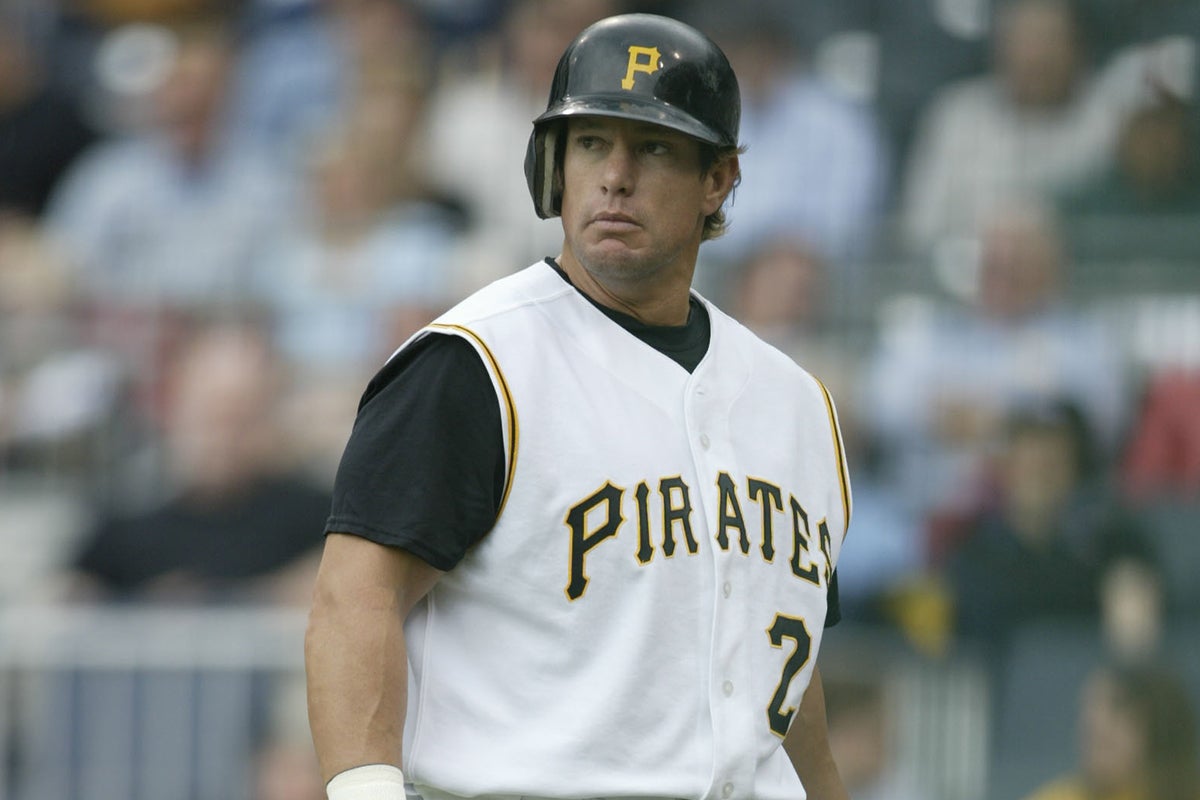
Giles finished the 2003 season batting .299 with 34 doubles, 20 homers, 88 RBI and 105 walks. He moved to right field and put up similar numbers in 2004 with 33 doubles, 23 homers, 94 RBI and 89 walks as the Padres welcomed more than three million fans to brand new Petco Park.
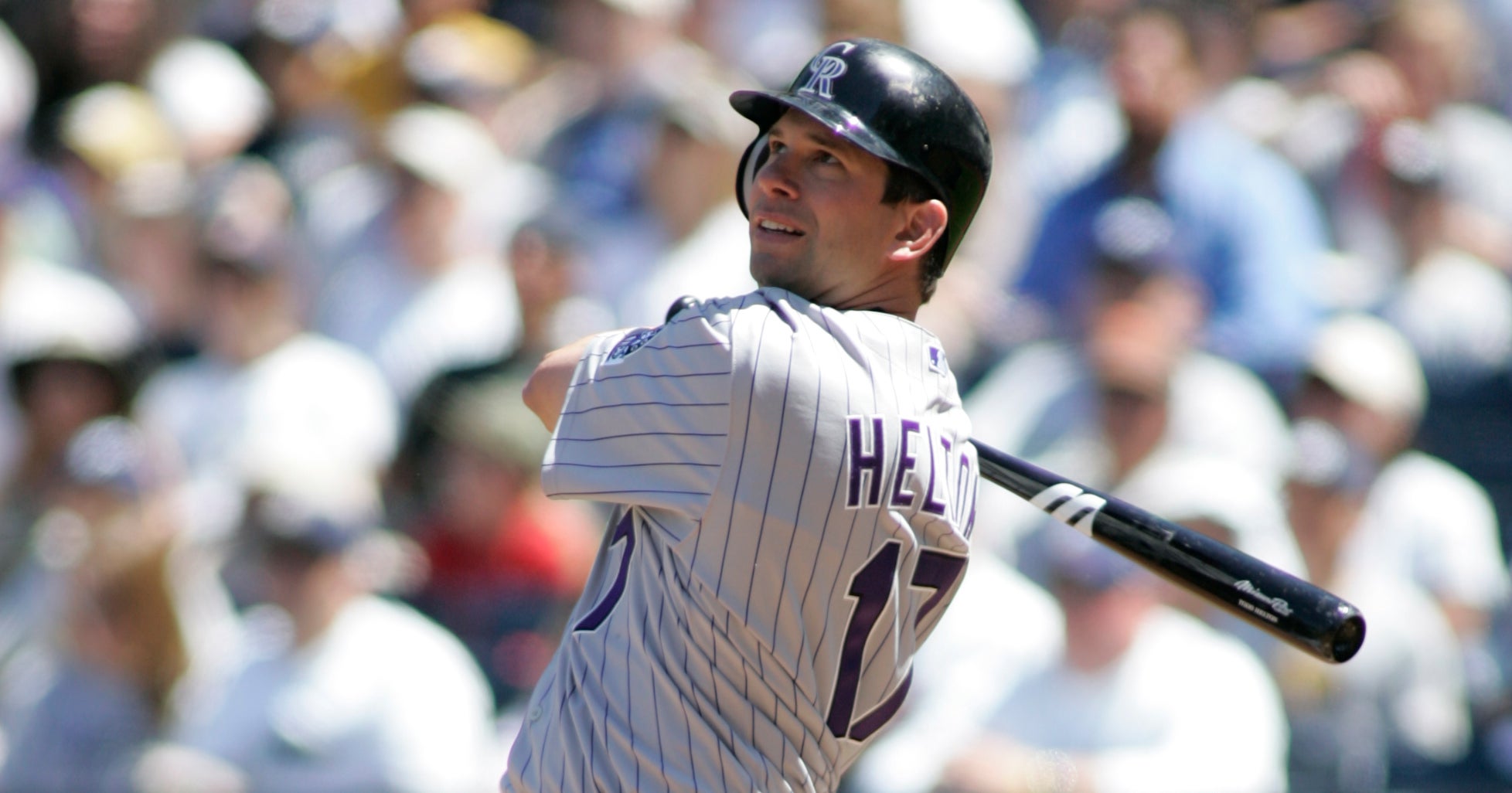
Then in 2005, Giles’ power numbers began to erode but he still kept his batting eye, hitting .301 with 38 doubles, 15 homers, 83 RBI and an MLB-best 119 walks, producing a .423 OBP that ranked third in the NL behind Todd Helton and Albert Pujols. The Padres finished 82-80 and won the NL West, sending Giles back to the postseason for the first time since 1998. He batted .231 (3-for-13) with a walk as the Cardinals swept San Diego in the NLDS.
With his contract expiring, Giles became a free agent and rejected the Padres’ initial offer before re-signing with San Diego for three years and $30 million with a club option for 2009.
“Brian Giles is a key reason why the San Diego Padres won the National League West in 2005, so I’m delighted we’re able to bring back a player of his caliber,” Padres chief executive officer Sandy Alderson told the AP. “I strongly believe that Brian is a significant element to what we are trying to accomplish.”
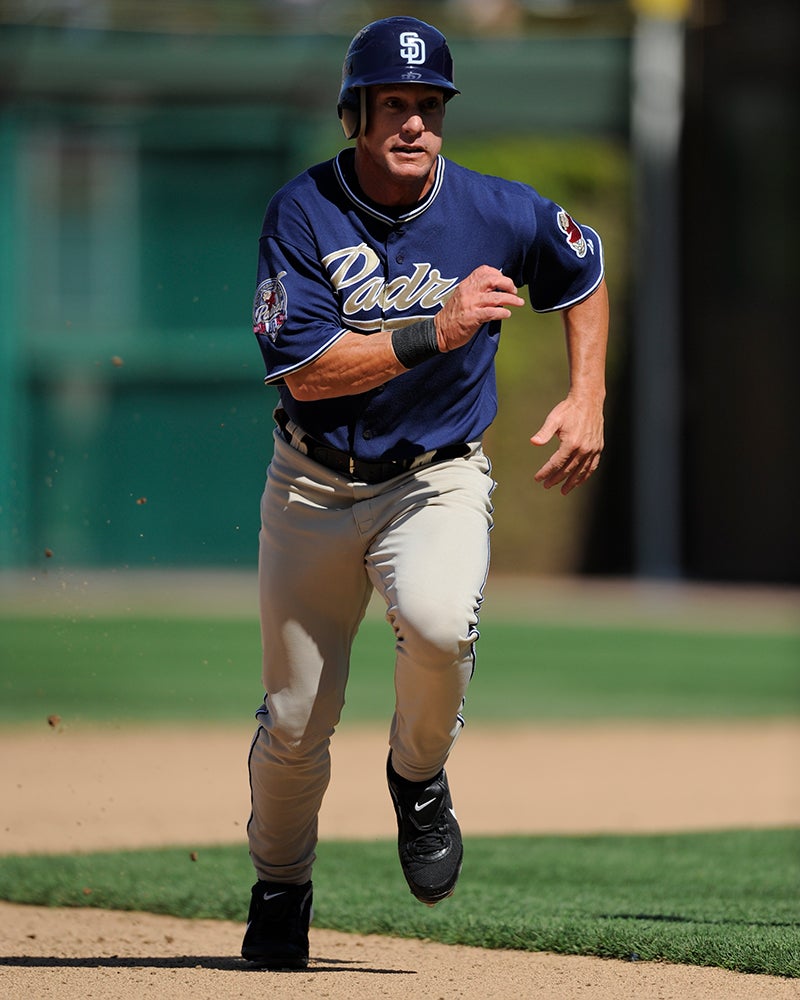
Giles appeared in 158 games in 2006, the sixth time in seven seasons he played in 153-or-more games. He batted .263 with 37 doubles, 14 homers, 83 RBI and 104 walks as the Padres once again won the NL West before once again losing to St. Louis in the NLDS.
Giles’ brother Marcus joined the Padres in 2007, giving the siblings the chance to play together in front of their hometown fans.
“You always dream about playing in your hometown,” Brian Giles told the AP that spring. “Then you get your little brother over there with you; it’s pretty exciting.”
The brothers worked overtime to keep the Padres’ clubhouse loose.
“Marcus is a knockoff,” Padres pitcher Jake Peavy told the AP. “It’s going to be Brian times two. It’s going to be a treat.”
But Brian’s power numbers kept declining, and he was limited to just 121 games in 2007 while batting .271 with 13 homers and 51 RBI. Marcus, meanwhile, hit .229 in 116 games in what would be his final big league season. The Padres failed to make the playoffs for the first time since 2004.
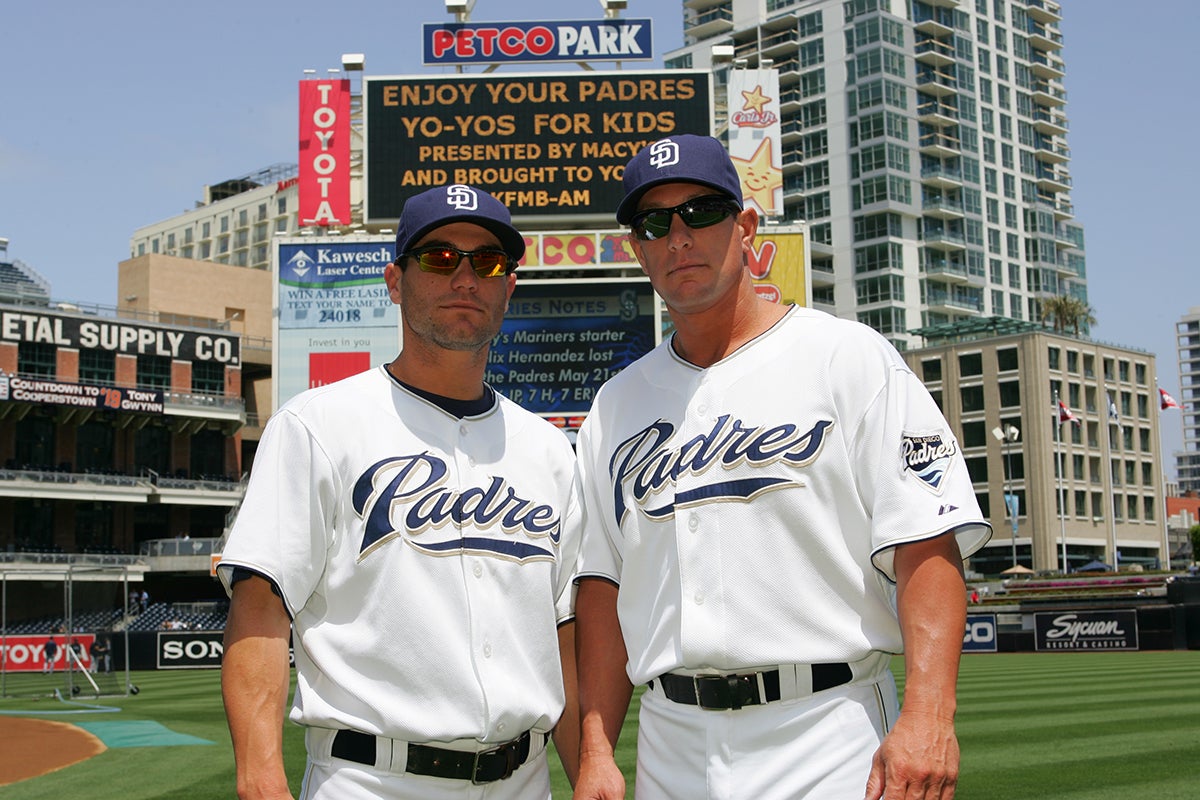
Brian bounced back in 2008 in his age-37 season, hitting .306 with 40 doubles, 12 homers, 63 RBI and 87 walks in 147 games. But after four straight winning seasons, the Padres lost 99 games that year.
San Diego picked up the option on Giles’ contract for 2009 but a chronic right knee problem sidelined Giles for much of the year. He hit .191 with two homers and 23 RBI in 61 games and finished with a -1.9 Wins Above Replacement mark, the first time in 15 MLB seasons he had a negative WAR.
A free agent once again, Giles signed with the Dodgers on Feb. 9, 2010. But a month later, Giles could no longer tolerate the pain in his right knee and announced his retirement.
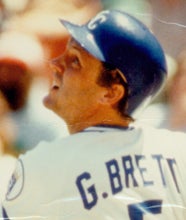
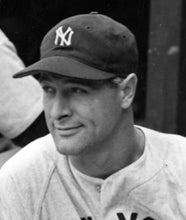
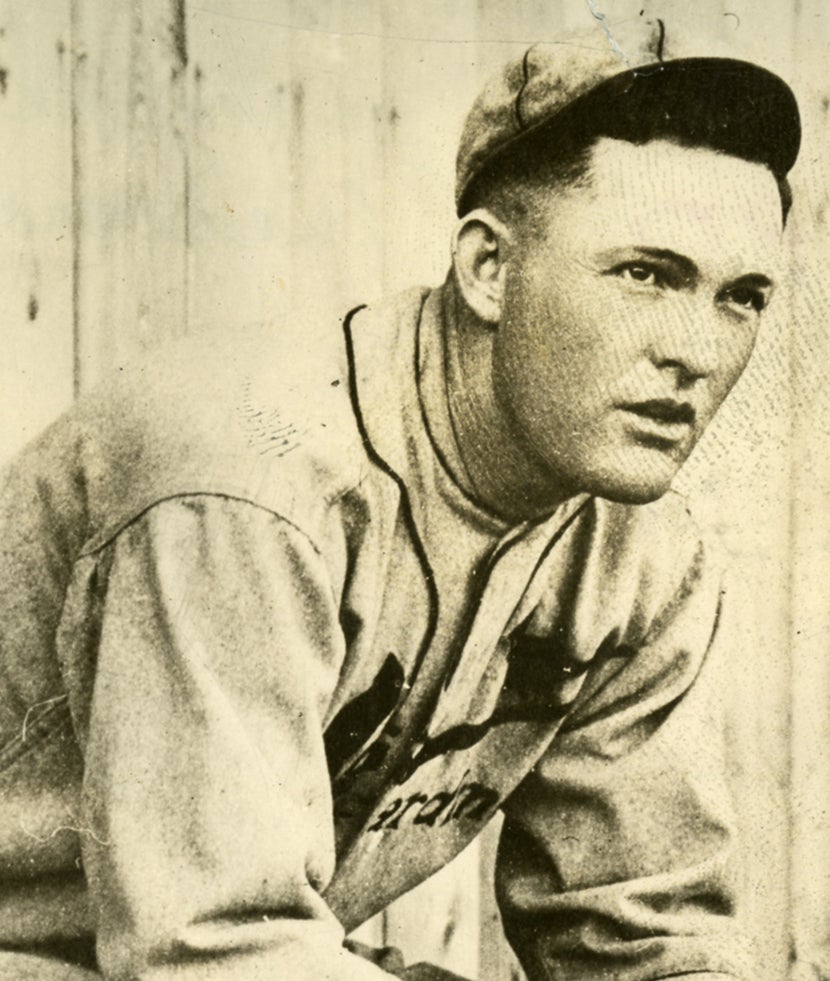
Over 15 seasons, Giles hit .291 with a .400 OBP, 1,897 hits, 411 doubles, 287 homers, 1,078 RBI, 1,183 walks and 109 steals. He remains one of only four players in history with at least 1,000 walks, fewer than 1,000 strikeouts, at least 275 home runs and at least 100 stolen bases. The other three are Hall of Famers George Brett, Lou Gehrig and Rogers Hornsby.
Giles accomplished it all going at the only speed he knew.
“Brian Giles is going to play full throttle on offense and defense and on the bases no matter what team he plays for,” Brian Graham, who managed Giles in the minor leagues and later was a front office executive with the Pirates, told the Post-Gazette in 1999. “That’s his personality, his nature.”
Craig Muder is the director of communications for the National Baseball Hall of Fame and Museum