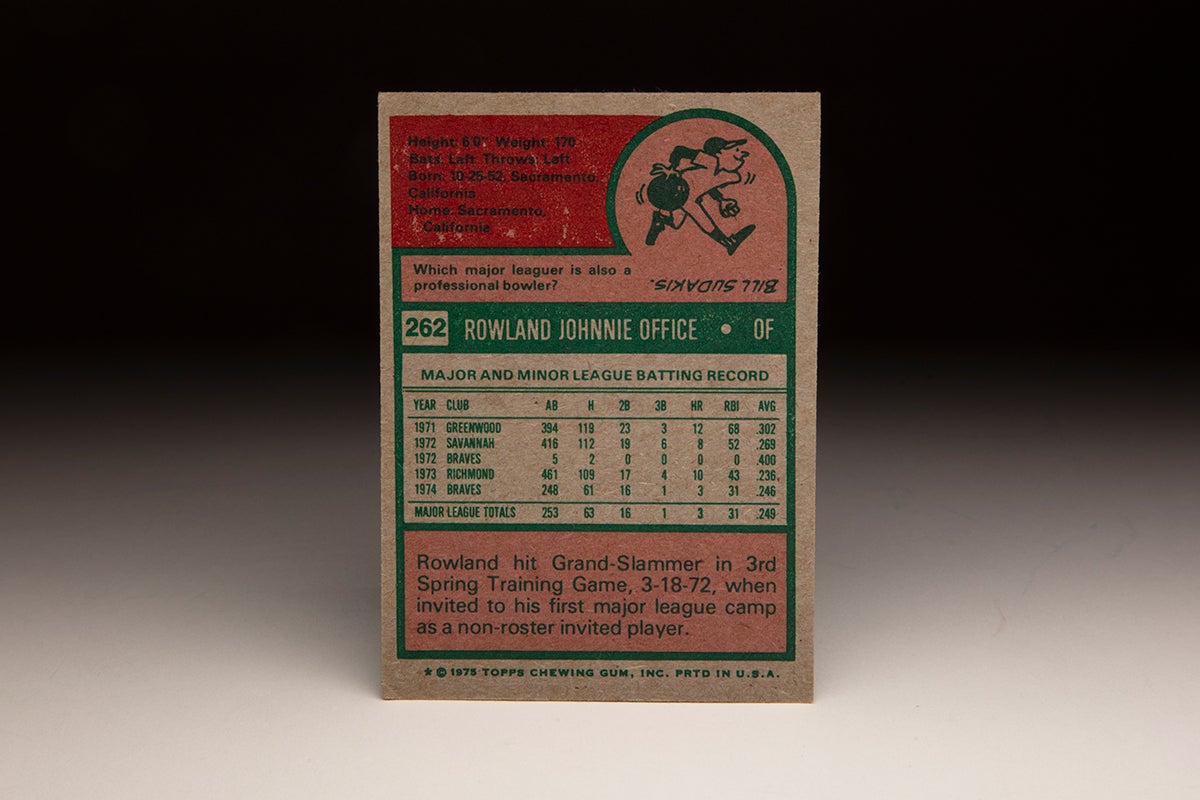
#CardCorner: 1975 Topps Rowland Office
Since the big league mound height was lowered in 1969, 26 players have totaled hit streaks of at least 30 games.
Just missing that list was Rowland Office, whose 29-game streak in 1976 provided the pinnacle of his 11 years in the major leagues.
Born Oct. 25, 1952, in Sacramento, Calif., Rowland Johnie Office starred for McClatchy High School and in American Legion baseball. As a senior in 1970, Office hit .512 while going 7-1 on the mound – earning a berth in the North-South All-Star Game at Anaheim Stadium.
The Braves selected Office in the fourth round of the 1970 MLB Draft. But since Office did not turn 18 until that fall, the Braves opted to begin his pro career in 1971 at Class A Greenwood of the Western Carolinas League. The Greenwood Braves won the league title that year, and Office was named to the All-Star team as the center fielder after hitting .302 with 23 doubles, three triples, 12 homers, 68 RBI and 43 walks in 117 games.
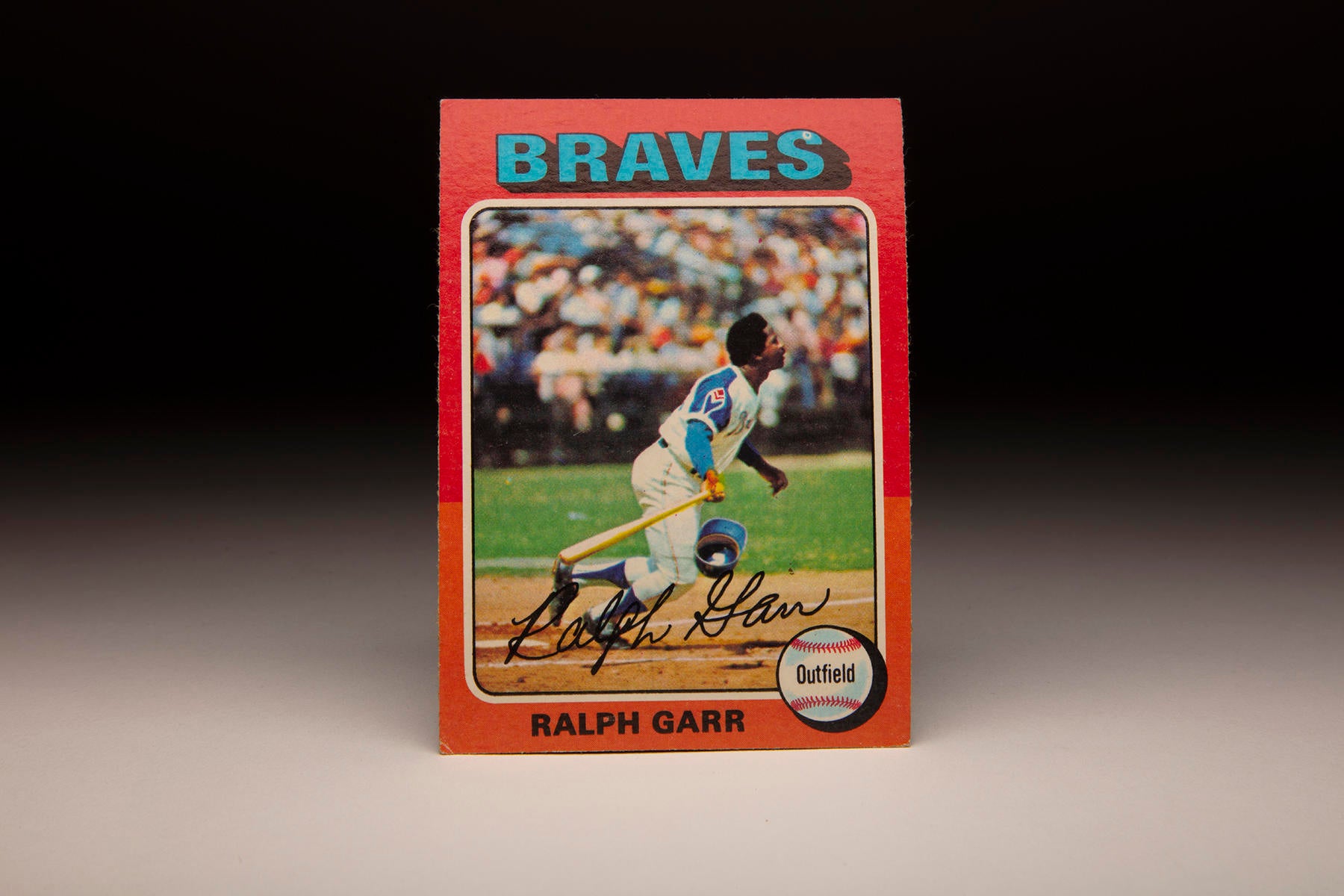
In 1972, the Braves brought Office to their big league Spring Training camp, where he and Ralph Garr were considered the fastest players in the organization.
“I never had time to race (Garr) in the spring,” Office told the Atlanta Constitution after being sent to Savannah of the Southern League that year. “I was too busy trying to stay with the big club.”
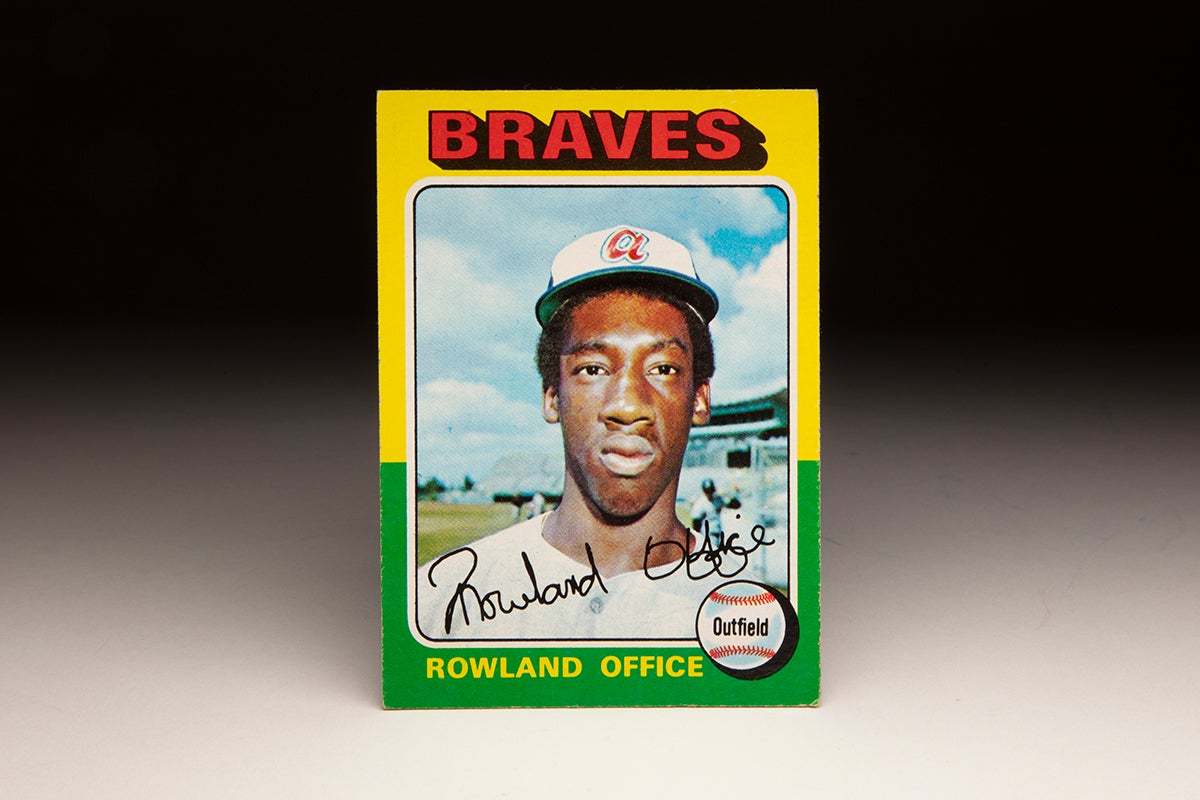
Office had little trouble adjusting to Double-A pitching, batting .269 with 19 doubles, six triples, eight homers and 52 RBI in 128 games. He was widely viewed as a future star.
“Rowland Office is going to play somewhere in (the Braves) outfield,” Savannah manager Clint Courtney told the Constitution. “And mark my word: It’ll be within the next two years, too. He’s close right now.
“And there’s no way, short of the darndest disaster you ever heard tell, (that) Rowland’s not gonna make it real big with the Braves.”
The Braves brought Office to the big leagues for two games in August, and he recorded his first hit off the Reds’ Wayne Simpson in his second game.
“I don’t mean this to sound too cocky, but I think all I need is just a little more experience,” Office told the Constitution.
Office spent the entire 1973 season at Triple-A Richmond, hitting .236 with 17 doubles, four triples, 10 home runs and 14 stolen bases in 139 games.
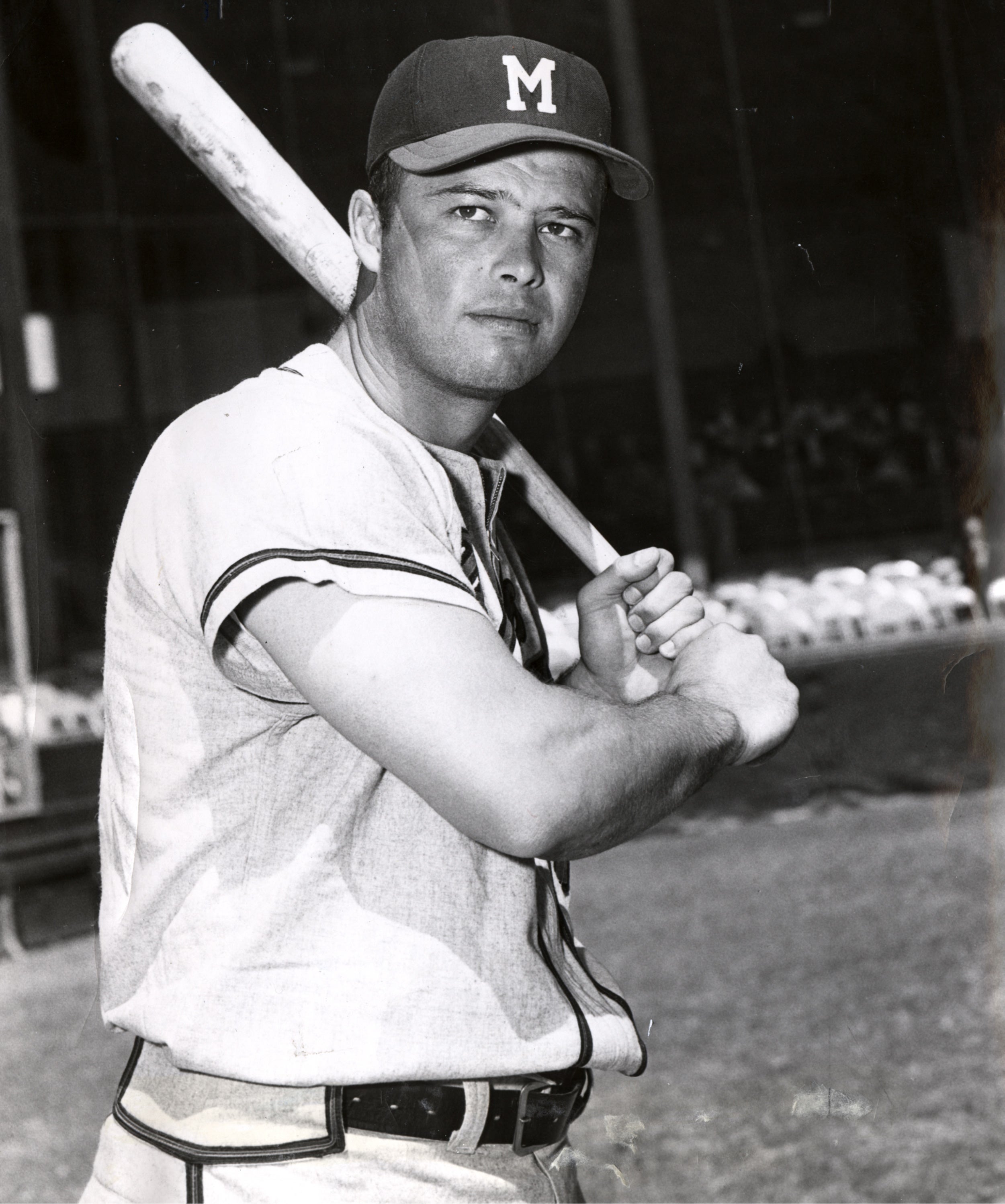
Then in 1974, Office had a front row seat for history. Braves manager Eddie Mathews named Office to the Opening Day roster as a reserve outfielder – a role that would see him enter games as a defensive replacement in center field. The Braves’ regular center fielder, Dusty Baker, would move to right field late in games, with right fielder Ralph Garr moving to left.
Starting those games in left field would be Hank Aaron, who was chasing Babe Ruth’s all-time home run record and would often leave games in the late innings. Office would take over in center field at that point.
“Sure, we all want to play every day,” Office told the Sacramento Bee. “But our outfield is tough to break into. I know my turn will come.”
On April 8, it was Aaron’s turn to make history. He homered off the Dodgers’ Al Downing in the fourth inning that night, the 715th long ball of his Braves career. With the home run record now his, Aaron had two more plate appearances that night before leaving the game after the seventh inning. Office took over in center and in Aaron’s spot in the batting order. But he did not come to the plate in a game Atlanta won 7-4.
“Office does everything real fine,” Donald Davidson, assistant to Braves board chairman Bill Bartholomay, told the Bee. “He is one of the best outfielders on our club and has unlimited potential. He is young but rapidly learning more and more each day.”
Office appeared in 131 games in 1974 but came to the plate just 268 times. He batted .246 with 16 doubles, a triple and three home runs in a year when he did not turn 22 until after the end of the season.
Eight days after his birthday, the Braves traded Aaron to the Milwaukee Brewers. Office was expected to be Aaron’s replacement in the lineup and move into center field permanently.
“I think I can play regularly,” Office told the Constitution after going 7-for-15 in the Braves’ first five Spring Training games in 1975. “But I know I have to prove it.”
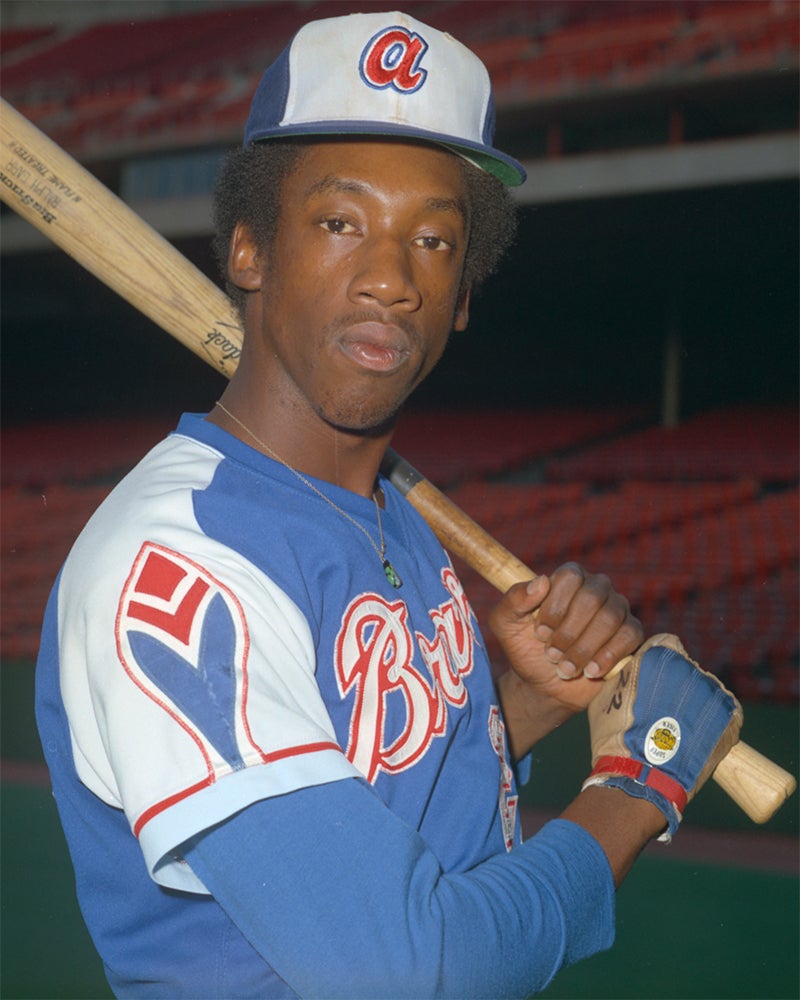
On Opening Day in 1975, new Atlanta manager Clyde King had Office playing center field and batting sixth against the Astros. But with Office hitting in the .260 range in late April, King tried to inject more offense into the lineup by moving Mike Lum to center field. The experiment lasted for about six weeks before Office returned to center, and he finished the year batting .290 for a Braves team that hit just .244 for the season.
Defensively, however, Office was charged with eight errors after leading all National League center fielders with a .994 fielding percentage the year before. Ironically, it was Office’s defense that gained him the most notice that year after he scaled the Atlanta Stadium fence to take a home run away from San Diego’s Mike Ivie on July 26.
Office summersaulted over the barrier and landed on his back, forcing him from the game but drawing praise from teammates and the media.
In 1976, the Braves opened the season with their fourth manager in three years and had traded Baker and Garr following the 1975 campaign. Dave Bristol had Office in the Opening Day lineup in center field and stuck with him despite Office’s .194 batting average through May 20. Office responded with a three-hit game the next day, and on May 23 he had four hits in a doubleheader against the Giants.
It would be the start of a 29-game hitting streak that featured seven games where he had at least three hits – a stretch that pushed his batting average to .311.
“I was trying to pull everything and wasn’t keeping my eye on the ball,” Office told United Press International when his hit streak reached 26 games. “(Braves coach) Eddie Haas talked to me about it…(and) told me just to meet the ball, to quit trying to pull it, and I listened.
“I’m just trying to keep the streak going. I won’t be all that upset when it comes to an end.”
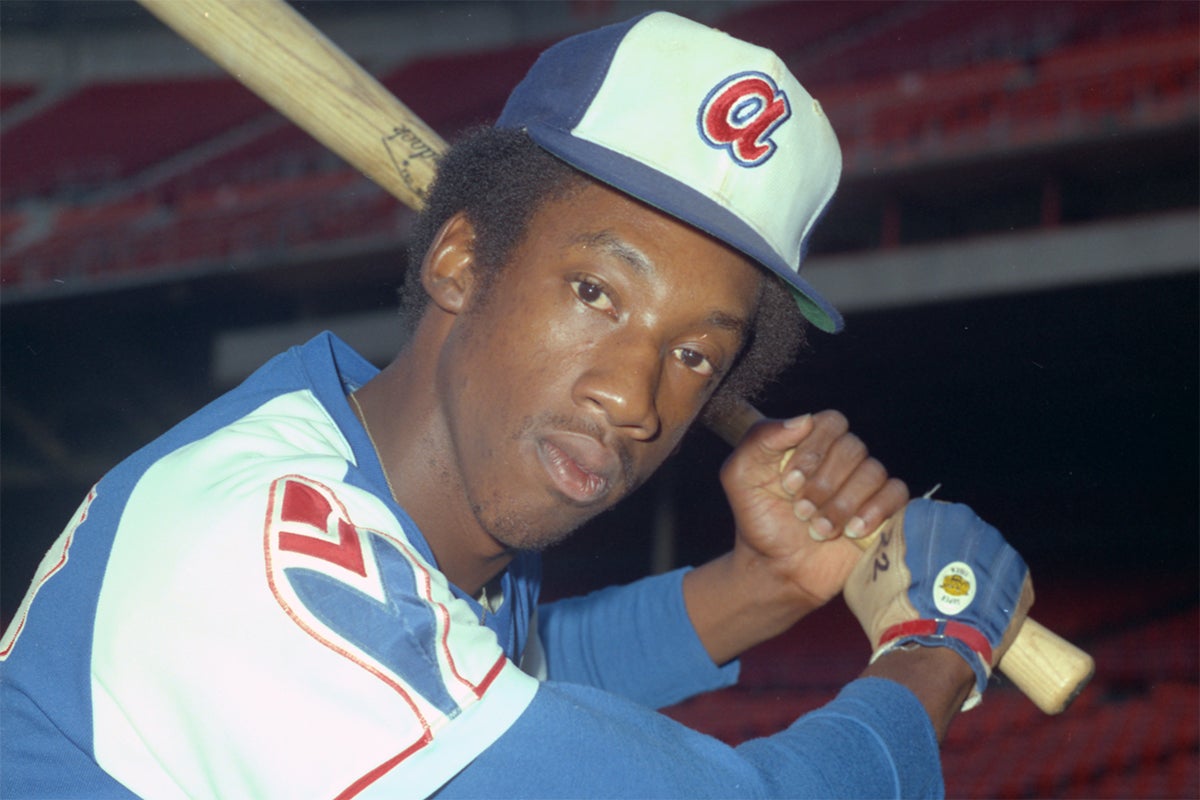
When Office was held hitless in four plate appearances against the Expos on June 24, he had come within two games of the Atlanta Braves record for consecutive games with a hit – 31 – set by Rico Carty in 1970. Office hit .408 during his streak with 10 doubles and 23 runs scored.
But 23 days after the streak ended, Office injured his knee while making a diving catch in Pittsburgh. He played in only 17 more games that season, finishing the year batting .281 with 51 runs scored, 17 doubles, four homers and 34 RBI in 99 games.
With hopes running high for a young Braves team in 1977, Office again started in center field on Opening Day. But in May, Office began experiencing pain in his left shoulder.
“I went to several doctors and they diagnosed it as a torn muscle,” Office told the Sacramento Union. “But I couldn’t recall one single play where it could have happened. It just seemed to come out of nowhere. Finally, they figured it was a blood clot lodged in my shoulder and that really spoiled my season. I began the year very well and then they had to cut me open and that was that.”
Atlanta finished the year 61-101 – aggravating owner Ted Turner enough to prompt him to take over the managerial reins for a game before the league interceded. Office batted .241 with 13 doubles, five homers and 39 RBI in what turned out to be the most at-bats (428) of any season of his career. His -2.6 Wins Above Replacement figure was the second worst in all of baseball behind only teammate Jerry Royster’s -4.0. Incredibly, another Braves player – Pat Rockett – had a WAR of -2.5, making the 1977 Braves the only team in history with three such players.
In the Modern Era (post 1900), only the 1914 St. Louis Terriers of the Federal League had as many as two position players with a WAR of -2.5 or worse.
No offense in history has compiled a worse WAR than the Braves’ -10.0 in 1977.
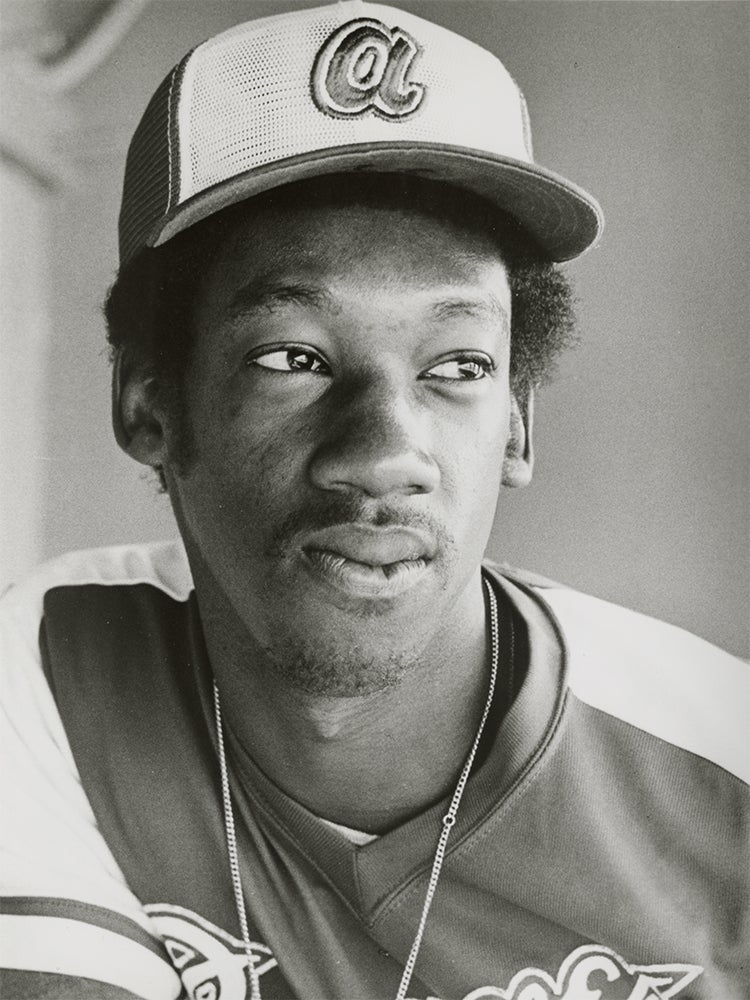
Unsurprisingly, changes were implemented in 1978 – the most meaningful being the hiring of 36-year-old Bobby Cox as Atlanta’s manager. The Braves improved by eight wins that year with a young lineup featuring Bob Horner and Dale Murphy as Office made his fourth straight Opening Day start in center field.
“Bobby is an easy guy to talk to and with a young team, that’s important,” Office told the Sacramento Union about the Braves new manager in 1978. “Maybe that’s because he’s so young himself.”
Office played in what would be a career-high 146 games that year, platooning in center field with right-handed hitting Barry Bonnell. Office hit .250 with nine home runs and 40 RBI, but when Bonnell hit well in Spring Training in 1979, the Braves made him their Opening Day center fielder.
Trade rumors surrounded Office all spring, with potential deals having him headed to Baltimore and Montreal. But the transactions did not pan out, and when Bonnell began to slump in late April, Office returned to his platoon role.
“All I needed was a chance,” Office told the Macon (Ga.) News. “It’s hard to play with all this going around. It’s hard to work when you read every day that you’re going to the Orioles or someplace.”
Office finished the 1979 season batting .249 with 14 doubles, two home runs and 37 RBI in 124 games, playing out his option to become a free agent. He was selected by nine teams in the re-entry draft, including the World Champion Pittsburgh Pirates. But Office chose to sign with Pittsburgh’s division rival Montreal, agreeing to a three-year deal worth a reported $600,000 on Dec. 6.
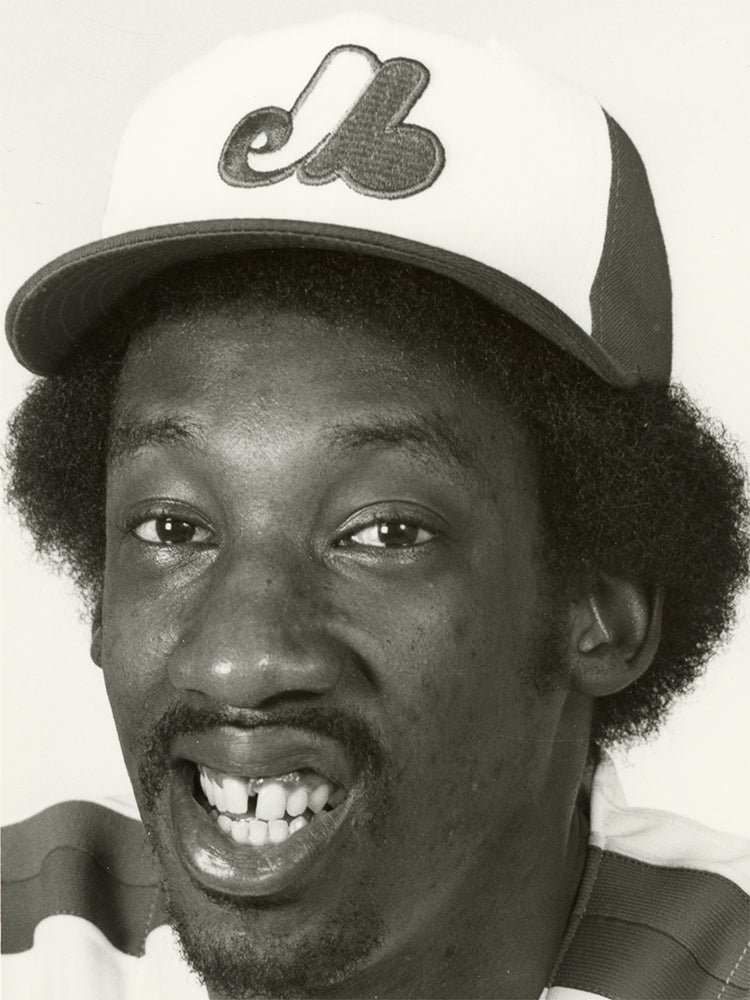
Office was expected to back up all three outfield positions – manned by young stars Warren Cromartie (left field), Andre Dawson (center field) and Ellis Valentine (right field). He was also signed as insurance in case the Expos were unable to trade for a first baseman.
But when the Expos traded for outfielder Ron LeFlore, the team shifted Cromartie to first base. Meanwhile, the Expos were counting on Office to provide motivation for their three fleet outfielders.
“There’s a message there,” Expos general manager John McHale told the Montreal Gazette about Office’s ability to push for playing time.
Whether it was Office’s presence or some other motivation, both Dawson and LeFlore had outstanding seasons in 1980 – with Dawson hitting .308 and LeFlore stealing an NL-best 97 bases. Valentine also performed well (.315 with 13 homers and 67 RBI) but was limited to 86 games due to hip and wrist injuries.
Office, meanwhile, hit .267 with 13 doubles, six home runs and 30 RBI in 116 games. The Expos led the NL East for much of the season before being eliminated by the Phillies in the next-to-the last game – a contest where Office started in right field, hit third in manager Dick Williams’ lineup and went 1-for-5. Office had a chance to win the game for the Expos in the bottom of the 10th but grounded out to first base with Jerry White on second with one out.
Mike Schmidt’s home run in the 11th gave the Phillies the runs they needed for the division title.
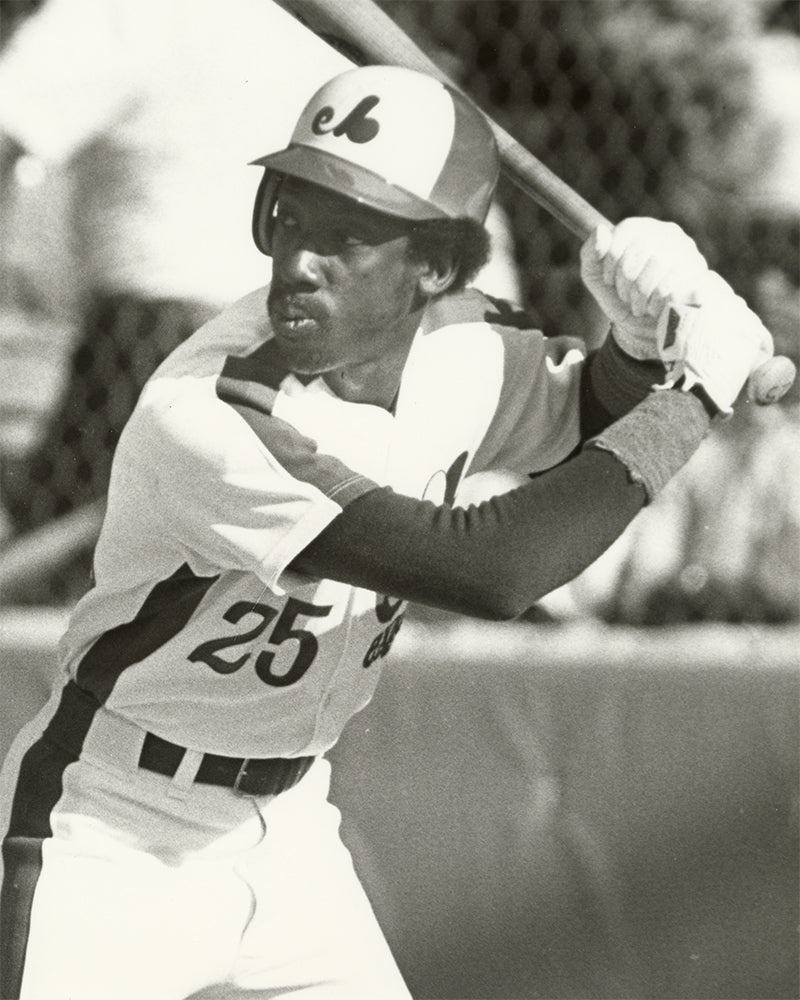
With expectations soaring in 1981, Montreal got off to a 12-3 start as rookie Tim Raines took over in left field. Office, who had clashed with Williams, was serving in a bench role when he was struck by a throw from Valentine while standing near the batting cage during pregame warmups. The ball fractured Office’s left ankle, which sidelined him into the work stoppage that lasted until late July.
Office returned in September and saw regular action down the stretch as Montreal advanced to the postseason by winning the second-half NL East title. For the season, he appeared in 26 games, batting .175 in 44 plate appearances.
He was left off the Expos’ Division Series roster against Philadelphia, but when Montreal advanced to the NLCS, the Expos chose to put Office on the roster instead of pitcher Tom Gorman. Office, however, did not appear in any games as the Dodgers beat Montreal in five games to advance to the World Series.
It would be as close as Office would come to a postseason appearance.
In 1982, Office appeared in just three games – all off the bench – before the Expos designated him for assignment on April 25 to make room for John Milner. When his DFA time was up, Office was released – and he signed with the Phillies a week later.
Reporting to Triple-A Oklahoma City, Office hit .183 in 26 games and drew his release from the Phillies on Jan. 13, 1983. He signed with the Yankees on Feb. 28 and was among the last cuts that spring when he was sent to Triple-A Columbus on April 3.
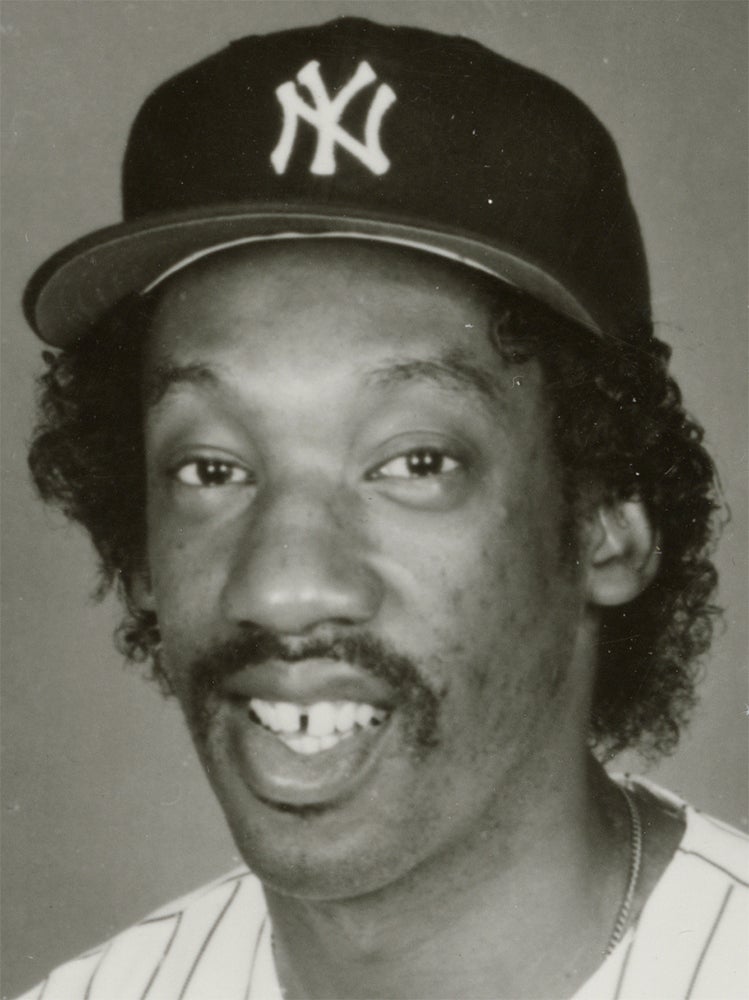
He was recalled to New York in mid-April when pitcher Roger Erickson refused his minor league demotion, but Office knew that the stop at Yankee Stadium was temporary.
“I’ll be here one day, two days – who knows?” Office told Newsday, which noted that Lou Piniella’s imminent return from a shoulder injury would force Office back to Columbus. “I’m grateful the Yankees have given me a chance. Maybe another club will notice me and I’ll be back in the majors someday.”
But after Office appeared in two games for the Yankees as a pinch-hitter, he returned to Columbus and did not play in the big leagues again. He hit .297 in 87 games for the Clippers in the final games of his career before he was released by the Yankees on Nov. 9, 1983.
In 11 big league seasons, Office hit .259 with 101 doubles and 242 RBI in 899 games. And though he never would approach the promise of his 1976 hitting streak, Office remained an in-demand reserve outfielder for almost a decade.
“He’s a good center fielder,” Braves general manager Bill Lucas told the Macon News about Office in 1978 when Office was fighting for playing time. “He’ll be around when some of those other guys are gone.”
Craig Muder is the director of communications for the National Baseball Hall of Fame and Museum