War and Remembrance
Baseball was forever altered by World War II – and the country forever changed by the game.
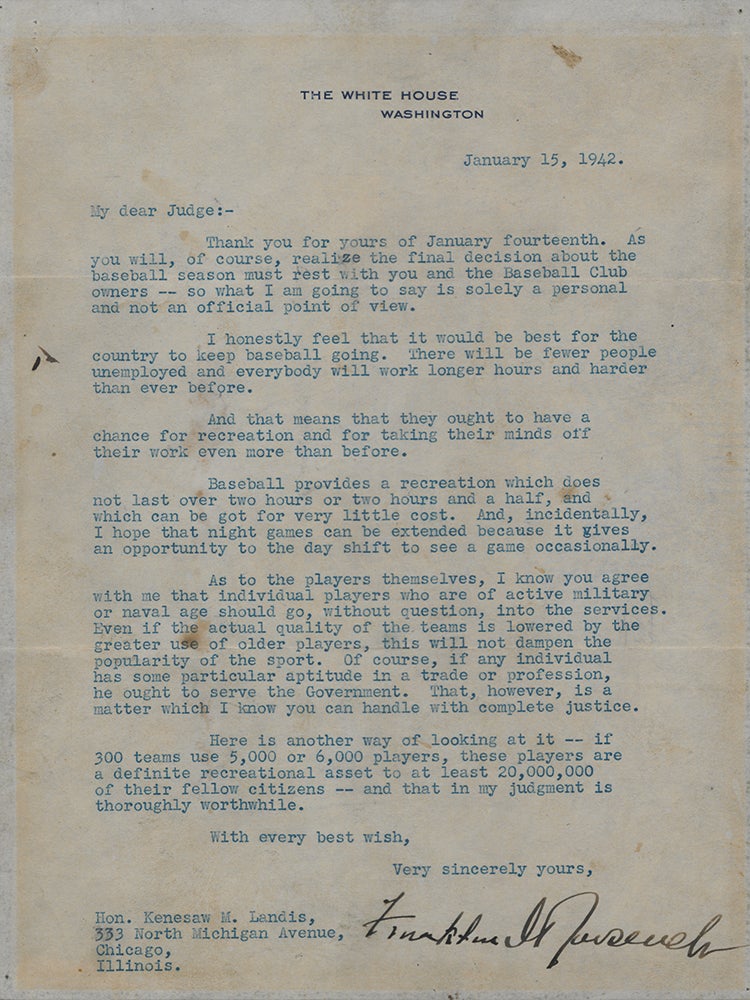
Among the thousands of artifacts in the National Baseball Hall of Fame and Museum, the one that whispers the loudest is a simple piece of paper.
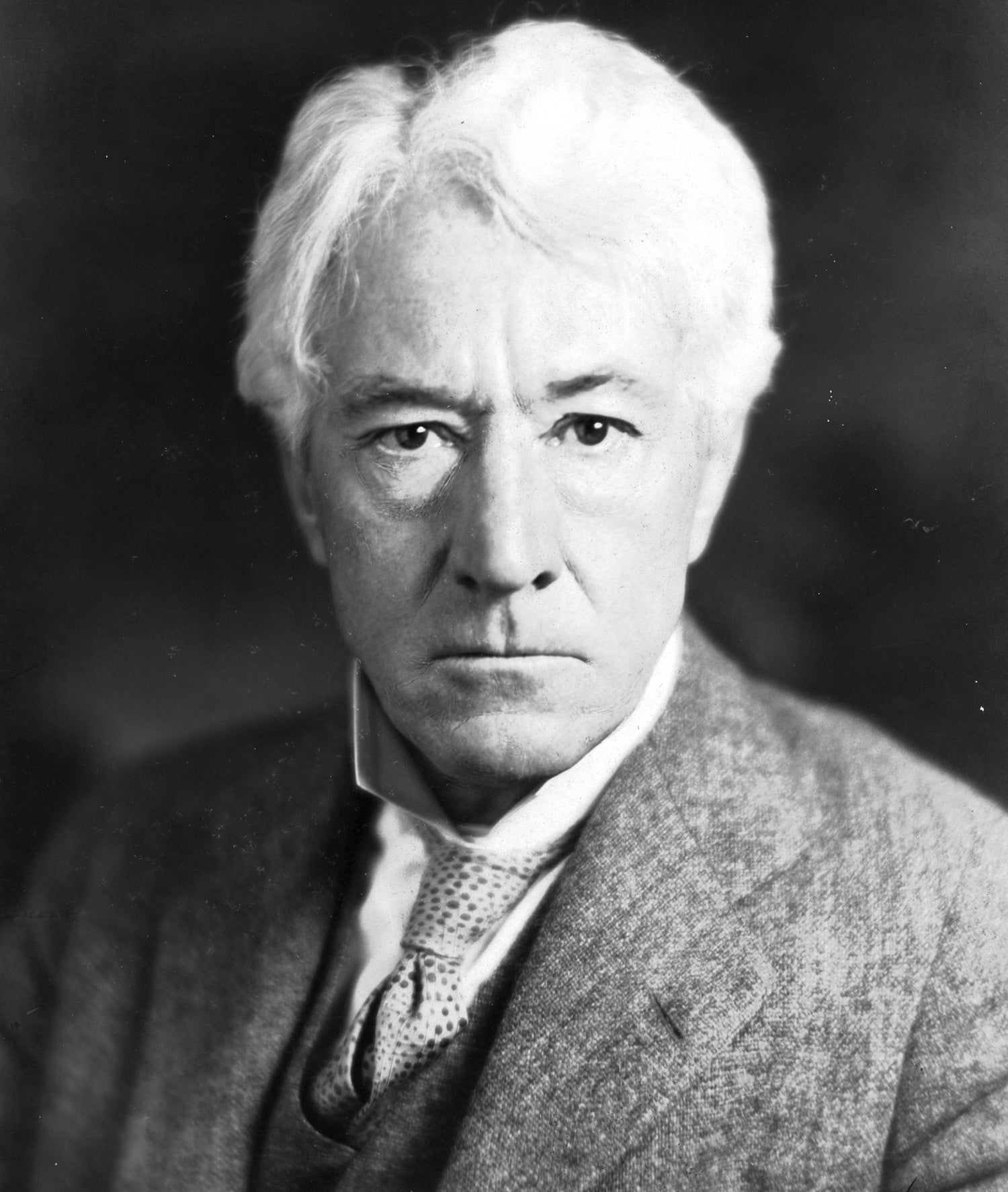
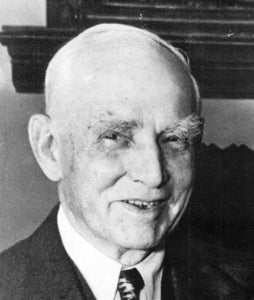
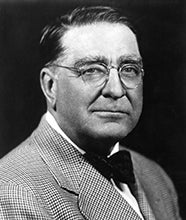
It is a letter on official White House stationery, dated Jan. 15, 1942, signed by Franklin Delano Roosevelt and addressed to the Hon. Kenesaw M. Landis, Commissioner of baseball.
The day before, and a few weeks after the bombing of Pearl Harbor, the Commissioner had written the president, asking for some guidance on what role baseball should play as the nation waged war against the Axis Powers: “I venture to ask what you have in mind as to whether professional baseball should continue to operate.”
In FDR’s eloquent response, which came to be known as “The Green Light Letter,” he wrote, “I honestly feel that it would be best for the country to keep baseball going. There will be fewer people unemployed and everybody will work longer hours and harder than ever before.
“And that means that they ought to have a chance for recreation and for taking their minds off their work even more than before.”
The president also made it clear that he expected eligible players to go into the military services. “Even if the actual quality of the teams is lowered by the greater use of older players, this will not dampen the popularity of the sport.”
FDR was right about that. But the green light he gave to baseball had an effect that lasted long past the war. Indeed, the runners he waved home changed the game for good and for posterity.
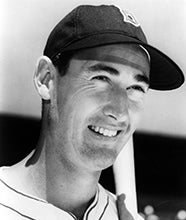
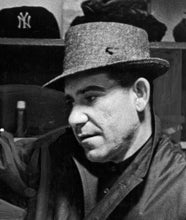
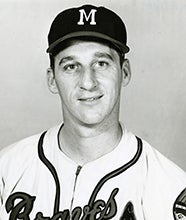
During those war years, more than 500 major leaguers donned different kinds of uniforms. Among them were established stars like Bob Feller, Joe DiMaggio, Hank Greenberg and Ted Williams, along with other future Hall of Famers – who had not yet established themselves in the big leagues – such as Yogi Berra and Warren Spahn. To take their place, teams relaxed their standards to welcome players who were either washed up or wet behind the ears – necessity was the mother of a 15-year-old Cincinnati Reds hurler named Joe Nuxhall in 1944.
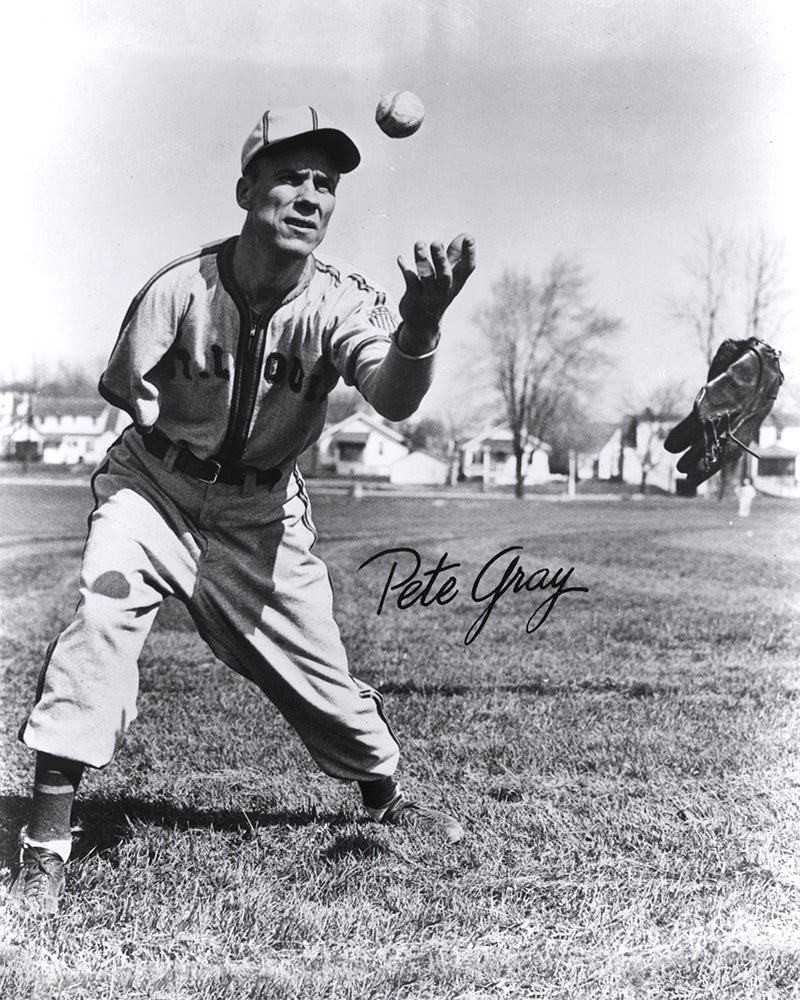
Baseball even made room for physically challenged players such as outfielder Pete Gray, who played 77 games for the 1945 St. Louis Browns despite having only one arm, his incredibly talented left. Women also got into the act, enlivening ballparks in the Midwest with the formation of the All-American Girls Professional Baseball League in 1943. And integrated service teams helped turn the distant dreams of Negro Leagues players into a post-war reality. If they could fight side-by-side, they could play side-by-side.
Inclusion also applied to the faithful. As the National Pastime became the National Salvation, fans were embraced as never before. They bought war bonds, returned foul balls, held their tongues about the inferior balata balls and the quadragenerian pitchers. The embrace also applied to the 1944 St. Louis Browns, whose loyal fans were rewarded with their first and only World Series appearance – despite the fact that they led the majors in 4Fs (unfit for service) with 18. As fate would have it, they faced the heavily favored Cardinals in a “Streetcar Series.”
According to Cardinal shortstop Marty Marion, “We thought we were going to walk through them. Who in hell’s the Browns, you know… we found out they were a pretty good ballclub.” It took the Cards six games to put the Brownies away.
If America discovered what it was made of in 1945, so did baseball. This was the season Gray made his major league debut. Fans and servicemen already knew about him because The War Department had made a movie about Gray while he was hitting .333 with 68 stolen bases for Memphis in ’44. Considering he was playing with only one arm, his statistics for the ’45 Browns were pretty amazing: 77 games, six doubles, two triples, 13 RBI, five stolen bases and a .259 on-base percentage.
But his true value was as an inspiration. In a deeply moving Coronet magazine story entitled “Heart Of A Ballplayer,” Carol Hughes described a meeting between Gray and a 3-year-old boy with one arm before a game in Memphis: “Pete picked the boy up in his arm… tears rolled down his cheeks. For the next hour he deviated from his habitual restraint by batting, swatting, pitching and catching for the little one-armed boy.”
In that game, Gray led Memphis to a 7-6 victory before 10,000 screaming fans. “When it was over,” Hughes wrote, “he walked back to the little boy and held out his hand. ‘Now we’re partners, aren’t we?’ he said, and left the field.”
In May of ’45, the Browns played the Senators in an exhibition game, which brought Gray face to face with Washington pitcher Bert Shepard, a former Army pilot who had lost a leg when he was shot down over Germany. He had taken up pitching again on an artificial limb while in prison camp, and Senators owner Clark Griffith had prevailed upon manager Ossie Bluege to put him on the active roster. It wasn’t until Aug. 4 that Bluege finally called on him to pitch – in the fourth inning of the second game of a doubleheader at Fenway with the Red Sox leading 14-2 with two outs and one on.
Shepard struck out Catfish Metkovich, then finished the game, allowing only three hits, one hit-by-pitch, one walk and one run. He never pitched another game in the majors. But both he and Pete Gray lived to see the day (Sept. 4, 1993) when Jim Abbott of the Yankees – who was born without a right hand – pitched a no-hitter against the Indians.
There were actually three World Series during the ’45 season. On Sept. 2, four months after Germany had surrendered, some 50,000 fans, most of them servicemen, filled a stadium in Nuremberg for the opener of a five-game series – the European Theater of Operations championship – between the Third Army team of General George Patton stationed in Germany and the Overseas Invasion Service Expedition All-Stars from France.
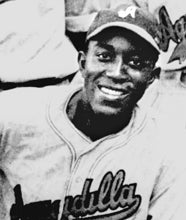
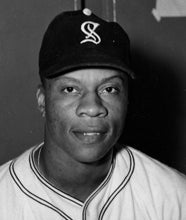
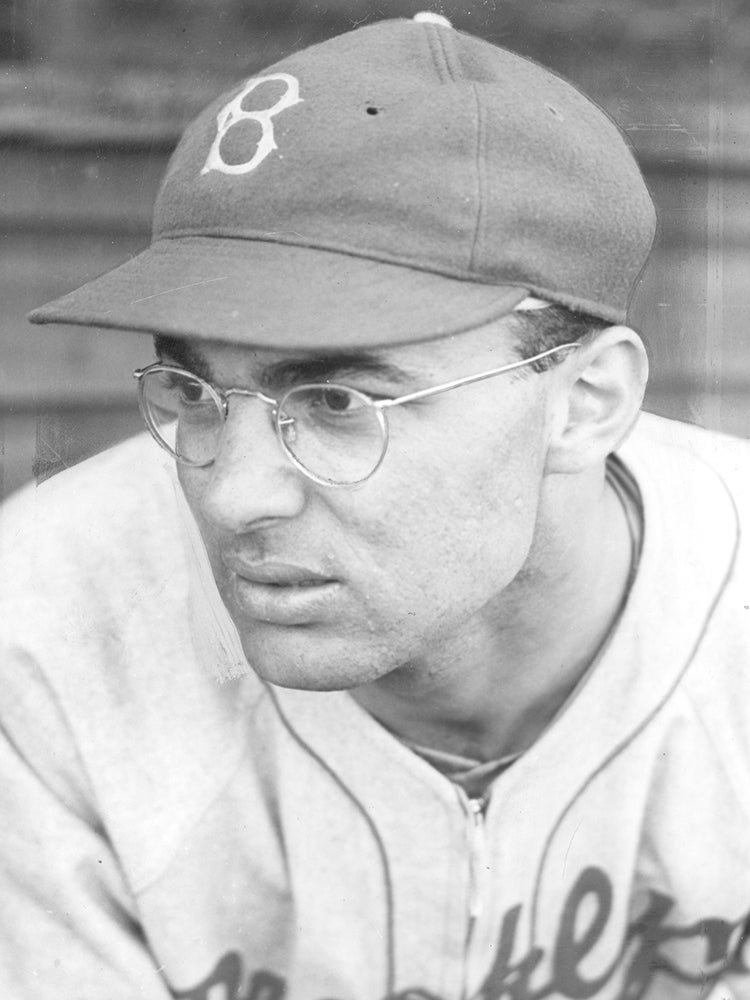
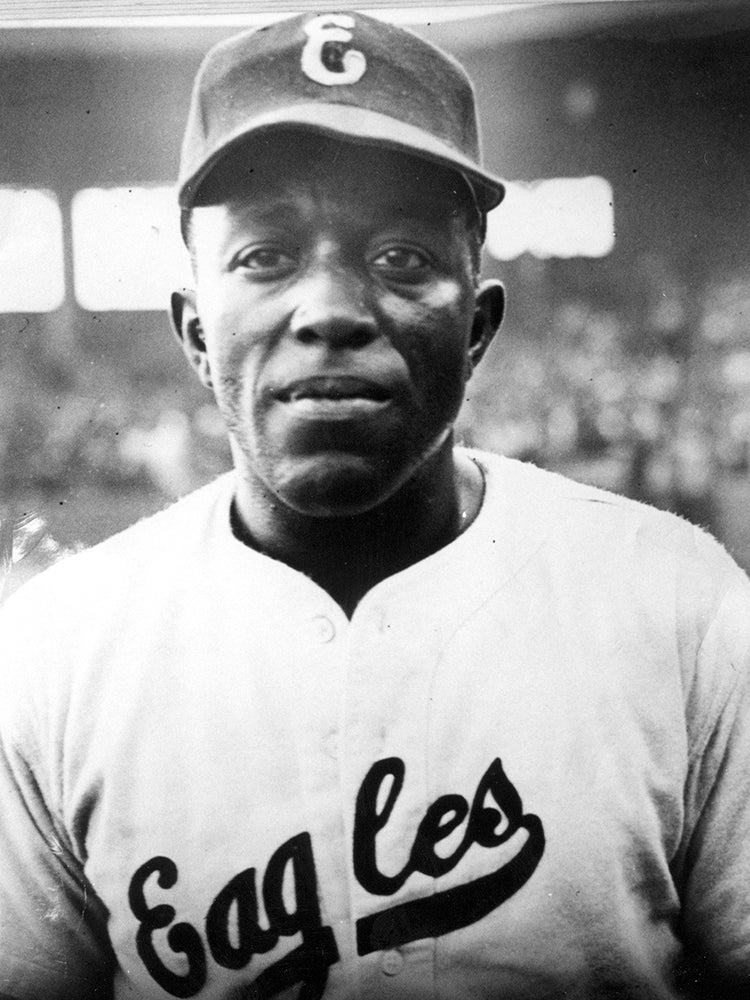
For what came to be known as the GI World Series, Patton’s “Red Circlers” were put together by the highly decorated Harry “The Hat” Walker, the Cardinals’ All-Star center fielder from Alabama. He had nine AL/NL players on the team, including the Cincinnati Reds’ side-arming fireballer Ewell Blackwell. Managing and pitching for the OISE All-Stars was Sam Nahem, a bespectacled Phillies reliever of Syrian Jewish descent. With only one other AL/NL player on his team, Nahem was facing a David vs. Goliath scenario. But he did have two stones to sling: pitcher Leon Day from the Newark Eagles and outfielder Willard Brown from the Kansas City Monarchs.
Game 1 was a 9-2 rout in favor of the Red Circlers. Game 2, though, had the fans on the edge of their seats: RBI singles by Brown and Nahem gave the troops from France a 2-0 lead, but Walker doubled home a run in the eighth. With the score at 2-1, and a runner on second with two outs in the ninth, Day struck out future All-Star Johnny Wyrostek to even the series and complete his four-hitter. The Negro leagues veteran had delivered just as he had one year before when he drove an amphibious “Duck” carrying supplies for the assault on Utah Beach on June 5, 1944.
The series then moved to Reims, France. Nahem outdueled Blackwell to give the OISE All-Stars a 2-1 victory and a 2-1 lead in games. The Red Circlers won Game 4 by a score of 5-0, setting the stage for the decisive Game 5 back in Nuremberg on Sept. 8. The crowd of 50,000 provided sounds, as Stars and Stripes described it, “as wild as any ever to emerge from Ebbets Field or the Polo Grounds.” It was Nahem against Blackwell again, and again, it came down to the ninth. In the top of the inning, minor leaguer Lewis “Shine” Richardson knocked in a run that put OISE ahead 2-1. With two outs and a man on second in the bottom of the ninth, Walker flied out to center… and on a field once dedicated to Adolf Hitler, white men and black men alike rushed the mound to celebrate the victory.
Fifty years later – six days before he passed away – Leon Day was elected to the Hall of Fame. Asked to name his favorite game, he went with his masterpiece in the GI Series. “Home Run” Brown, his teammate that day, was posthumously inducted into the Hall in 2006.
As the GI Series was being played, so were the playoffs for the 1945 AAGPBL, then in its third season. Started by Chicago Cubs owner Philip K. Wrigley, the league was already a success, attracting players from all over the continent and fans from its six Midwestern cities. In the best-of-seven championship round, the first-place Rockford Peaches faced the Fort Wayne Daisies.
Playing for the Daisies were two sisters from Vancouver, British Columbia, Helen and Margaret Callaghan. Helen, a diminutive but speedy outfielder, hit .299 that year while stealing 92 bases. Alas, the Peaches proved too much for the Daisies, winning the series in the fifth game on Sept. 15, 3-2, behind a two-run homer by Millie Deegan and the pitching of Carolyn Morris, who won her third game of the series.
It was after that season that Helen made her most important contribution to women’s baseball. A League of Their Own would not be on Netflix today, and “There’s no crying in baseball,” would not have been a catchword phrase, had she not married Bobby Candaele, a hockey player from Vancouver.
Among their five boys was Kelly, who one day decided to make a documentary about the league. That film caught the interest of Penny Marshall, who borrowed the title and turned it into a blockbuster movie starring Tom Hanks and Geena Davis. Another of the Candaele sons, Casey, became a major leaguer – he finished fourth in the voting for NL Rookie of the Year in 1987, batting .272 while playing six different positions for the Expos.
Candaele was with the Astros when the Hollywood movie premiered in 1992, a few months before his mother passed away. Now the manager of the Triple-A Buffalo Bisons, Candaele recalls: “I asked Mom which character in the movie most reminded her of herself. When she said, ‘Madonna,’ I said, ‘No, not all All The Way Mae.’ She laughed.
“Every once in a while, one of my players will bring up the movie. And it’s great that they’re starting a women’s professional baseball league (in 2026). I honestly think that someday, a woman will play in a major league game.”
The actual 1945 World Series came as a breath of relief, and a reminder of just how lucky we as Americans were. Of the approximately 500 major leaguers who fought in World War II, only two former players had been killed in combat: Harry O’Neill, who played one inning behind the plate for the Philadelphia A’s in ’39, and Elmer Gedeon, a center fielder for the Washington Senators with just 15 at-bats that same season.
That’s not to say major leaguers stayed out of harm’s way. Plenty saw combat, and Greenberg had a very close call. Greenberg was a second lieutenant in the Army Air Corps in Fort Worth in 1943 when he was granted his request for an overseas assignment. He was overseeing B-29 bombers in the Far East when one of the planes crash-landed. As Greenberg described it for Arthur Daley in The New York Times: “Father Stack, our padre, and myself raced over to the burning plane to see if we could help rescue anyone. As we were running, there was a blast when the gas tanks blew and we were only about 30 yards away… it knocked us right into a drainage ditch.”
Greenberg couldn’t talk or hear for a few days, but he recovered quickly enough. When he was discharged in June of ’45, the 34-year-old slugger rejoined the Tigers, who were on their way to winning the American League pennant. Their World Series opponents were the Chicago Cubs, whose last world championship had been in 1908.
It was an epic, back-and-forth Series that began in Detroit on Oct. 3 with the Cubs beating the Tigers 9-0. The next day Detroit evened the series with a 4-1 victory courtesy of Greenberg’s three-run homer in the fifth and a complete game by Virgil Trucks, who had just been discharged from the Navy. Claude Passeau threw a one-hitter in the Cubs’ 3-0 Game 3 win.
When the Series moved to Chicago and Wrigley Field for Game 4, legend took over. The ushers wouldn’t let Billy Sianis, owner of the Billy Goat Tavern, bring his goat, Murphy, into the game. Sianis put a curse on the Cubs, and sure enough, they lost the next two games, although Greenberg’s three doubles in the Tigers’ 8-4 win in Game 5 might have had something to do with it.
The goat in Game 6 was Greenberg, who failed to corral a hard roller to left field in the bottom of the 12th, allowing the Cubs to win 8-7. But two days later, Greenberg put one over on the Cubs by bunting with men on in the first to set up a five-run rally. After their 9-3 victory, Tiger manager Steve O’Neill declared: “I’m the happiest man in the world.”
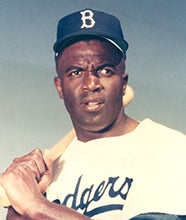
Thirteen days later, Brooklyn Dodgers president Branch Rickey signed Jackie Robinson of the Kansas City Monarchs.
Word traveled fast – and long. Buck O’Neil of the Monarchs was serving in the Stevedore Battalion of the Navy in the Philippines when his commanding officer summoned him over the loudspeaker at 11 o’clock at night. As O’Neil recalled: “This white man looked me right in the eye and told me, ‘I just thought you should know that the Brooklyn Dodgers just signed Jackie Robinson.’ Well, I thanked the officer for this information, then got on the horn myself and said, ‘Now hear this! Now hear this! The Dodgers just signed Jackie Robinson!’ You should have heard the celebration. Halfway around the world from Brooklyn, we started hollering and shouting and firing our guns into the air.”
We can still hear those echoes.
Steve Wulf is a freelance writer living in New York City
RELATED STORIES

RELATED STORIES
Memories and Dreams
This story previously appeared in Memories and Dreams, the award-winning bimonthly magazine exclusively available to supporters of the Museum's Membership Program.